TRANSMISSION // 2610.18690v3
A Granularity Dial for Leaner Vision-Language Models
Source published
Varest groups image tokens into semantic regions and later prunes tokens to reduce visual input. The authors report strong benchmark retention at a small token budget, but the evidence here comes only from the paper’s abstract.
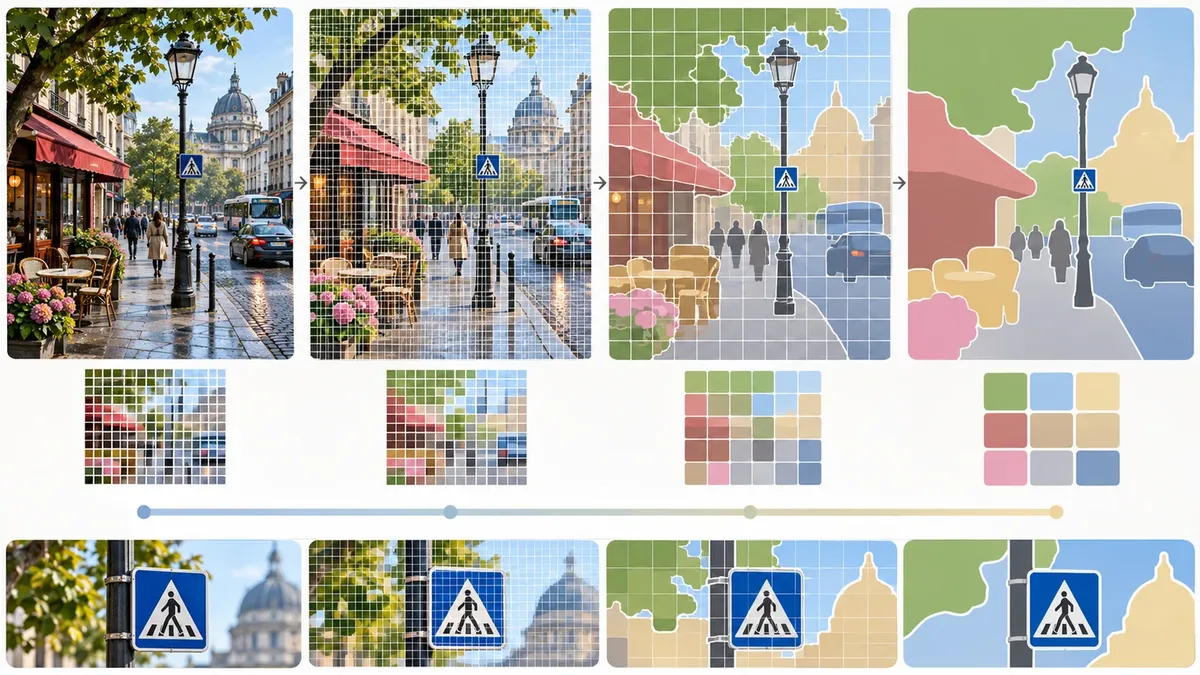
Vision-language models can be asked to interpret an image alongside a text prompt, but processing every part of a detailed image can be costly. A new method, Varest, aims to shrink that visual input without discarding important meaning.
Keeping image meaning while using fewer tokens
Vision-language models (VLMs) connect images with language—for example, to answer questions about a picture. Their visual input is represented as tokens, small units the model processes. Using fewer tokens can reduce computation, but simply dropping or merging image regions risks losing details or spatial relationships.
The authors of Varest propose a different strategy: group image tokens when they describe coherent content that can be summarized with little loss. The paper calls this “semantic fungibility.” In plain terms, some visual information can be combined more safely than other information, and the method tries to recognize the difference.
How the method works
According to the abstract, Varest uses object boundaries identified by a visual foundation model to guide token grouping. It also uses text localization to protect image details that may matter for reading. As the token budget gets tighter, the image is represented by coarser semantic regions while the method aims to retain coverage across the whole image.
The approach also changes what happens later in the model. After early language-decoder layers process the image representation, a learned selector removes visual tokens that later layers no longer need. The stated aim is to avoid repeatedly accessing information that has already been integrated.
What the authors report
The authors tested Varest with three LLaVA model backbones across 13 benchmarks, comparing it with 10 training-free and five trained baselines. They report that Varest achieved higher mean performance retention than those baselines at every evaluated token budget. At the most compressed setting described in the abstract, it used 5.56% of the original tokens and retained 86.10–92.33% of uncompressed performance. The authors also say the method generalizes to Qwen3.8-27B, a more modern vision-language model.
These results suggest that, in the reported evaluations, carefully grouping image content and then selectively pruning tokens can preserve more measured performance than the comparison methods while substantially reducing the visual token count. They do not establish that every task or image will retain the same level of detail.
What remains uncertain
This account is based on the abstract, not the full paper. It does not provide benchmark-by-benchmark results, details of the evaluation setup, uncertainty estimates, or enough information to assess how the baselines were configured. “Mean performance retention” also compresses results across tasks; an average cannot show whether particular abilities or examples suffered more than others.
The abstract’s claim of generalization to Qwen3.8-27B is not accompanied here by the size or conditions of that evaluation. Nor does the abstract report real-world latency or energy measurements, so the token reduction alone should not be treated as a measured speedup. The work is an arXiv preprint, and the available evidence does not establish whether it has been peer reviewed. Readers should consult the full paper and subsequent evaluations before drawing broader conclusions.
- vision-language models
- image tokens
- model efficiency
- Varest
- semantic compression
- artificial intelligence
Reviewed cross-references
These connections were reviewed by a model, not independently fact-checked by a human. Similarity does not imply agreement; consult the original papers and the evidence below.
Teaching Vision-Language Models Which Image Tokens to Keep
Supporting evidence: Both papers report that visual-token compression can retain useful task performance, with particular relevance to text-heavy image tasks: Varest protects localized text while reporting 86.10–92.33% mean performance retention at 5.56% of tokens across its evaluated settings; DTM reports strong results on ChartQA and TextVQA at 80% deletion. The methods, model families, benchmarks, and retention measures differ, so these results are compatible but not a direct comparison.
Model review: · openai-codex/gpt-6-luna
Evidence and provenance
Selected excerpts, not complete papers. PDF extraction can omit figures or damage equations, tables and reading order; sources may be preprints.
2610.18690v3 — Original paper
Excerpt reference:
static/papers/2610.18690v3.md:13-76
Basis: Paper text
Source SHA-256:4fc6ddd8570fe1d41c4d41b79362633ed154f37781e5624dec0acc07c7a0b3552611.27064v1 — Original paper
Excerpt reference:
static/papers/2611.27064v1.md:13-64
Basis: Paper text
Source SHA-256:49f05339419219b02815e838db30afe7a3d6fdf2b43e6521eab832caf574aa0a
Related reading
Automatically matched by shared topic keywords. These links do not imply that the sources agree or establish a consensus.
Teaching Vision-Language Models Which Image Tokens to Keep
Source published
Shared keywords: vision language models
Looped language models gain depth by reusing layers
Source published
Shared keywords: artificial intelligence, model efficiency
Shiva-DiT aims to make diffusion transformers faster by learning which tokens to keep
Source published
Shared keywords: model efficiency
Can Transformers learn a smaller structure?
Source published
Shared keywords: model efficiency
Can a neural network change shape after training?
Source published
Shared keywords: model efficiency