TRANSMISSION // 2610.17584v2
Can a network learn what happens when a cell sleeps?
Source published
RAN-JEPA learns from routine network measurements, then controlled sleep-and-wake tests, to predict how energy-saving actions may affect mobile-network performance.
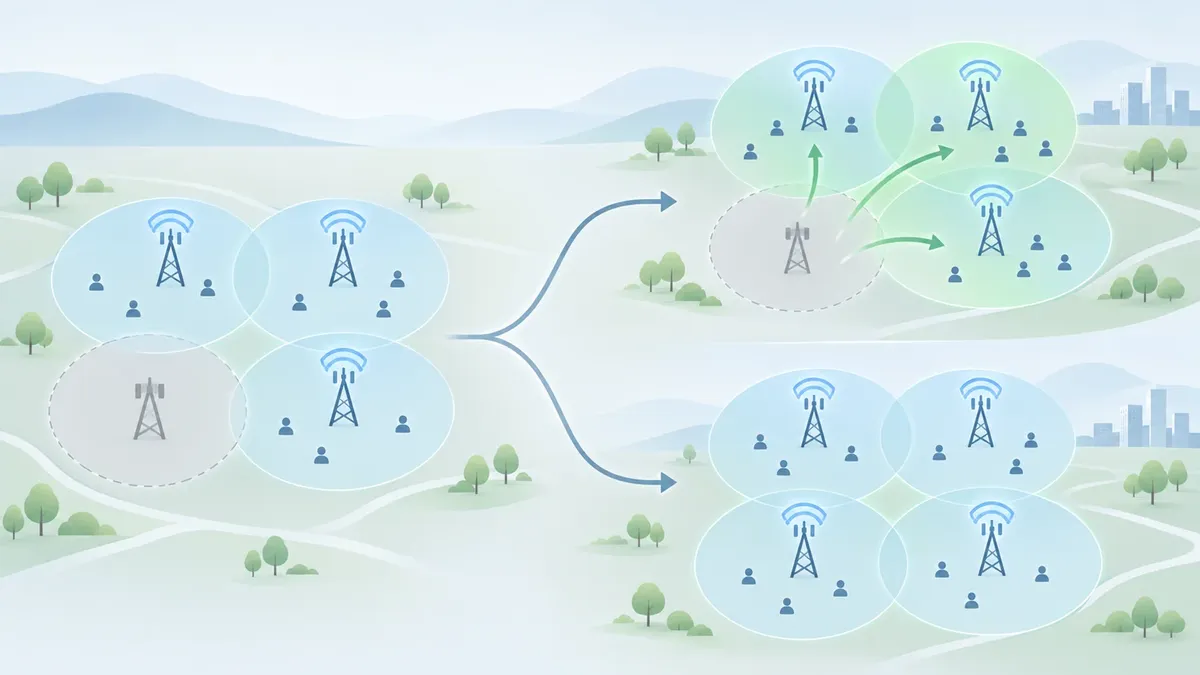
Mobile networks collect plenty of measurements, but fewer examples of what happens after a deliberate change. A preprint tests whether learning from routine data first can help a model predict the effects of putting a cell into an energy-saving state.
Mobile networks constantly record measurements such as traffic, resource use and the number of connected users. But those records mostly show what happened under existing settings—not what might happen if an operator changed a cell’s state. Carefully testing such changes can be costly and may affect service.
That imbalance is the problem tackled by RAN-JEPA, a proposed model for predicting the effects of energy-saving actions in a radio access network, or RAN. The researchers ask whether routine measurements can teach a model how a network behaves before controlled tests teach it how deliberate actions change that behavior.
Putting a cell into a sleep state may save energy, but can shift users to neighboring cells and increase their load. A controller needs to estimate those consequences before acting. RAN-JEPA predicts possible outcomes for candidate action plans; a separate controller uses those predictions alongside energy and service-quality objectives to choose what to do.
Learning in stages
First, the model learns from network observations without sleep-action labels. Its encoder compresses recent measurements into a representation of network state and learns to predict future representations, rather than reconstructing every measurement individually. The researchers pretrained it on public operator performance data, then adapted it using observation-only data from their testbed.
Next, they froze the encoder and trained a new component on controlled sleep-and-wake trajectories from the testbed. This component predicts how planned actions affect future network behavior. In effect, routine records teach the model about network dynamics, while intervention data teach it about the consequences of specific actions.
The public dataset used for pretraining contains performance records from 264 base stations. Separately, the researchers used real 5G equipment in a four-cell testbed for domain adaptation, controlled action training and evaluation. The testbed used emulated users and controlled radio conditions. For predictions, the model received recent observations and a proposed action plan, but not future traffic or measurements. The researchers compared it with a GPT-2-based model and a mechanistic rule. They also used a persistence reference—which repeats the most recent 15-minute average—to normalize prediction error; it was not treated as a trained competing model.
What the tests found
For predictions following a sleep action, RAN-JEPA had lower average error than the GPT-2 model and mechanistic rule across four future 15-minute intervals. Its error remained close to the persistence reference. The paper says the results do not establish a statistically significant advantage over that reference, so the margin over it should be interpreted cautiously.
The researchers also examined a representative episode in a calibrated digital twin. Starting from the same observations, they asked the model to predict outcomes under either a SLEEP or KEEP plan. The predicted paths differed: under SLEEP, the model anticipated users leaving the target cell and increased load on a neighboring serving cell. This shows that predictions responded differently to the proposed action in this test. It does not prove that the model will accurately predict every real-world counterfactual.
Finally, the researchers put the predictions into a closed-loop controller on the testbed. Across the reported settings, RAN-JEPA supported higher sleep ratios than the other controllers at comparable added congestion cost. Sleep ratio measures how aggressively cells were put to sleep; it is not a direct measurement of electricity saved. The authors note that the observed differences do not by themselves establish statistical significance.
What remains uncertain
The results come from controlled experiments on four cells, with emulated users and defined radio conditions. They do not establish how the method would perform across larger commercial networks, different traffic patterns or more varied operating conditions. Nor do they demonstrate network-wide energy savings: the study uses sleep ratio as a proxy and identifies direct energy measurement as a next step.
RAN-JEPA is described in an arXiv preprint, which may not have undergone peer review. These findings are early evidence for an observation-first approach to network control, not a deployment guarantee. Testing across broader networks and measuring energy directly would help show how far the approach can be applied.
- mobile networks
- 5G
- radio access networks
- energy efficiency
- world models
- machine learning
Reviewed cross-references
These connections were reviewed by a model, not independently fact-checked by a human. Similarity does not imply agreement; consult the original papers and the evidence below.
A functional map for hybrid AI in radio networks
Supporting evidence: Both papers distinguish predicting network outcomes from selecting actions: RAN-JEPA predicts effects of candidate actions for an external controller, while the survey treats Prediction and Simulation and Decision Synthesis as separate functions. This is a conceptual alignment, not independent empirical validation; the survey is broader and does not evaluate RAN-JEPA.
Model review: · openai-codex/gpt-6-luna
Evidence and provenance
Selected excerpts, not complete papers. PDF extraction can omit figures or damage equations, tables and reading order; sources may be preprints.
2610.17584v2 — Original paper
Excerpt reference:
static/papers/2610.17584v2.md:170-235
Basis: Paper text
Source SHA-256:2546abdbfb0ee7adb5d76329ec3aca73d6b2b7149d6d865d229a0c88394c4d852611.33035v1 — Original paper
Excerpt reference:
static/papers/2611.33035v1.md:1132-1184
Basis: Paper text
Source SHA-256:2e4a8fbdf822034180e3d50774cc78bcf33cdd064a5713c8fe16a44f3138c571
Related reading
Automatically matched by shared topic keywords. These links do not imply that the sources agree or establish a consensus.
A functional map for hybrid AI in radio networks
Source published
Shared keywords: radio access networks
An AI controller that anticipates a building’s heat
Source published
Shared keywords: world models
Training video models to remember how scenes change
Source published
Shared keywords: machine learning
A model explores how power engineering research might change
Source published
Shared keywords: world models
One Energy Lens for Many Kinds of Machine Learning
Source published
Shared keywords: machine learning