TRANSMISSION // 2610.17029v2
SPLICE adapts a physics library to unlabeled mixtures
Source published
SPLICE adapts a pretrained library of neural simulation operators using unlabeled trajectories. Tests show it can recover some represented mechanisms, but not discover arbitrary physics from scratch.
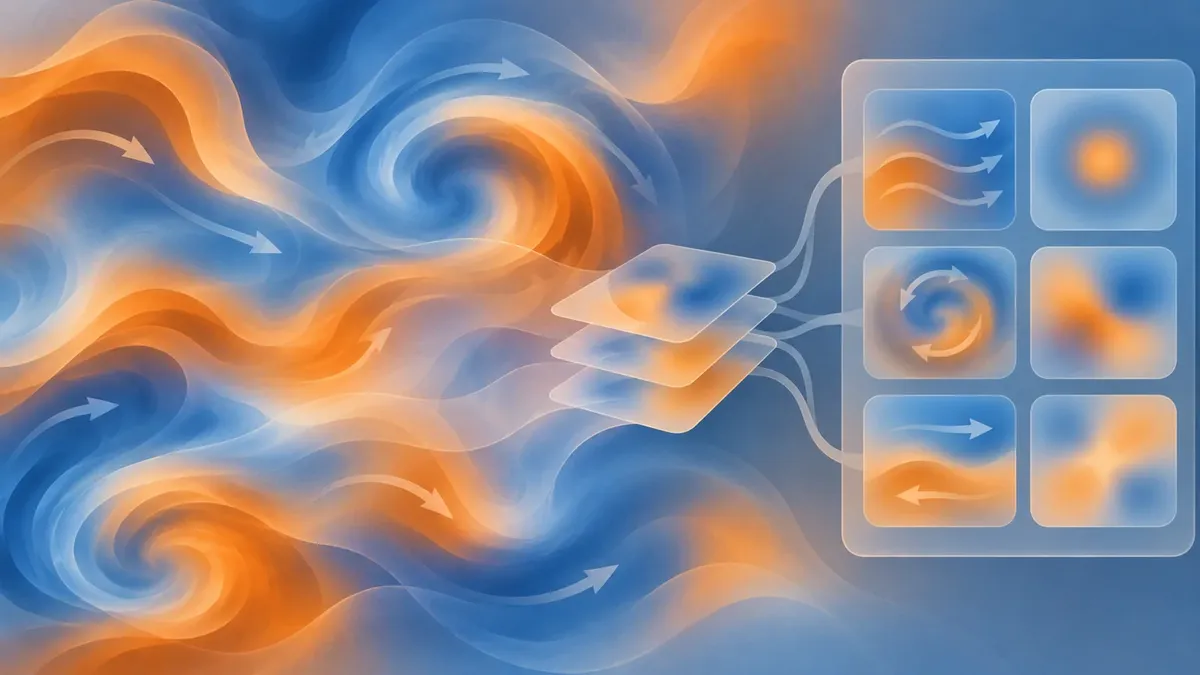
Physical simulations often combine processes such as transport and diffusion. Existing neural-operator-splitting approaches build libraries from mechanisms specified and labeled in advance. SPLICE asks whether a pretrained library can instead be adapted using trajectories where several mechanisms act together—and whether researchers can test what its operators have learned.
A fluid’s motion can reflect several processes at once: advection transports material, while diffusion smooths differences. A reusable library of simulation components could help model equations made from combinations of familiar effects. But existing neural-operator-splitting approaches require mechanisms and their labels to be specified in advance. This paper asks whether a pretrained library can instead be adapted from unlabeled trajectories, and whether researchers can test what its operators have learned.
SPLICE starts with a library trained on labeled examples of individual mechanisms. It does not begin with a blank network: adaptation changes operators within a pretrained network. The researchers then use trajectories where multiple mechanisms act together, without labels naming them. For each trajectory, SPLICE estimates the contributions of candidate operators by solving a nonnegative least-squares problem—a convex optimization step—and refines the operators to improve predictions of future states.
If the library cannot explain some data well, SPLICE can restart an underused operator using a poorly reconstructed data window. In the main discovery procedure, physical identities are assigned afterward: researchers compare each operator’s behavior on separate probe fields with reference solvers, which are withheld from discovery. This makes identification a test rather than a training label. The paper also explores an identity gate that uses reference checks to constrain later adaptation, so the separation is not absolute in every experiment.
The authors tested SPLICE on simulated one- and two-dimensional systems. In a one-dimensional task involving five hidden mechanisms, a single run identified four. Pooling runs with the codebook architecture identified all five under the paper’s discriminative grading protocol; a control architecture identified three of five under that grading. The codebook method selected active mechanisms in held-out mixtures with 95% accuracy, compared with 46% permutation chance. These results depend on the architecture and evaluation choices: exact optimization for assigning contributions also performed better than the tested learned assignment alternatives.
The two-dimensional Navier–Stokes experiments tested a harder situation: Euler advection and diffusion acted together, with neither mechanism observed alone. When SPLICE adapted on unlabeled coupled-flow trajectories, it identified both mechanisms in all ten tested seeds. Its composed simulations had a reported error of 0.139 ± 0.017. The authors’ supervised library, trained on labeled pure-mechanism trajectories, scored 0.159 ± 0.015; this is a comparison between libraries with different training conditions, not a supervised result trained on the coupled flows. In a separate condition, adaptation on mixtures of pure-mechanism trajectories produced an error of 0.177 ± 0.010. These results apply to the study’s datasets, models and evaluation protocol, not automatically to other fluids.
The paper also reports a limited transfer test on shear flow from The Well, a dataset of physical simulations rather than experimental observations. Adapting on 32 unlabeled realizations changed the reported VRMSE from 0.868 to 0.818, but did not reach the target of 0.72 that the authors set before the run. The Euler-selected trajectory still diverged. The result illustrates both a measurable change in this setup and the gap between identifying a mechanism and producing a useful simulation.
That gap appears elsewhere too: forcing an identified operator into a particular composition can make the rollout worse. In a developed-turbulence test, the search selected single-operator rollouts, so composition provided no benefit over a monolithic rollout in that comparison. The authors suggest that when mechanisms interact strongly, the local error assumed by the splitting approach may no longer be small.
Other limits shape what SPLICE can claim. Mechanisms with similar actions—diffusion, hyperdiffusion and drag in some tests—can be confused or share an operator. Growth can recover a mechanism represented by the pretrained network, but cannot reliably add physics the network itself cannot express. The representation standardizes each input window by its mean and scale. In the reported tests, assignment weights tracked coefficients for advection, but not reliably for the other mechanisms; the authors link this limitation to the representation, which also makes amplitude-dependent effects less natural to model.
SPLICE is best understood as a method for adapting and checking a pretrained library, not as a system that discovers any physical law from scratch. Its experiments examine selected simulated settings, including one external simulation dataset, and show limits in identification, composition and transfer. The work is an arXiv preprint, so its findings are provisional pending further scrutiny and independent replication. The authors report that code is available for others to inspect and test.
- SPLICE
- neural operators
- physics simulation
- unlabeled data
- Navier–Stokes
- system identification
Related reading
Automatically matched by shared topic keywords. These links do not imply that the sources agree or establish a consensus.
Can an AI Agent Build Useful Equations From Real-World Data?
Source published
Shared keywords: system identification
How PhyMotion scores AI-generated human movement
Source published
Shared keywords: physics simulation
How CoMNO uses scale mismatch to forecast PDEs
Source published
Shared keywords: neural operators
Can one input reveal a system’s hidden coefficients?
Source published
Shared keywords: system identification
A neural operator targets fine-scale airflow around cars
Source published
Shared keywords: neural operators