TRANSMISSION // 2610.14998v2
Can tabular AI get deeper without getting bigger?
Source published
A proposed looping design lets a tabular foundation model reuse a small set of blocks. The abstract reports benchmark accuracy comparable to a much larger model, with fewer parameters, but the evidence comes from a preprint abstract.
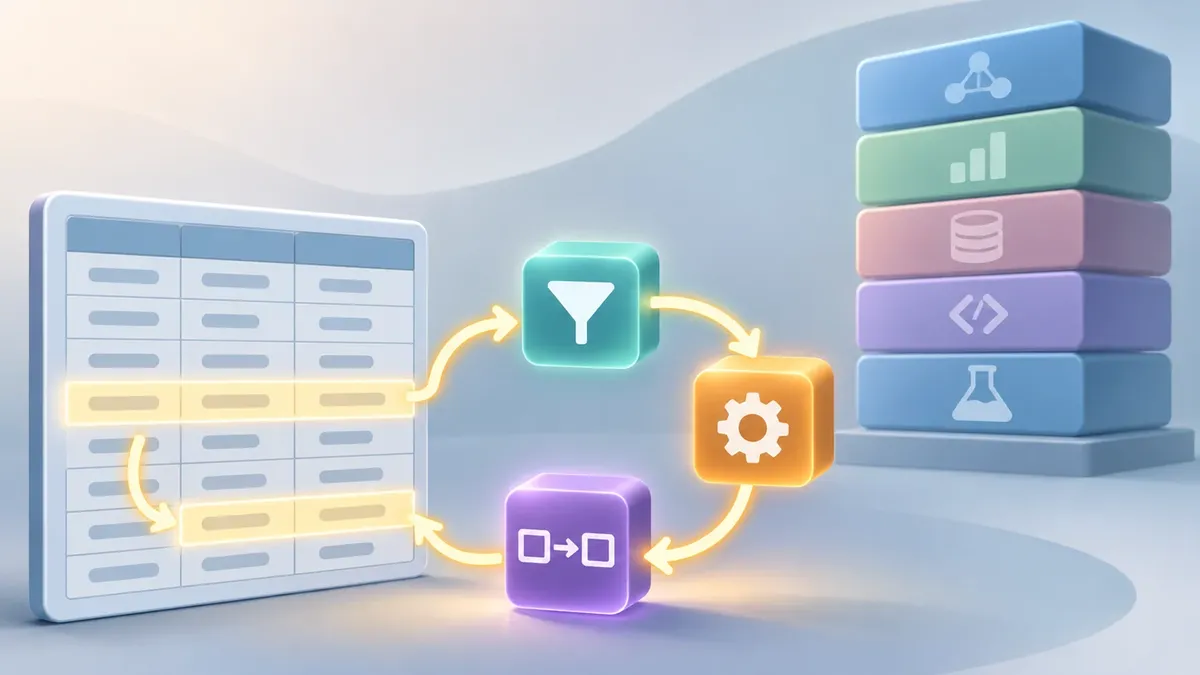
Tabular foundation models make predictions from labelled examples supplied at prediction time. This paper asks whether making them more capable requires adding more distinct model blocks—or whether a smaller set of blocks can be reused repeatedly to provide greater computational depth.
The question: more parameters, or more passes?
Many machine-learning models become deeper by stacking additional layers, each with its own learned parameters. That can improve their ability to process information, but it also increases model size. The authors of Recurrent In-Context Learning for Tabular Foundation Models ask whether this trade-off is necessary for models that predict from tables.
These tabular foundation models use in-context learning: they receive labelled rows as examples and predict labels or values for new rows, without updating their parameters for each new task. The paper focuses on the model’s in-context learning stage and proposes a different way to add depth: reuse a small group of computational blocks in a loop rather than stacking a unique block at every step.
What the authors tested
The authors introduce Tab-Loop, built on the TabICLv2 architecture. Instead of using a separate set of parameters for every block in its in-context stage, Tab-Loop applies a smaller set of shared-parameter blocks repeatedly. In effect, the model revisits the same learned transformations for additional steps.
According to the abstract, the researchers compared this design with standard architectures under equal training and inference compute budgets. They report tests on classification and regression tasks using held-out synthetic tables and two benchmarks, TabArena and TALENT. They also varied the number of distinct blocks and the model’s effective depth, and tested whether running more loops at prediction time could help without retraining.
The abstract does not give details about the datasets, evaluation protocol, uncertainty estimates, or individual task results. So it supports a high-level account of the comparison, but not a detailed assessment of how the experiments were run or how variable the outcomes were.
What the abstract reports
The authors say that, across the evaluated tasks, Tab-Loop matched the accuracy of a standard model with three times as many in-context blocks while using roughly 60% fewer parameters. They also report that a non-looped model of the same size as Tab-Loop performed worse—even though that baseline was trained on 32% more tables.
The reported pattern held as the researchers varied both the number of distinct blocks, from one to twelve, and effective depth. The abstract further says that adding loops at inference improved predictive accuracy without retraining. Training with deeper loops extended the range over which extra inference steps remained beneficial; at the reported highest setting, Tab-Loop matched the released TabICLv2 on TabArena while using 2.7 times the in-context computation.
These findings suggest a possible design trade-off: a model may be able to spend more computation at prediction time without growing its parameter count at the same rate. But the abstract’s result is about the specific model, comparisons and benchmarks described there—not a general proof that looping will work equally well for every tabular task or architecture.
What remains uncertain
The evidence provided here is the paper’s abstract, not its full text. That means important details are unavailable, including how accuracy was aggregated, how much results varied across tasks or runs, and how compute budgets were measured. The abstract also does not establish whether the reported gains carry over to other models, datasets or practical settings.
The source is an arXiv preprint. Preprints are research manuscripts shared publicly, but their presence on arXiv does not by itself establish that they have passed peer review. The claims should therefore be read as the authors’ reported experimental results, pending closer examination of the full paper and independent evaluation.
For now, the work offers a focused answer to a useful engineering question: perhaps tabular models can gain from repeated computation, not only from adding more unique parameters. Whether that approach is broadly useful will depend on the details and on testing beyond the evidence available in the abstract.
- tabular foundation models
- in-context learning
- Tab-Loop
- machine learning
- parameter sharing
- test-time compute
- preprint
Related reading
Automatically matched by shared topic keywords. These links do not imply that the sources agree or establish a consensus.
Why Tabular AI Can Work With Relational Data
Source published
Shared keywords: in context learning, machine learning, tabular foundation models
RamanPFN gives spectral AI a more chemistry-aware view
Source published
Shared keywords: machine learning
When a Row in the Table Can Change the Answer
Source published
Shared keywords: in context learning, tabular foundation models
Could More Computing Time Improve Time-Series Forecasts?
Source published
Shared keywords: machine learning, test time compute
How well do synthetic training tasks match real tables?
Source published
Shared keywords: machine learning, tabular foundation models