TRANSMISSION // 2610.14041v2
Why geometry matters in inverse reinforcement learning
Source published
A theoretical paper argues that occupancy-space geometry can guide reward updates in inverse reinforcement learning. Its claims are based on analysis described in an arXiv preprint abstract.
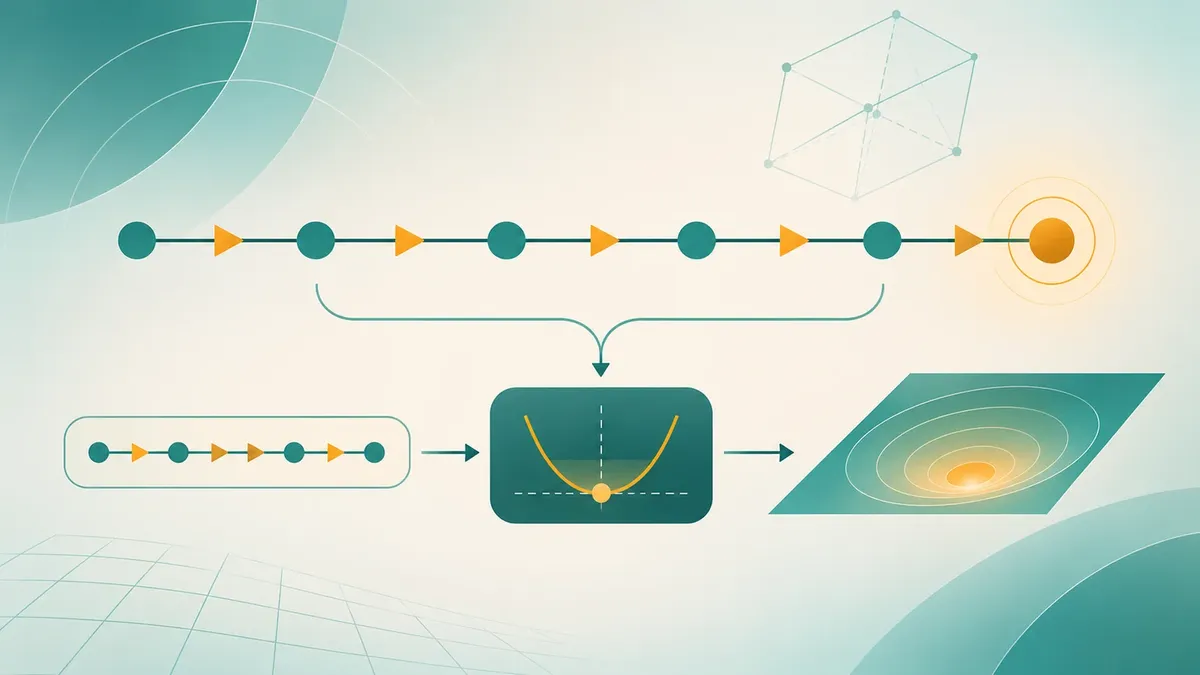
Inverse reinforcement learning tries to infer what an agent values from its behavior. A paper by Anish Diwan, Jan Peters and Oleg Arenz examines how the geometry of state-and-action occupancy might shape the way researchers update inferred rewards.
Inverse reinforcement learning (IRL) works backward from behavior. Rather than giving an agent a reward function and asking it to act, researchers observe demonstrations and try to infer a reward that could explain them. A central challenge is how to update that inferred reward during learning.
In A Geometric Perspective on Reward Function Updates in Inverse Reinforcement Learning, Anish Diwan, Jan Peters and Oleg Arenz propose looking at updates in occupancy space: a representation of how often a policy visits different states and takes different actions. Their abstract argues that the geometry of this space affects the gradient used to adjust reward parameters.
The authors focus on a route toward an optimal occupancy called an e-geodesic, described in the abstract as a straight line in occupancy space. They say the geometry along this route affects the gradient of the IRL dual problem. That observation motivates preconditioning the gradient with the average Fisher information along the occupancy trajectory. In plain terms, preconditioning changes an update to account for the structure of the problem instead of following the raw gradient unchanged.
According to the abstract, the resulting update can be expressed as a convex interpolation between the current reward and a target reward. The authors describe it as a natural-gradient-style update with little additional computational overhead. They also analyze these updates through Mirror Descent, an optimization framework, and report that policy search under the updated rewards induces an approximate form of entropic Mirror Descent on the policy. The abstract says the paper concludes with convergence results for geometry-aware IRL algorithms.
These are theoretical claims about how an update can be formulated and analyzed. The abstract does not establish that the method improves performance in a particular application. Nor does it provide the assumptions behind the convergence results, experimental details, benchmarks, or enough information to judge how broadly the approach applies.
The evidence available here is limited to the paper’s abstract, so the derivations and qualifications cannot be assessed in detail. The work is an arXiv preprint; the supplied record does not establish whether it has undergone peer review. The full paper would be needed to evaluate the analysis and its limitations.
- inverse reinforcement learning
- reward learning
- occupancy space
- natural gradient
- Mirror Descent
- reinforcement learning
Related reading
Automatically matched by shared topic keywords. These links do not imply that the sources agree or establish a consensus.
Learning Payment Fraud Sequences to Train Better Detectors
Source published
Shared keywords: inverse reinforcement learning
A model of situation-dependent planning in human decisions
Source published
Shared keywords: inverse reinforcement learning
One Energy Lens for Many Kinds of Machine Learning
Source published
Shared keywords: reinforcement learning
How social experience may shape AI alignment
Source published
Shared keywords: reward learning
Learning chemotherapy schedules from patient records: a small study with major limits
Source published
Shared keywords: reinforcement learning