TRANSMISSION // 2610.13465v2
Why AI Misses Text You Can Read by Squinting
Source published
Some image text is woven into broad shapes and textures. People may recover it by squinting or stepping back, while multimodal AI models sometimes report no text. A study investigates why and tests training to improve reading from the original image alone.
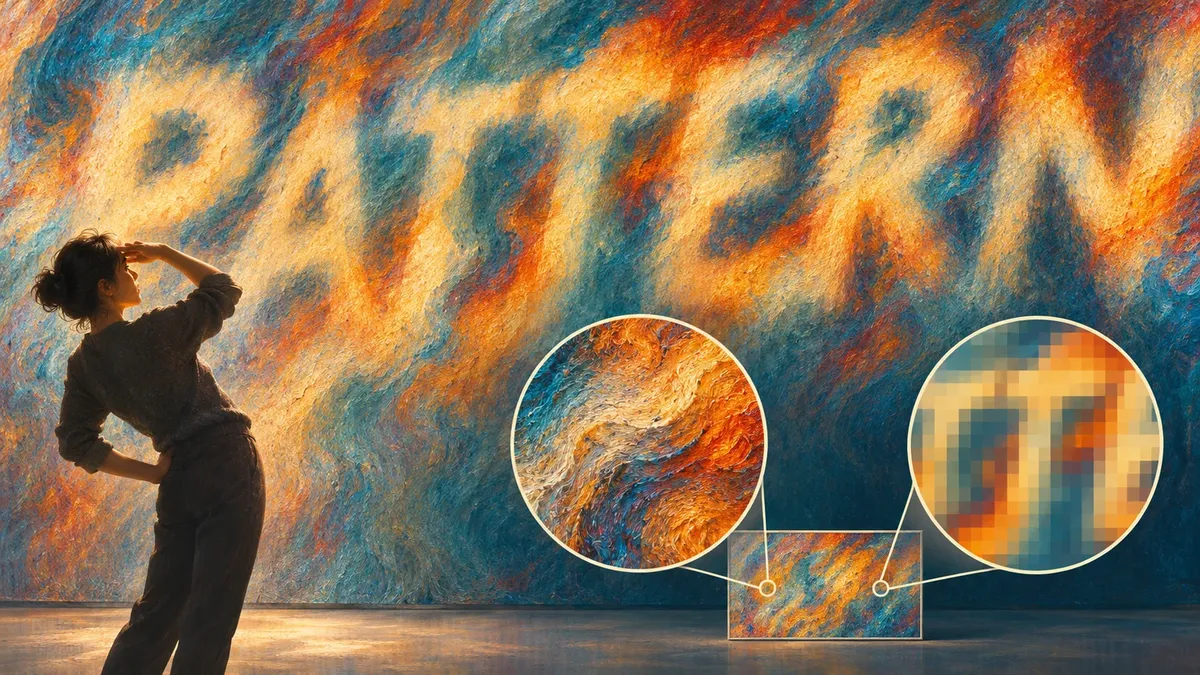
Text can be present in an image without looking like ordinary lettering. Phrases woven into an image’s larger patterns may become easier to read when you step back or squint. Researchers call this “Squint Text” and investigate why multimodal language models often miss it—and whether training can help them read it without a second view at use time.
When text is there, but the model says it isn’t
A multimodal language model asked to transcribe an image can overlook words blended into its larger shapes, textures or shading. In examples drawn from a content-moderation pipeline, people could recover the text by squinting or viewing the image at reduced scale, while AI systems sometimes answered that there was no text. The researchers name this failure mode Squint Text.
The issue may matter in moderation: if a message is carried by lettering embedded in an image, a system that fails to transcribe it may miss information relevant to review. But this study evaluates text reading; it does not show that a particular moderation system caused harm or that the proposed approach is ready to deploy.
Two kinds of test
The team assembled SquintBench, a set of 1,076 production-derived moderation images. Six participants transcribed the images. Their transcriptions achieved 98.6 ANLS, a measure of similarity between predicted and reference text, and the authors say the transcriptions were checked by multiple annotators. The paper does not specify that squinting was permitted during this transcription exercise.
The researchers also created SquintCtrl, a synthetic set for isolating possible mechanisms. Its controlled comparisons vary whether hidden text is present, which characters appear and how strongly they are embedded. In some experiments, the known locations of the characters supplied an exact mask—information that would not generally be available in ordinary use.
For diagnostic tests, the researchers examined frozen model weights: the model was not updated while they probed what information its internal visual features contained. They also tested image-processing changes and compared viewing conditions. Separately, they trained a model using Squint OPSD, a form of on-policy distillation. During training, a frozen teacher saw the original image, a downscaled view and the correct transcription as privileged context. The student learned from the teacher’s next-token probability distributions while following its own generated text trajectories. At inference, the trained student received only the original image.
Detecting text is not the same as reading it
In controlled tests, probes could distinguish images with hidden text from images without it. But identifying individual letters or characters was harder. Glyph identity became easier to decode when the probe focused on the text-bearing area rather than pooling information across the whole image; selecting the exact glyph-shaped regions improved it further. These are diagnostic results about internal features, not proof that a model naturally locates and reads the text reliably at inference.
The researchers also found that filtering out high-frequency image detail improved reading. At a matched 64-token visual budget, ANLS rose from 29.2 to 67.0 after stronger low-pass filtering. The experiments support high-frequency interference as an important factor. Token count may contribute too, but its effect could not be fully separated from changes in image frequency in the relevant comparison.
A downscaled view helped an unmodified model: on SquintBench, adding a one-eighth-scale view raised its score from 26.50 to 58.96. The trained Squint OPSD model scored 88.61 while using the original image alone at inference. For context, the paper reports 24.44 for the best general-purpose model tested on the original view and 68.60 as the best off-the-shelf score under one downscaled-view condition. These figures apply to this benchmark and these setups, not to AI systems generally.
A meaningful gain, with boundaries
The paper also reports transfer to three external hidden-text benchmarks. On standard vision-language tests, however, the adapted model showed task-dependent declines: its reported AI2D, DocVQA and OCRBench scores were lower than those of the unadapted backbone. The authors describe this as a measurable specialization trade-off. Results also varied across additional model backbones: one improved with OPSD, while another performed substantially worse than its supervised fine-tuning baseline. The benefit is therefore not established across architectures.
The authors’ interpretation is that some visual evidence survives in the image representation but is difficult for a model to use to identify the right characters. Their experiments support roles for spatial selection and image frequency, while leaving token count as a possible additional factor. Training cannot restore text whose visual signal has been largely destroyed: in synthetic recoverability tests, the method showed little clear advantage in the most severely obscured condition.
SquintBench offers a production-derived test, but it comes from one moderation pipeline, and the authors do not establish that it represents all hidden-text images. Access to its production-derived portion is gated because it contains real websites and potentially sensitive material. The synthetic suite helps isolate mechanisms but cannot capture every real-world image. Finally, this is an arXiv preprint, so its findings should be treated as research claims awaiting independent scrutiny—not as settled evidence or a guarantee of performance in production.
- multimodal AI
- Squint Text
- image text recognition
- vision-language models
- AI moderation
- on-policy distillation
Reviewed cross-references
These connections were reviewed by a model, not independently fact-checked by a human. Similarity does not imply agreement; consult the original papers and the evidence below.
UniCompress packs four vision-language skills into a smaller model
Shared method: Both papers use on-policy training to improve a vision-language student: Squint OPSD distills token-level teacher distributions along student trajectories, while UniCompress combines student-generated trajectories with offline anchoring to recover behavior after INT2 quantization. This is a methodological overlap, not evidence that either method’s results transfer to the other’s task or setting.
Model review: · openai-codex/gpt-6-luna
Evidence and provenance
Selected excerpts, not complete papers. PDF extraction can omit figures or damage equations, tables and reading order; sources may be preprints.
2610.13465v2 — Original paper
Excerpt reference:
static/papers/2610.13465v2.md:13-60
Basis: Paper text
Source SHA-256:c9b738982278b7edadc6fe1e8f99de00c24ec189f4f35e7c6bd08b7a5b108f632611.06075v1 — Original paper
Excerpt reference:
static/papers/2611.06075v1.md:148-194
Basis: Paper text
Source SHA-256:a95dd41bceb3c51babe1bc390b6b684bf56017c96cce08bb58311057a7c5a41b
Related reading
Automatically matched by shared topic keywords. These links do not imply that the sources agree or establish a consensus.
UniCompress packs four vision-language skills into a smaller model
Source published
Shared keywords: on policy distillation, vision language models
Why a personal AI assistant needs to find the right person first
Source published
Shared keywords: multimodal ai, vision language models
Why Multimodal AI Can Forget—and How SAME Tries to Help
Source published
Shared keywords: multimodal ai, vision language models
AI image preferences can transfer through unrelated number training
Source published
Shared keywords: multimodal ai, vision language models
Why Multimodal AI Can Forget in Two Places
Source published
Shared keywords: multimodal ai, vision language models