TRANSMISSION // 2610.13184v2
Teaching AI Sudoku one difficulty step at a time
Source published
An adaptive curriculum steers a vision-language model toward Sudoku puzzles it can learn from, aiming to avoid training groups with no variation in correctness rewards.
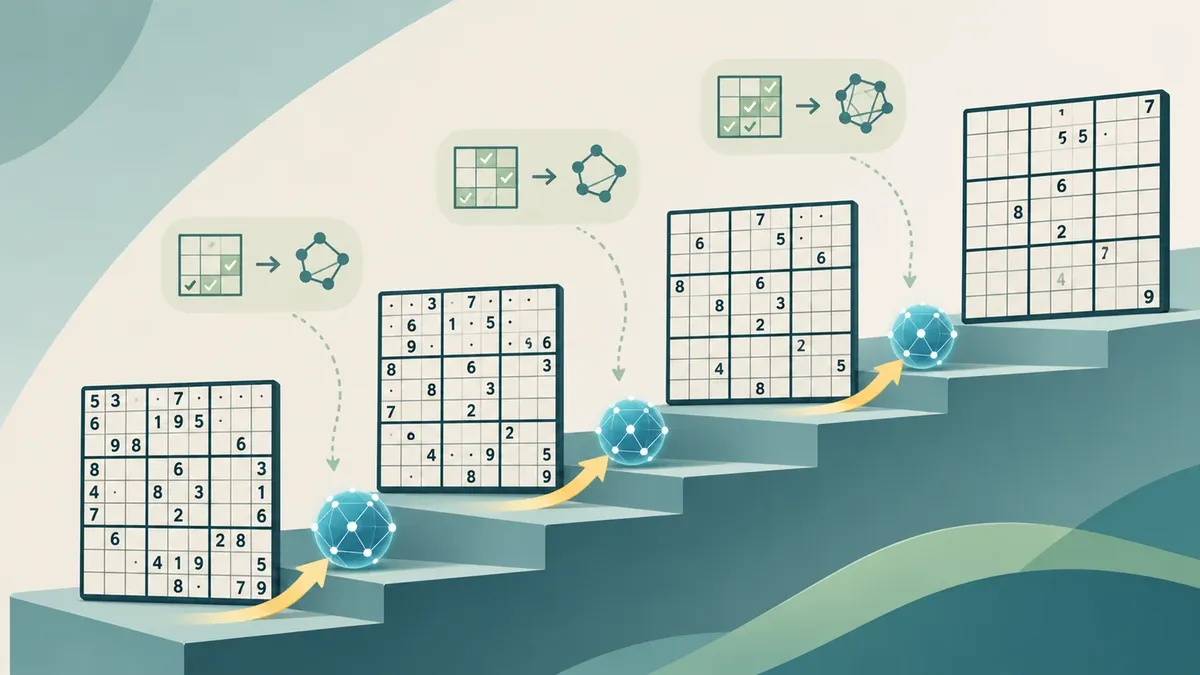
Sudoku is easy to check but can be hard to solve: one wrong digit may disrupt a chain of deductions. A new study tests whether adapting puzzle difficulty during training can help vision-language models manage those long chains—and where the method still falls short.
When hard puzzles provide little feedback
A Sudoku answer can be checked against the solution, giving a model a clear accuracy reward: correct or incorrect. But in group-relative reinforcement learning, attempts for the same prompt are compared with one another. If every attempt in that group is wrong—or every one is right—the accuracy rewards have no variation to guide an update. The method described in this paper also includes an auxiliary formatting reward, but that is not used to decide which difficulty level to train on.
Sida Li and colleagues address this challenge in a preprint introducing AdaC-GRPO, an adaptive training method for visual Sudoku. They ask how well multimodal models solve boards shown as images, and whether a curriculum can help models learn puzzles requiring longer chains of deductions.
A benchmark organized by difficulty
The researchers created FG-Sudoku, with 3,072 training puzzles and 768 test puzzles. It includes 4×4, 6×6 and 9×9 grids, divided into four difficulty tiers. To estimate difficulty, they used a Sudoku solver to measure the deductive work required—not just grid size or the number of clues missing. They checked that puzzles had unique solutions, and evaluated answers by comparing the completed grid cell by cell with the correct solution.
AdaC-GRPO uses online rollout accuracy—the model’s success rate on attempts—to decide which difficulty group to sample from. It aims to keep training within a “Zone of Proximal Development”: challenging puzzles where the model can still sometimes succeed, rather than tasks it has mastered or tasks so hard that successful attempts are extremely rare. The Sudoku solver helps construct and organize the benchmark; the method does not consult it to solve puzzles during training.
The team trained Qwen2.5-VL-7B, first using supervised fine-tuning on 300 reasoning traces and then reinforcement learning. They compared AdaC-GRPO with standard GRPO and other curriculum methods. They also evaluated existing multimodal models, including proprietary and open-weight systems. The main measure was Pass@1: whether one attempt produced the exact solution.
Improvements, but hard cases remain
In the paper’s reported main runs, overall Pass@1 was 0.586 for AdaC-GRPO and 0.427 for standard GRPO. On the hardest 9×9 group, AdaC-GRPO scored 0.219, compared with 0.086 for DAPO in the main comparison. The authors say this approaches Gemini-2.5-Flash’s 0.293 on that tier. They also report that AdaC-GRPO closed 62.2% of the overall accuracy gap between the untuned Qwen model and Gemini-2.5-Pro. These are comparisons on this benchmark, not general rankings of the systems.
The authors also examined training groups at the point when the models entered the hardest group. They sampled 16 trajectories per prompt and split them into groups of eight. In this analysis, 99.7% of DAPO groups had no variation in accuracy reward, compared with 54.7% for AdaC-GRPO. The curriculum made informative groups more common in this setup, but did not eliminate groups with identical accuracy outcomes.
A three-seed analysis gives a more cautious view of the overall results: mean Pass@1 was 0.5820 for AdaC-GRPO and 0.4184 for GRPO. The paper reports that using only grid size to set curriculum stages sharply reduced accuracy on the hardest group. A variant rewarding partially correct grids also scored 0.000 on that group, consistent with the authors’ concern that locally correct entries may still form a globally invalid solution.
The study reports improvements on two other benchmarks when AdaC-GRPO was trained separately for each task. That tests whether the scheduling method can be applied beyond Sudoku; it is not evidence that a Sudoku-trained model broadly transfers its capabilities.
What the evidence can support
The results suggest that matching task difficulty to a model’s current performance can help reinforcement learning on a task with objectively verifiable answers. They do not establish that AdaC-GRPO will work for long-horizon reasoning in general. FG-Sudoku covers standard grids up to 9×9, and results remain low on the hardest subgroups. The method also depends on meaningful difficulty groups, which may be difficult to define in open-ended tasks.
The authors repeated the central GRPO and AdaC-GRPO comparisons across three training seeds; other training baselines were reported from single runs because multimodal reinforcement learning is costly. The work is an arXiv preprint, not peer-reviewed validation. Its findings are best understood as a promising test of adaptive curricula on a controlled puzzle benchmark, with broader applicability still uncertain.
- multimodal AI
- visual reasoning
- Sudoku
- reinforcement learning
- curriculum learning
- AdaC-GRPO
Reviewed cross-references
These connections were reviewed by a model, not independently fact-checked by a human. Similarity does not imply agreement; consult the original papers and the evidence below.
How VideoGym trains agents to search long videos
Shared method: Both studies combine GRPO with training-distribution adaptation: AdaC-GRPO samples Sudoku difficulty groups using online accuracy to target a competence window, while VideoGym uses an EXP3-inspired sampler to shift rollouts toward low-accuracy video-question categories. This is a shared adaptive-sampling approach, not the same scheduling rule; the tasks and sampling signals differ, so their reported gains are not directly comparable.
Model review: · openai-codex/gpt-6-luna
Evidence and provenance
Selected excerpts, not complete papers. PDF extraction can omit figures or damage equations, tables and reading order; sources may be preprints.
2610.13184v2 — Original paper
Excerpt reference:
static/papers/2610.13184v2.md:223-304
Basis: Paper text
Source SHA-256:d5a826ac91527be85c4f378592568a6827417af9644727d3c29f9364557e10582611.28102v1 — Original paper
Excerpt reference:
static/papers/2611.28102v1.md:83-160
Basis: Paper text
Source SHA-256:d5bb37fb0cac80b0df126fbb1e29341ebc38fca2bb68b33cfc28bde70f369f76
Related reading
Automatically matched by shared topic keywords. These links do not imply that the sources agree or establish a consensus.
AI can read an image yet struggle to reason about it
Source published
Shared keywords: multimodal ai, reinforcement learning, visual reasoning
Teaching Visual AI When to Call a Tool
Source published
Shared keywords: multimodal ai, reinforcement learning, visual reasoning
Can AI Models Think in Pictures, Not Just Words?
Source published
Shared keywords: multimodal ai, visual reasoning
Teaching Small Vision Models What to Notice
Source published
Shared keywords: multimodal ai, visual reasoning
AVIS Lets Vision-Language Models Spend Effort Where It May Help
Source published
Shared keywords: multimodal ai