TRANSMISSION // 2610.11242v2
Testing a New Way to Detect Satellite Maneuvers
Source published
A simulation tests whether an independent reference filter can help detect small satellite maneuvers while limiting false declarations.
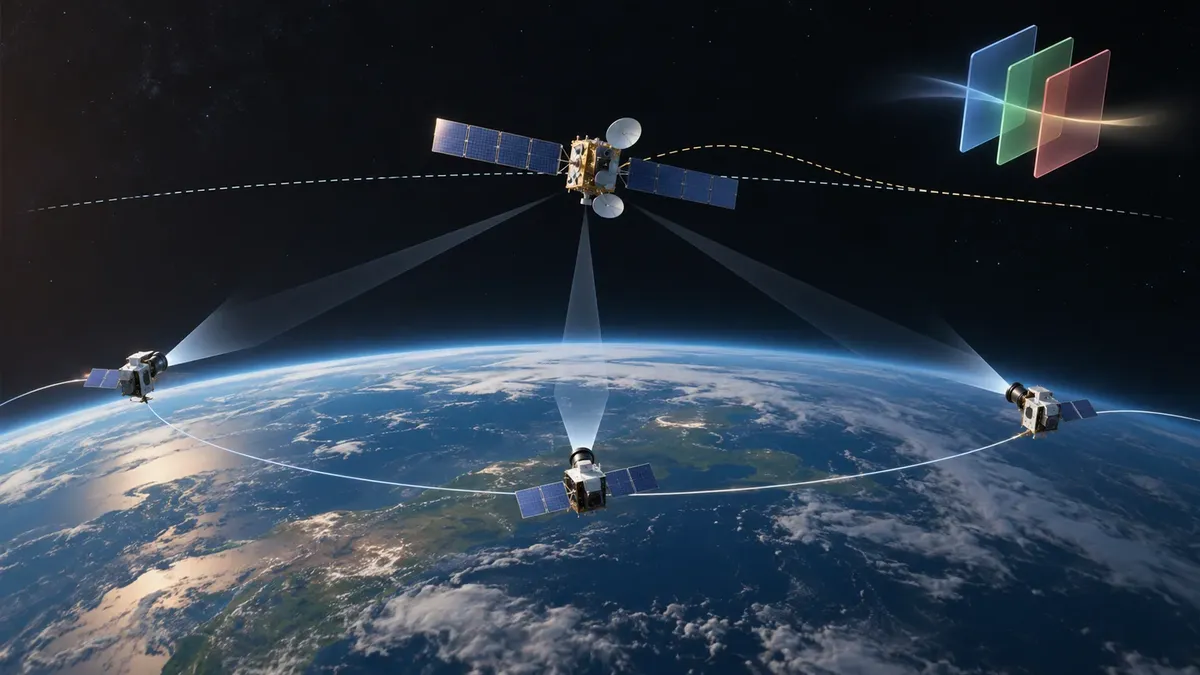
When a satellite changes course without warning, orbit estimates can become unreliable. Researchers tested whether a separate reference filter could help tracking software recognize simulated maneuvers without relying on a feedback-prone adjustment method.
An unannounced satellite maneuver can make its predicted path wrong just when accurate tracking matters. For geostationary satellites, that may complicate efforts to maintain reliable catalogs and assess possible close approaches. But detecting a maneuver quickly is not enough: a system that mistakes ordinary tracking noise for a maneuver can also degrade its orbit estimate.
A common tracking approach, the interacting multiple model (IMM) filter, runs two estimates in parallel: one assumes the satellite is coasting, while the other allows for maneuver-like motion. It combines those estimates and assigns each a probability. A transition probability matrix (TPM) helps determine how readily the filter switches between the two modes. If the chance of switching to the maneuver model is set low, a small maneuver may be missed or detected late. Set it high, and false declarations or less accurate estimates during normal flight may become more likely.
Euiseok Han, Sangheon Choi and Seung-Hyun Kong propose adapting that switching probability using a separate “reference” filter. The reference filter assumes the satellite is coasting and processes the same observations, but it does not take its estimates from the IMM. The researchers use its normalized innovation squared (NIS)—a measure of how surprising new observations are relative to predictions—to adjust the IMM’s coast-to-maneuver probability.
The separation is intended to avoid a feedback problem. In some adaptive IMM methods, the statistics used to change switching probabilities are themselves affected by those probabilities. The authors explain that this loop can raise maneuver probabilities when no maneuver has occurred, or dampen their rise after a real maneuver. In particular, the IMM’s interaction step can pull its coast estimate toward its maneuver estimate, reducing the coast filter’s NIS response. The independent reference filter is designed to retain that signal.
The researchers evaluated their method, called RD-IMM, in simulations of a geostationary target observed by four space-based optical sensors. In the simulated setup, the sensors were in circular Earth orbits at 622 km altitude and provided angle-only observations—azimuth and elevation—at one-minute intervals. Two to four sensors observed the target at each measurement time. The team compared RD-IMM with a fixed-probability IMM, an adaptive IMM and a filter that switches after a threshold is crossed. They ran 50 simulated trials for each maneuver case and 500 maneuver-free trials to estimate false declarations.
In this particular simulation, RD-IMM detected many 1–3 metre-per-second velocity changes that the fixed-probability IMM rarely detected. For 1 m/s changes, RD-IMM’s detection probability was 0.80 for an in-track maneuver and 0.98 for an out-of-plane maneuver; the fixed-probability IMM’s values were 0.06 for each. The measured false-declaration rate for RD-IMM was 0.032, below the 0.05 false-alarm probability used to set the reference filter’s design. That design value is not the same as the measured false-declaration rate of the complete system.
The paper reports that RD-IMM had lower position error than the compared filters during the first hour after the simulated 1–3 m/s maneuvers. This is a specific time window and comparison, not a general advantage in every condition: after reconvergence and in maneuver-free runs, the threshold-based CI-IMM was more accurate. Detection speed also involved a trade-off. In one test, making the system more responsive reduced the median delay for an in-track 1 m/s maneuver, but increased false declarations in the maneuver-free trials used for that parameter test.
These findings come from simulations, not an operational demonstration. The authors say that sparse observations with long gaps and low-thrust maneuvers remain for future work. Their estimated detection floor of roughly 0.5–1 m/s applies to the simulated scenario, not satellite tracking generally. The study also examines sensitivity to process-noise calibration, but results from that test do not establish performance under all possible modeling conditions. The paper is an arXiv preprint, so its claims should be treated as research findings rather than as a settled operational result. The separate-filter approach addresses a potential feedback weakness in adaptive tracking; whether it performs reliably with real observations and less frequent tracking remains to be tested.
- satellite maneuver detection
- space situational awareness
- interacting multiple model
- orbit tracking
- optical sensors
- simulation