TRANSMISSION // 2610.09931v4
What Should a Quantum Computer’s Run Record Keep?
Source published
A study proposes ways to choose which execution details to record—and how precisely—to bound differences between quantum computers’ output distributions.
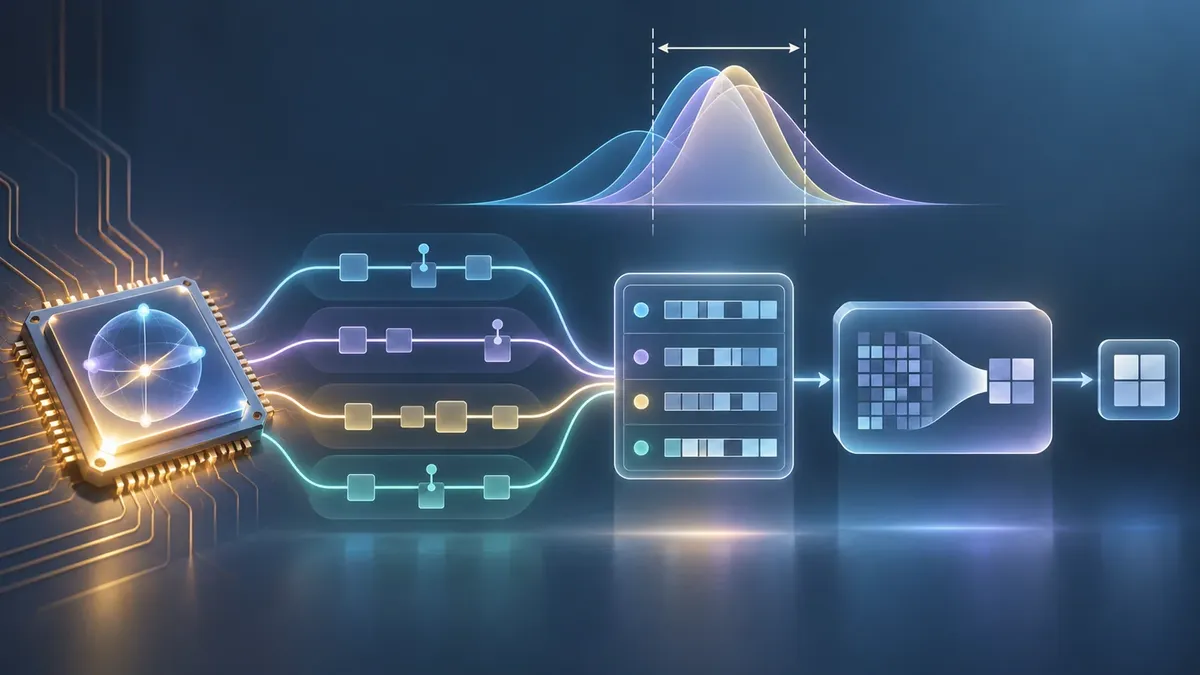
A record of a quantum-computing run can help others inspect how it was produced. But two runs with the same record may still behave differently. This study asks what information a record needs to retain to limit that difference, and tests the approach in simulations and on quantum hardware.
The problem with matching records
A quantum-computing experiment can depend on details such as how qubits are mapped to hardware, how gates are routed, and the noise affecting gates and measurements. Keeping these details can help explain a run, but recording more information is not always necessary for a particular purpose. The challenge is to know which details can safely be omitted—and how finely to record continuous quantities such as noise strengths or rotation angles.
The authors define a record as sufficient when any two executions with the same recorded details have output probability distributions within a chosen tolerance. They measure that difference using Hellinger distance, a statistical measure of how far apart two distributions are. This is a guarantee about agreement between executions, not about whether either execution matches an ideal answer: two runs can agree and still both be biased.
Two ways to build a guarantee
For continuous noise and angle parameters, the authors derive a certificate from a specified model of the quantum channels. It combines independent stochastic noise with differences in coherent rotations—systematic changes to how quantum states are rotated. The resulting bound sets bin widths for recording those parameters without simulating output distributions. It has no explicit dependence on the number of qubits, but it does depend on the assumed circuit and noise model.
For finite sets of execution contexts, the authors use a different approach. They compare pairs of contexts whose output distributions exceed the chosen tolerance. A sufficient record must retain at least one field that distinguishes every such pair. In this formulation, choosing a lowest-cost sufficient set becomes a weighted hitting-set problem; for the small examples studied, all possible field sets can be checked exhaustively.
Simulations: omissions can combine
The simulation study calculates output distributions by propagating quantum states through four-qubit circuits: two hardware-efficient ansatz circuits and two quantum approximate optimization algorithm (QAOA) circuits. The finite-context examples vary factors including layout, routing, gate noise, readout error, angle bias and sampler-seed labels. The researchers compare proposed recording rules against the maximum difference between any two executions sharing a record.
For depth-one QAOA, a channel-based certificate finds that a 13-bit comparison record is sufficient at Hellinger tolerance 0.05 across a specified continuous noise range. The bound applies across programmed angles when the task is held fixed. A gate-by-gate sum using the same family of bins requires 19 bits in this example. These are sufficient budgets under the model, not universal minimums for all quantum circuits.
The finite examples highlight why checking omissions one at a time can be misleading. In one QAOA case, omitting routing alone or angle bias alone stays just below the 0.05 tolerance. Omitting both pushes the discrepancy just above it. The exhaustive method identifies sufficient field sets by checking the joint criterion rather than assuming that individually acceptable omissions remain acceptable together.
Hardware: the decoder changes the record
The hardware test uses six contexts on an IBM Heron processor for a quantum task based on a synthetic computed-tomography image. Each context has 32,768 application shots. The researchers compare raw measurement outputs with outputs transformed by a fixed application decoder, which keeps two boundary variables. They set a Hellinger tolerance of 0.15 and report simultaneous confidence intervals based on assumptions of stationary, independent shots within each context.
For these tested contexts, the raw outputs need a two-label record, supplied by qubit layout, to meet the criterion. After decoding, no additional context label is needed. This result concerns the decoded variables, not the entire image segmentation, and does not establish the same record requirements on other tasks or devices.
What remains uncertain
The channel certificate is only as reliable as its assumptions. The paper notes that unmodelled correlated environments, context-dependent measurements or compiler changes could invalidate it; parameter-estimation uncertainty also needs to be covered. The hardware result is a finite-context test under a sampling model, not a validation of the continuous channel certificate on hardware. The authors also report that a separate IQM Garnet test did not resolve the decoded comparison at the stated tolerance, so it does not support pooling results across providers.
The study’s contribution is a framework for turning a declared agreement target into checkable recording requirements. Its numerical examples are limited to specified circuits, contexts, devices and assumptions. The source is an arXiv preprint; the materials provided here do not establish that it has undergone peer review. Its guarantees should therefore be read as claims within the paper’s stated models and experimental scope, rather than general assurances about quantum-computing reproducibility.
- quantum computing
- quantum provenance
- quantum circuits
- Hellinger distance
- reproducibility
- quantum hardware
Reviewed cross-references
These connections were reviewed by a model, not independently fact-checked by a human. Similarity does not imply agreement; consult the original papers and the evidence below.
A Faster Way to Match Quantum Circuits to QPUs
Supporting evidence: Both studies indicate that execution context can matter when assessing quantum runs: the origin study found that retaining layout was sufficient to compare raw output laws across its six tested contexts, while the scheduler study reports that routing overhead can change estimated success probability and rechecks the selected device after compilation. These are complementary, not identical, outcomes; neither establishes a universal guarantee across devices or workloads.
Model review: · openai-codex/gpt-6-luna
Evidence and provenance
Selected excerpts, not complete papers. PDF extraction can omit figures or damage equations, tables and reading order; sources may be preprints.
2610.09931v4 — Original paper
Excerpt reference:
static/papers/2610.09931v4.md:1330-1401
Basis: Paper text
Source SHA-256:8a82f0e8e2ace9031e6d8c667451a378ec9a724bbf10ef950b676d584fda61b62611.27927v1 — Original paper
Excerpt reference:
static/papers/2611.27927v1.md:47-107
Basis: Paper text
Source SHA-256:a8ce024143ca203d790cd5acba251baab2611e623a6dc1085d4d4567be35a58c2611.27927v1 — Original paper
Excerpt reference:
static/papers/2611.27927v1.md:198-270
Basis: Paper text
Source SHA-256:a8ce024143ca203d790cd5acba251baab2611e623a6dc1085d4d4567be35a58c
Related reading
Automatically matched by shared topic keywords. These links do not imply that the sources agree or establish a consensus.
Teaching a quantum-circuit optimizer which frequencies to use
Source published
Shared keywords: quantum circuits, quantum computing, quantum hardware
A quantum model aims to rethink Transformer design
Source published
Shared keywords: quantum computing
Quantum error correction that adapts as noise drifts
Source published
Shared keywords: quantum circuits, quantum computing
Preparing low-temperature states with shallow quantum circuits
Source published
Shared keywords: quantum circuits, quantum computing
Teaching Quantum Circuit Search to Scale
Source published
Shared keywords: quantum circuits, quantum computing