TRANSMISSION // 2610.09335v2
A drone that imagines where to search next
Source published
SearchWorld combines a drone’s map of explored and blocked areas with a learned spatial-value map. In UAV-ON simulation, it improved reported search success, but real-world performance remains untested.
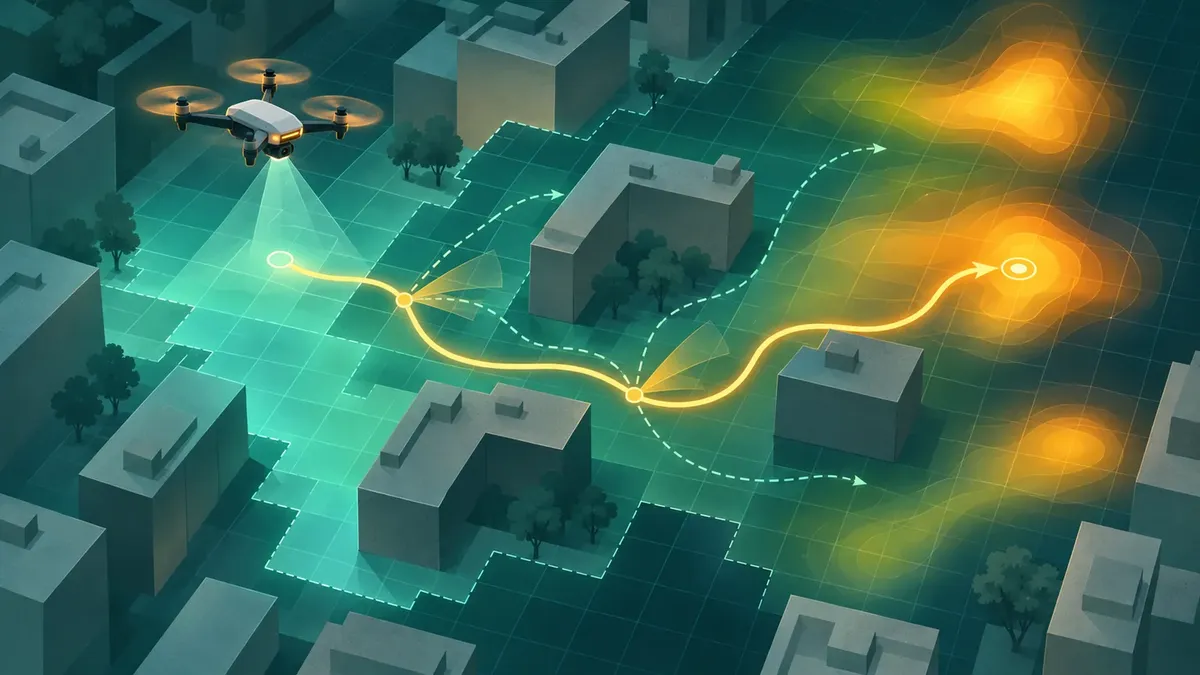
Finding a particular object from the air means more than spotting something that looks similar: a drone must keep track of where it has searched, avoid obstacles and decide where to look next. SearchWorld, a preprint system tested in simulation, uses a learned model of possible future states to help train that decision-making.
The challenge: searching beyond the current view
A drone looking for a particular car or other object may have only a short instruction and its current camera view to go on. The target’s location is unknown, similar-looking objects can distract it, and streets or buildings can block safe routes. A map of past observations helps prevent repeatedly searching the same places, but it does not by itself tell the drone which place would be useful to visit next.
SearchWorld, by Yatai Ji and colleagues, asks whether a learned model of how the search situation changes with movement can help answer that question. The researchers focus on a trade-off in “world models”: these systems can imagine possible future states, but generating imagined images can be computationally demanding, while compact models need a way to connect their predictions to meaningful spatial decisions.
A map with a learned guide
SearchWorld combines a recurrent state-space model—a system that keeps a compact, evolving summary of observations—with an explicit bird’s-eye-view map. Two map layers are built from the drone’s depth readings and pose: one records observed coverage, and the other marks projected obstacles. A third layer is different: the model predicts a task-aware spatial value, estimating which locations may be worth searching given the instruction and current state.
During training, the system imagines action sequences in its learned, compact representation rather than generating pictures of each possible future. It evaluates predicted spatial values over the areas that candidate movements would cover, then uses those estimates to refine a movement policy. Training follows three stages: learn state changes and spatial representations, imitate successful expert demonstrations, and refine movement using imagined utilities. At deployment, the learned policy selects actions directly; it does not run those imagined rollouts for every decision.
The target’s true coordinates are used to construct training labels, but the paper says they are not provided as input to the deployed policy. The study evaluates eight discrete actions, including movements, rotations and stopping.
What the simulation results show
On UAV-ON, an aerial object-search benchmark built with AirSim, the paper’s main results table reports a 23.8% success rate and a 35.5% “oracle success rate.” Success requires the drone to stop within 20 metres of the target. Oracle success means its route passed within that distance at any point, even if it did not stop successfully there. The authors report that SearchWorld’s overall success rate exceeded OctMem-Agent’s reported 19.5%; the comparison should be read with a qualification: the systems used different action configurations and episode limits.
For held-out scenes, the main table reports 23.02% success for SearchWorld. This suggests the policy retained some performance in layouts excluded from training, within this benchmark. It does not establish that the method will generalize to real cities or unfamiliar sensors. In one ablation, removing explicit spatial memory reduced success to 15.96%; removing the value-guided refinement stage reduced it to 19.71%. These comparisons support the usefulness of those components in the tested setup, but do not prove that they will help in every search task.
The paper also reports a measured 0.31 seconds per step. Its timing discussion distinguishes deployment from training: imagined rollouts are used to refine the policy during training, not to rank candidate actions at test time. Timing figures depend on the evaluation setup and should not be taken as a guarantee of onboard performance.
What remains uncertain
The experiments are entirely in simulation. They assume exact pose and ground-truth depth, and the action interface treats movements as idealized; the authors say robustness to sensor errors, actuation noise and real-world transfer remains to be evaluated. Their obstacle map is a two-dimensional projection that can miss details such as overhead wires, and it does not guarantee collision-free flight. The paper’s failure analysis describes occlusion traps, confusion between similar instances and indecision between unexplored directions.
There is also a reporting discrepancy worth noting: the supplied abstract record gives 19.9% success on unseen scenes, while the detailed paper table reports 23.02% (rounded to 23.0% in the paper’s abstract). This article uses the detailed table’s figure but cannot resolve the mismatch from the supplied source. Comparisons also mix reproduced baselines with results taken from other publications, and the authors acknowledge differences in evaluation settings.
SearchWorld is presented as an arXiv preprint, not as a peer-reviewed result in the material available here. Its results are promising evidence for spatially grounded imagination in one simulated benchmark—not a demonstration of a flight-ready search system.
- SearchWorld
- UAV
- drone search
- world models
- robotics
- spatial memory
- simulation
Related reading
Automatically matched by shared topic keywords. These links do not imply that the sources agree or establish a consensus.
PoseVLN Gives Navigation AI a Geometric Memory
Source published
Shared keywords: spatial memory
Teaching robot video models to focus on what moves
Source published
Shared keywords: world models
An RL agent that learns to focus on objects and interactions
Source published
Shared keywords: world models
A lazier search helps robots plan complex retrieval tasks
Source published
Shared keywords: world models
A graph-based approach to robot world-model drift
Source published
Shared keywords: world models