TRANSMISSION // 2610.08751v3
How distance-unit choices can skew conclusions from galaxy maps
Source published
A preprint finds that defining certain modelling assumptions in megaparsecs, rather than megaparsecs divided by the expansion parameter h, substantially reduces statistical shifts in synthetic galaxy-survey analyses. The improvement comes from changing the assumptions attached to model parameters—not from changing the underlying physics.
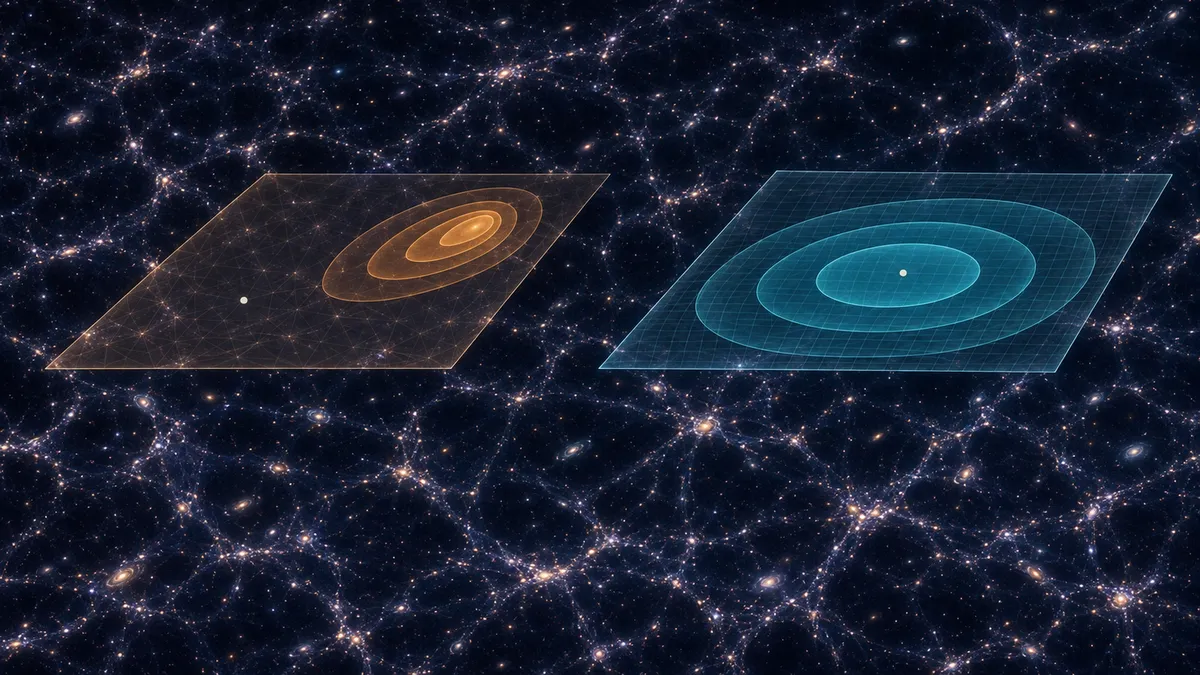
Galaxy clustering helps cosmologists investigate cosmic expansion and dark energy. But extracting those answers requires assumptions about effects the data cannot fully constrain. In a preprint, Andrea Pezzotta and colleagues show how the distance units used to define those assumptions can substantially influence the conclusions.
Where the statistical shift comes from
The distribution of galaxies carries information about how cosmic structures grow and how the Universe expands. Researchers compare statistical descriptions of that distribution with theoretical predictions, estimating cosmological quantities alongside additional, or nuisance, parameters. These account for effects such as galaxy motions and unresolved small-scale physics.
Bayesian analysis combines the agreement between predictions and data—the likelihood—with prior distributions describing assumptions about parameter values. To obtain results for cosmological quantities alone, researchers integrate over the nuisance parameters, a process called marginalisation.
That integration depends on more than where the model fits best. A cosmological solution compatible with a larger range of nuisance-parameter combinations can receive greater total weight. When those parameters are weakly constrained, this can shift the marginalised result away from the known input cosmology, even when the model can fit it correctly. The paper investigates these prior-volume effects.
Why units enter the problem
Galaxy-clustering analyses commonly express distances in Mpc/h: megaparsecs divided by the dimensionless expansion parameter h. Several nuisance parameters carry powers of distance, so their numerical values depend on this convention.
The authors argue that holding their priors fixed in Mpc/h introduces an artificial connection to h. The physical scales associated with unresolved effects are more consistently described in megaparsecs across cosmologies with matching power-spectrum shape and clustering amplitude. Defining fixed assumptions in h-dependent units instead makes the effective weighting vary as h changes.
Crucially, this is not a claim that converting units changes physics. Consistently converting predictions, measurements and their uncertainties leaves the likelihood unchanged. Converting the entire prior distribution consistently also preserves the statistical result. The difference arises when researchers impose fixed priors in each convention: these represent different assumptions as h varies. What matters is where the priors are defined, not simply the units displayed in an analysis.
Testing against known answers
The team generated synthetic clustering measurements representative of an idealised Euclid-like survey covering roughly 15,000 square degrees, with four redshift bins between 0.9 and 1.8. They analysed the power spectrum, which describes clustering strength across different spatial scales and directions.
They tested two modelling frameworks, effective field theory and the velocity difference generating function model. Each synthetic data set was generated with the same framework subsequently used to analyse it. This deliberately excluded modelling mismatch, allowing the researchers to isolate statistical shifts.
The cosmological fits included the standard model with a cosmological constant, an extension allowing spatial curvature, and models allowing dark energy’s pressure-to-density relationship to be constant but unknown or to evolve over time.
The standard cosmological model showed relatively modest prior-volume effects. Shifts became more pronounced when curvature was allowed, and were strongest in the flexible dark-energy models. With conventional Mpc/h-defined priors, some results lay several reported standard deviations from the input values. Defining the priors in megaparsecs reduced these discrepancies to well within one standard deviation in the principal tests.
Broader uncertainty ranges sometimes accompanied the improvement. Those broader ranges did not mean information had been discarded: the narrower alternatives had partly reflected prior-induced weighting. Holding h fixed at its known input value also largely removed the discrepancy between conventions, supporting the proposed explanation.
Alternatives and limits
The megaparsec-based approach performed comparably to more elaborate corrections, including Jeffreys priors applied to nuisance parameters entering the model linearly. Another strategy redefined nuisance parameters using quantities describing growth and geometry. Here, the clustering-amplitude measure sigma12 performed better than sigma8: sigma12 uses a fixed radius of 12 megaparsecs, whereas sigma8 uses 8 Mpc/h, a physical radius that varies with h.
Additional tests broadly supported the findings when survey area was reduced, acoustic-oscillation distance information was added, or the assumed reference cosmology differed from the input cosmology. Tests resembling DESI’s redshift coverage also showed that the performance of the sigma8-based correction depended on which galaxy samples were included.
These remain controlled synthetic-data results, not a reanalysis of observed galaxies or evidence establishing dark-energy evolution. The calculations used approximate Gaussian covariance matrices and omitted survey-window effects. Matching the generation and analysis models also means the study cannot establish either framework’s accuracy on real data. Some residual prior-volume effects remained. The practical conclusion is therefore specific: defining these priors without explicit h-dependence is a promising way to reduce an identified statistical distortion, but actual survey applications still require tailored validation.
- galaxy clustering
- Bayesian inference
- prior-volume effects
- cosmological parameters
- dark energy
- megaparsecs
- Euclid
Related reading
Automatically matched by shared topic keywords. These links do not imply that the sources agree or establish a consensus.
A softly broken symmetry offers a route across the phantom divide
Source published
Shared keywords: cosmological parameters, dark energy
Finding more cosmological information in DESI’s nearby galaxies
Source published
Shared keywords: dark energy
Could cosmic voids reveal uneven dark energy?
Source published
Shared keywords: dark energy
Choosing galaxies could shape the science of a future giant telescope
Source published
Shared keywords: dark energy
Could dark matter’s hidden properties change the cosmic web?
Source published
Shared keywords: dark energy