TRANSMISSION // 2610.06917v2
How FluidPD reallocates work in LLM servers
Source published
FluidPD shifts bounded prompt work or changes worker roles as demand changes. Tests found gains over fixed splits in some workloads, but not all: static splits sometimes did better.
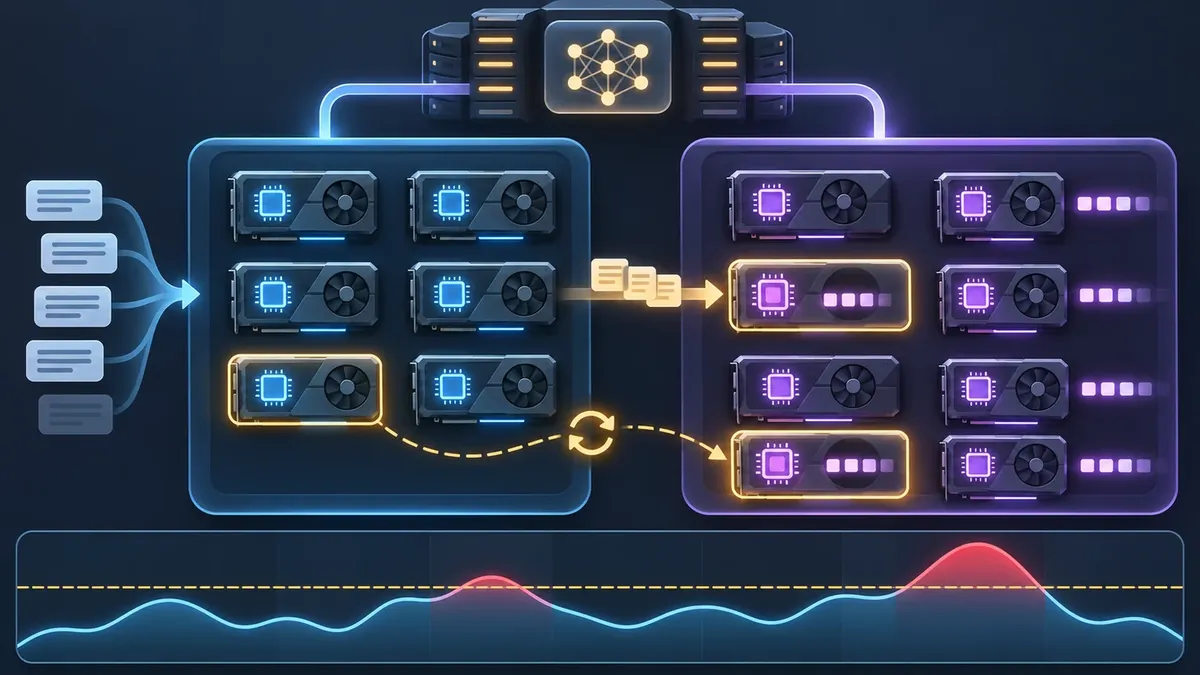
Large language model servers process prompts and generate replies in separate stages. When demand shifts between them, one group of workers can become overloaded while another has room. FluidPD aims to rebalance work within the existing deployment; its reported benefits depend on the workload and system setup.
When you ask a large language model a question, its server first processes the prompt, then generates a reply one token at a time. These stages are called prefill and decode. Some serving systems assign each stage its own group of GPU workers. That separation can help performance, but it can also leave prompt-processing requests waiting while decode workers have some spare capacity.
The balance can change quickly, with a burst of prompts, or more gradually as the mix of requests changes. Adding GPUs is one possible response, but preparing new workers can take time. The researchers behind FluidPD ask whether an existing deployment can adapt its allocation quickly enough to help meet latency targets—without adding workers.
Two ways to adjust the workload
FluidPD combines two mechanisms. FluidToken addresses shorter bursts by moving a bounded suffix of selected prompt-processing work to the decode worker paired with that request. The worker does this only within limits set by its available timing slack, to reduce the risk of delaying replies it is already generating. The work is moved, not eliminated, and the mechanism stops borrowing when decode workers are too busy.
For imbalances that persist, FluidRole switches a running worker between prefill and decode roles. The design avoids restarting the serving engine or reloading model weights. In-flight requests are handled through the transition rather than being discarded, though a switch can still take time as work and data transfers finish.
The controller uses two pressure signals. One estimates whether queued prompts are likely to miss their time-to-first-token target. The other estimates how close decode workers are to their output-speed and memory limits, including demand waiting for memory space. These estimates are intended to expose pressure before a target is missed. But shifting work cannot solve a shortage in both worker pools; the paper says admission control or autoscaling is still needed when the deployment lacks enough overall capacity.
How the system was tested
The authors implemented FluidPD in SGLang v0.5.4 and tested it on servers with eight NVIDIA A100 GPUs connected by NVLink. They evaluated four language models. Qwen3-32B ran with tensor parallelism across four workers, using two GPUs per worker. Workloads were based on production Azure request traces and ShareGPT conversations.
Some tests replayed mixed requests; others arranged requests in stages to create sustained changes in the balance between prompt processing and generation. The researchers used controlled request arrival rates and measured overall SLO attainment: the share of issued requests that completed while meeting both the time-to-first-token and time-per-output-token limits. They compared FluidPD with fixed worker splits, including the best static split they tested at each load. The main results used 64-token KV-cache pages. Most configurations ran once; seven settings near performance limits were repeated with a different arrival seed.
Gains in some tests, not a universal improvement
The largest reported advantage over the best tested static split was 47.9 percentage points. It occurred on a staged ShareGPT-based workload with Llama-3.1-8B at 40 requests per second: 92.8% of requests met both targets with FluidPD, compared with 45.0% for the best static split. This is a result for one test condition, not a general estimate of performance in deployment.
The advantage did not hold across all workloads. On some mixed Azure workload settings, the best static split exceeded FluidPD. At the highest tested loads for Llama-3.1-8B, FluidPD’s overall attainment was also below the best static split in some cases. In those high-load results, its time-per-output-token attainment was a few percentage points lower and its 99th-percentile inter-token latency was higher. The authors note that many of the gaps above the output-token target occurred while a decode worker was running a stolen prompt suffix; this does not establish that work stealing explains every observed difference.
Configuration mattered substantially. The main results used 64-token KV pages, while tests with one-token pages produced markedly different outcomes. The paper describes how, in the tested SGLang and transfer setup, one-token pages could increase the overhead of transferring prompt information as decode-worker memory filled. Results therefore reflect not only the proposed control system but also its software, hardware, cache-transfer configuration, models, workloads and latency targets.
This is a systems evaluation, not evidence that FluidPD will improve every production service. Most configurations were run once, limiting what can be inferred about run-to-run variation. The headline comparison is against the best static split among those tested, and the authors did not directly compare with every related system; some alternatives lacked public implementations at evaluation time. The paper is an arXiv preprint, so its findings should be treated as provisional rather than independently confirmed through peer review.
FluidPD offers two ways to redistribute existing workers’ effort as inference demand shifts: borrowing a limited amount of prompt work for brief pressure, and changing worker roles when imbalance persists. The tests show that this approach can improve target attainment in some conditions, but its benefits—and trade-offs—depend on the workload and system configuration.
- FluidPD
- large language model serving
- LLM inference
- prefill and decode
- GPU scheduling
- latency SLOs
- arXiv preprint
Reviewed cross-references
These connections were reviewed by a model, not independently fact-checked by a human. Similarity does not imply agreement; consult the original papers and the evidence below.
AMD’s InferaSim predicts which LLM serving setups are worth testing
Supporting evidence: Both studies indicate that prefill/decode allocation should account for workload conditions: FluidPD reports improved SLO attainment during sustained shifts in phase demand versus static splits, while InferaSim predicts disaggregation can outperform colocation for long prompts but not short ones in its tested configurations. These are compatible, bounded findings from different workloads; InferaSim’s comparison is a prediction validated on specific AMD GPU deployments, not a general result.
Model review: · openai-codex/gpt-6-luna
Evidence and provenance
Selected excerpts, not complete papers. PDF extraction can omit figures or damage equations, tables and reading order; sources may be preprints.
2610.06917v2 — Original paper
Excerpt reference:
static/papers/2610.06917v2.md:13-71
Basis: Paper text
Source SHA-256:f45a1ed638656d87fdea2700192e8390b864b9c9f6bf418106a1cb1dad84a08c2611.04032v1 — Original paper
Excerpt reference:
static/papers/2611.04032v1.md:1018-1076
Basis: Paper text
Source SHA-256:f9e4bbbb06a147e8e8be31c354a99f7314b2cc50c3effb21b63735d997ba114e
Related reading
Automatically matched by shared topic keywords. These links do not imply that the sources agree or establish a consensus.
RankCast targets the busiest GPU in MoE serving
Source published
Shared keywords: llm inference
A GPU schedule for Kimi K3’s expert layer
Source published
Shared keywords: gpu scheduling
A Better Timetable for Training Reasoning AI
Source published
Shared keywords: gpu scheduling
Busy GPUs, wasted research time
Source published
Shared keywords: gpu scheduling
A cooler way to run mixture-of-experts language models
Source published
Shared keywords: llm inference