TRANSMISSION // 2610.06621v2
In LoRA, Which Factor You Freeze May Matter More at Low Rank
Source published
The authors report that freezing LoRA’s input factor outperformed freezing its output factor in their main low-rank comparisons, though the pattern varied by setting.
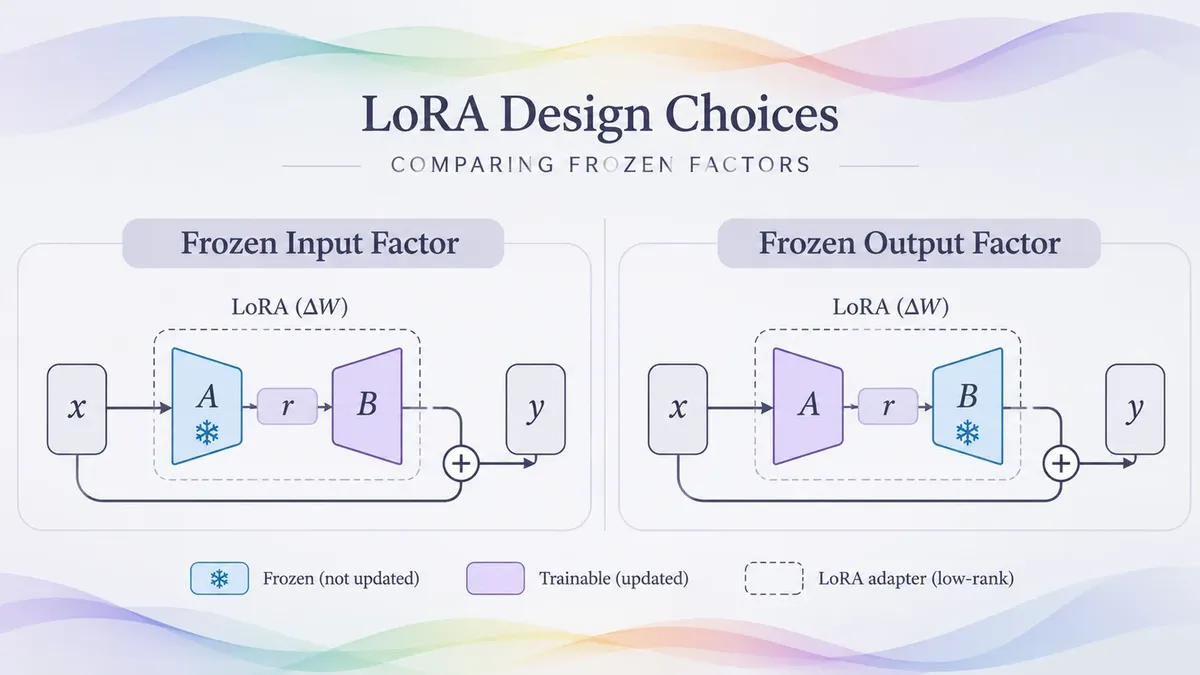
LoRA adapts a model using a low-rank update represented by two factors, A and B. The authors ask whether performance depends more on which factor is frozen or on which band of singular directions is selected. This article is based on the paper’s abstract alone; the reported findings and caveats have not been independently checked against the full methods and results.
A small design choice, tested
LoRA represents an update with two low-rank matrices, commonly called A and B. Some variants freeze one factor while training the other; variants can also select different bands of singular directions, mathematical components used to describe an update. The authors compare these choices, drawing on MiCA and PiCa, and ask which matters more at low rank, where the update has limited capacity.
According to the abstract, the authors used a 2-by-2 design crossing the frozen factor with the selected spectral band. In their notation, MiCA freezes output factor B, while PiCa freezes input factor A. They report experiments on models ranging from 1 billion to 8 billion parameters, with main evidence from two task–model pairs, ranks 1 to 8, and relatively few optimizer steps. The full paper’s methods and results tables were not available for this account.
What the authors report
The abstract says that freezing A outperformed freezing B across both spectral bands in the main comparisons. On the primary format task, the reported difference was 12 to 20 percentage points at rank 2; on OpenBookQA, it was about 7 points at rank 8. The authors report that a Holm correction for multiple testing across 258 primary tests preserved the A-versus-B advantage in 15 of 16 tests. They also say factor choice led band choice at ranks 1, 2 and 4. At rank 8, the factor-over-band lead passed its own test but not the Holm correction.
The authors further report a similar advantage of 11 to 13 percentage points at rank 2 with two 7B models. According to the abstract, the advantage also held when freezing B used as many or more parameters, when A was randomly frozen, and with sixteen times the format-task training budget. Since the underlying experimental details cannot be examined here, these remain claims reported in the abstract, not independently verified results.
The abstract describes exceptions and qualifications. It says the advantage narrowed above rank 8 on most tested pairs, and in other settings including rank 8 with an 8B model on the two main tasks, ARC, and a task mixture. On OpenBookQA, the difference closed by the final step of longer training. At MiCA’s and PiCa’s own settings, the reported difference was smaller or not detected. The authors also identify the rank-1 format-task result as post hoc.
A qualified takeaway
The authors’ abstract suggests that, in their main low-rank, short-training comparisons, which LoRA factor was frozen mattered more than the spectral band selected. It does not establish that freezing A is generally better: the reported pattern varies with rank, task, model, and training duration. The abstract also does not establish why factor choice might affect performance.
The source is an arXiv paper, but the evidence available here does not establish its peer-review status. Because this account relies on the abstract rather than the full paper, its experimental protocols, uncertainty estimates, and complete comparisons cannot be assessed. The post hoc result and the rank-8 comparison that did not survive the stated multiple-testing correction further counsel against treating the reported pattern as a general rule for LoRA design.
- LoRA
- low-rank adaptation
- parameter-efficient fine-tuning
- machine learning
Reviewed cross-references
These connections were reviewed by a model, not independently fact-checked by a human. Similarity does not imply agreement; consult the original papers and the evidence below.
Why AI Update Structure May Matter in RLVR
Supporting evidence: Both studies suggest nominal rank alone does not explain adaptation behavior: the origin paper finds that which LoRA factor is frozen affects accuracy at ranks 1–8, while Kazakov and Javat report abrupt high-rank LoRA failures under a cold-start GRPO protocol and differences associated with update structure. These are complementary, not direct replications: the tasks, training regimes, and structural comparisons differ.
Model review: · openai-codex/gpt-6-luna
Evidence and provenance
Selected excerpts, not complete papers. PDF extraction can omit figures or damage equations, tables and reading order; sources may be preprints.
2610.06621v2 — Original paper
Excerpt reference:
static/papers/2610.06621v2.md:13-72
Basis: Paper text
Source SHA-256:f87f8621be4b2da628144f404d932bb2e1bff6509059e2fa2f29dd985123ad7f2611.27148v1 — Original paper
Excerpt reference:
static/papers/2611.27148v1.md:15-81
Basis: Paper text
Source SHA-256:14ec41d36c22e032fd15a3f0eed681d4a3d3e2fa9f5ab5c181d193f0d78a1a33
A better way to resize AI updates for unequal devices
Shared method: Both papers study LoRA’s paired-factor representation: the origin paper compares freezing its input versus output factor, while Chen et al. study extracting lower-rank adapters from aggregated LoRA factors. The shared method is LoRA, but their questions and settings differ; the federated extraction results do not test the origin paper’s factor-freezing accuracy claim.
Model review: · openai-codex/gpt-6-luna
Evidence and provenance
Selected excerpts, not complete papers. PDF extraction can omit figures or damage equations, tables and reading order; sources may be preprints.
2610.06621v2 — Original paper
Excerpt reference:
static/papers/2610.06621v2.md:13-72
Basis: Paper text
Source SHA-256:f87f8621be4b2da628144f404d932bb2e1bff6509059e2fa2f29dd985123ad7f2611.12961v1 — Original paper
Excerpt reference:
static/papers/2611.12961v1.md:245-303
Basis: Paper text
Source SHA-256:b4e08fa52fb46148fb29c166f52f76977b8662685884533317900008d4cc4500
Related reading
Automatically matched by shared topic keywords. These links do not imply that the sources agree or establish a consensus.
KiRA explores a more compact way to adapt AI models
Source published
Shared keywords: machine learning, parameter efficient fine tuning
One LoRA, seven backbones: testing adapter superposition
Source published
Shared keywords: parameter efficient fine tuning
AI Specialists Can Use Different Adapter Sizes, but Combining Them Is Tricky
Source published
Shared keywords: parameter efficient fine tuning
How SAM-3 Finds Its Own Paths to Better Segmentation
Source published
Shared keywords: parameter efficient fine tuning
A better way to resize AI updates for unequal devices
Source published
Shared keywords: low rank adaptation