TRANSMISSION // 2610.05523v2
Reshaping telescope grids could widen the search for gamma-ray bursts
Source published
A theoretical study finds that tapered grid slats could help high-energy telescopes admit more off-axis photons and avoid gaps in their directional response. Diamond-shaped profiles offer the strongest geometric improvement, while more practical hexagonal shapes recover much of the benefit.
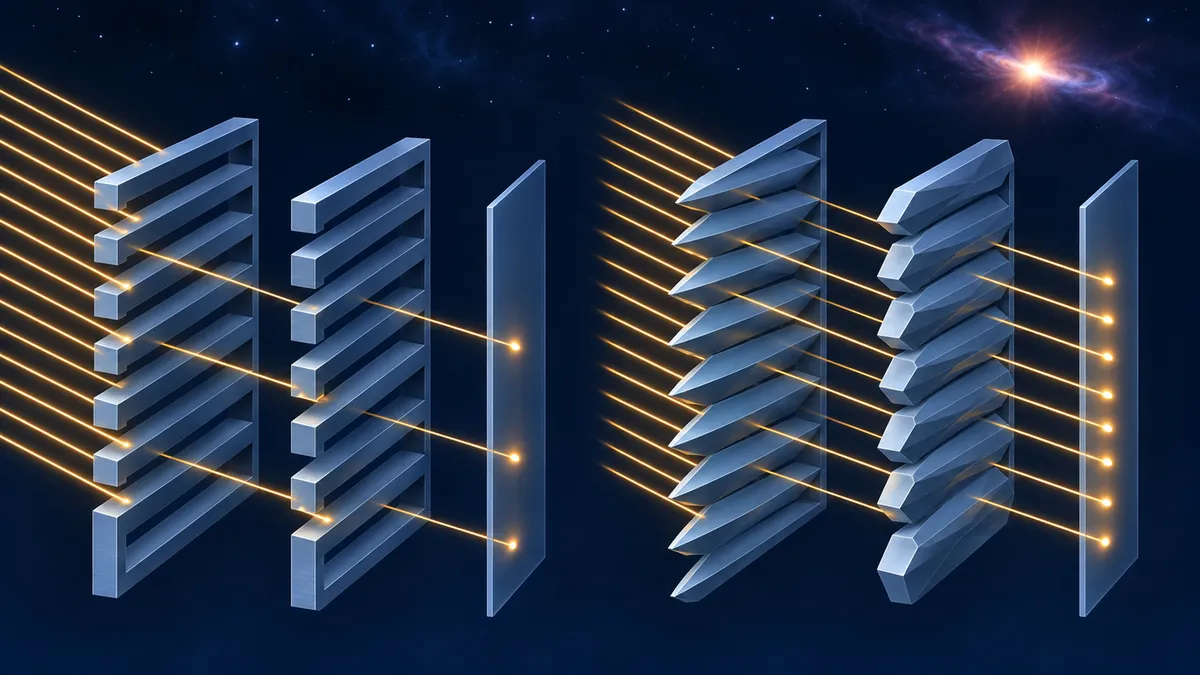
A telescope’s view can be limited by its own internal shadows. Steven E. Boggs explores whether changing the cross-sectional shape of tiny metal slats could give instruments hunting gamma-ray bursts a wider, more useful view of the sky.
When the grid gets in the way
Locating a brief gamma-ray burst requires an instrument that can determine where incoming high-energy photons originated. A modulation collimator does this using separated grids of parallel slits. Their overlapping shadows create a transmission pattern that depends on the source’s direction. Measuring that pattern provides information about its position.
The difficulty is that the metal between the slits must be thick enough to block the photons of interest. For radiation arriving at an angle, that thickness becomes an obstacle: the sides of the slats obscure part of each opening. This self-shadowing, called self-vignetting, reduces transmission and eventually closes the usable view.
Boggs’s study asks whether this penalty is dictated entirely by grid thickness, or partly by the rectangular slat shapes conventionally used. The work is available as an arXiv preprint; its latest landing page reports acceptance for publication in The Astronomical Journal. Its results are analytical predictions, not a demonstration of a new working telescope.
Comparing four cross sections
The analysis describes each grid through an effective slit width: the opening that remains available to photons arriving from a particular angle. That width determines both the maximum transmission and how much of the repeating directional response becomes flat and uninformative.
Boggs derives expressions for rectangular, diamond-shaped and irregular hexagonal slats, alongside circular wires used in early X-ray astronomy. The shaped-slat comparisons hold grid spacing, slit width and maximum thickness constant. Wire grids have an additional constraint: wire diameter ties thickness and spacing together, limiting independent adjustment of opacity and angular resolution.
For rectangular slats, clipping begins as soon as a source moves off-axis. Removing the corners to make a diamond changes that behavior. Over an initial angular range, rays pass without additional clipping; only at larger angles do the diamond’s upper and lower points obstruct them.
The worked example chooses dimensions for which rectangular slats stop transmitting geometrically at an off-axis angle of 60 degrees. Diamond slats retain their on-axis peak transmission throughout that range, then decline to zero near 74 degrees. These angles are measured away from the viewing axis in the direction perpendicular to the slits.
The unchanged peak transmission is 50 percent for the assumed half-open grids. This is the maximum when the two grids’ openings align for a source, not a promise that half of all incoming photons pass through at every source position.
Avoiding gaps in directional information
Transmission alone does not tell the whole story. The paper also examines a fixed instrument arrangement using four grid pairs whose repeating responses are offset by a quarter-cycle. Together, these channels sample different parts of the same directional pattern.
As clipping narrows each channel’s response, fewer channels carry a modulated source signal. Eventually, some source positions can fall into gaps where none of the four channels supplies that signal. These are the study’s blind spots.
In the model, diamond slats preserve the unclipped four-phase response across the entire 60-degree target range. Rectangular slats develop blind spots before reaching its edge.
Perfect diamonds may be difficult to manufacture using standard photochemical etching. An irregular hexagon, with tapered sides but finite-width top and bottom faces, offers a practical compromise. For an etching factor near one, the model preserves the unclipped response to 45 degrees and avoids complete four-channel blind spots throughout the target range, even though peak transmission decreases beyond 45 degrees.
What remains to be tested
The calculations assume sharp edges and perfect alignment. They omit diffraction and do not quantify how manufacturing errors or misalignment would change performance. The paper points to existing precision-grid manufacturing capabilities, but a dedicated tolerance analysis remains necessary.
Opacity also needs care. A diamond has less average metal thickness than a rectangle of the same maximum thickness. Equal geometric dimensions therefore do not automatically mean equal photon blocking. Using an approximate average-path treatment, Boggs finds that leakage decreases at larger off-axis angles and changes modulation amplitude without moving the geometric blind-spot boundaries.
That treatment uses one representative attenuation coefficient rather than evaluating a complete energy band. Real instrument design must account for energy-dependent absorption as well as fabrication tolerances.
The central result is consequently a design opportunity, not established telescope performance: reshaping grid slats could preserve useful directional information over a wider field without changing grid spacing.
- astrophysics
- gamma-ray bursts
- modulation collimators
- telescope instrumentation
- grid geometry
- self-vignetting
- X-ray astronomy
Related reading
Automatically matched by shared topic keywords. These links do not imply that the sources agree or establish a consensus.
Falling merger debris could fuel—and frustrate—a second cosmic jet
Source published
Shared keywords: x ray astronomy
Fading X-rays connect merger-driven gamma-ray bursts to their opening flash
Source published
Shared keywords: gamma ray bursts
Simulated galaxy clusters match X-ray outskirts—but their cores look too faint
Source published
Shared keywords: x ray astronomy
How bright knots of gas complicate measurements of galaxy clusters
Source published
Shared keywords: x ray astronomy
Triangular Calibration Improves GALI’s Gamma-Ray Burst Localization in Tests
Source published
Shared keywords: gamma ray bursts