TRANSMISSION // 2610.04534v2
Why cavity losses matter even in strong light–matter coupling
Source published
A new computational treatment suggests that finite cavity losses can noticeably reshape molecular polariton energies—even when strong coupling persists.
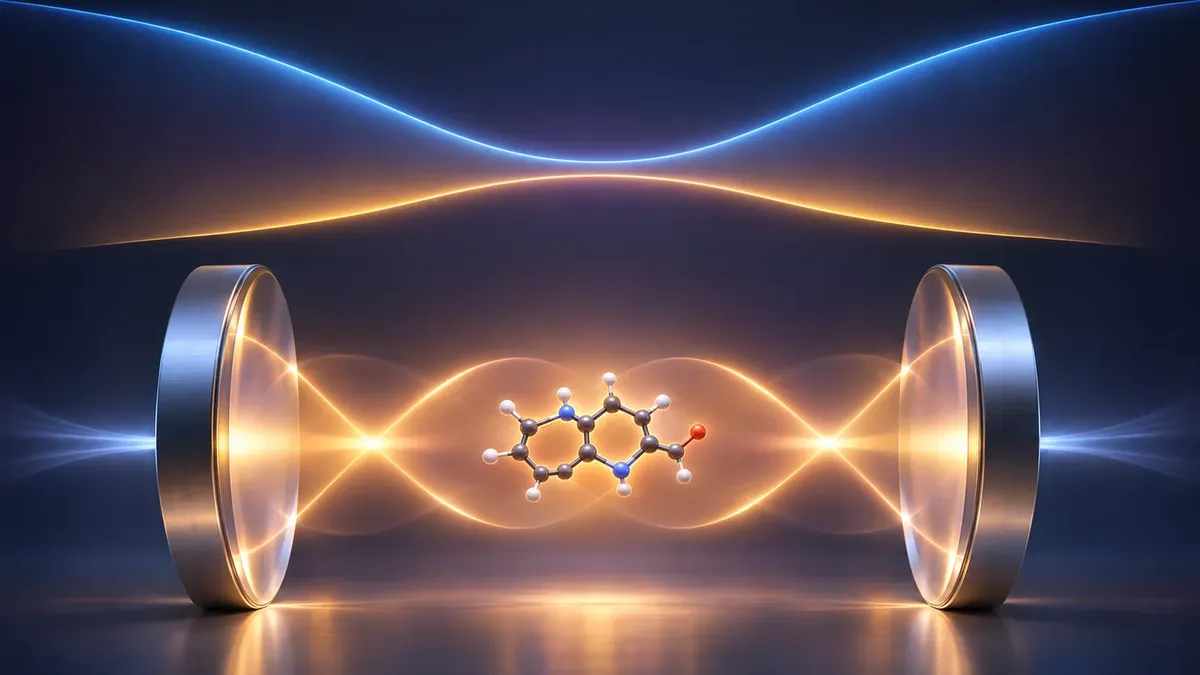
Optical cavities can mix light with molecular excitations, creating hybrid states called polaritons. But real cavities leak light, while many first-principles calculations treat them as lossless. A theoretical study adds cavity dissipation to simulations of p-nitroaniline and finds that the resulting energy shifts may matter for predicting cavity-driven molecular behavior.
Strong light–matter coupling occurs when a molecule and a cavity exchange energy so effectively that their excitations become hybrid light–matter states, known as polaritons. Researchers study these states partly because they may alter molecular properties or reactivity. Yet calculations often simplify the cavity by treating its light as if it never leaks away. A new theoretical study asks how much that idealization can change predicted polariton energies.
The answer, for the system examined, is that losses can matter even when strong coupling remains. The authors report that including cavity dissipation reduces the calculated Rabi splitting—the energy separation between the upper and lower polariton branches—by about 11% for p-nitroaniline. They also find that the cavity frequency at which the polariton gap is smallest shifts downward by about 0.24 electron volts. These results challenge the idea that observing strong coupling alone guarantees that cavity losses have only a minor effect on the system’s energetics.
Turning cavity quality into a calculation
The team built a model in which the cavity field behaves like a damped harmonic oscillator. The damping is set using the cavity’s quality factor, or Q, an experimentally accessible measure related to how long light remains in the cavity. Higher Q means a longer photon lifetime and, generally, lower losses.
They incorporated this description into quantum electrodynamics coupled-cluster singles and doubles (QED-CCSD), a first-principles method for calculating coupled electronic and photonic states. A time-dependent unitary transformation lets them express the resulting Hamiltonian as a real, Hermitian operator. In the authors’ formulation, the changes to the light–matter interaction and dipole self-energy can be added by modifying terms already present in the calculation, without increasing its computational scaling.
They applied the method to p-nitroaniline, a molecule with a strong electronic transition, in a single-mode cavity. The calculations used a specified molecular geometry, electronic-structure basis and light–matter coupling, then compared polariton branches across cavity frequencies for an ideal lossless cavity and for cavities with finite Q. The study describes its coupling parameter as unrealistic for a single emitter in a real device: the goal was to quantify relative effects of dissipation, not to reproduce a particular experiment.
Strong coupling is not the same as negligible loss
For a cavity with Q = 60, the calculated Rabi splitting falls from 1.250 eV in the lossless limit to 1.111 eV. That is a reduction of roughly 11%. The system can still be in the strong-coupling regime, so strong coupling and near-ideal cavity behavior are not interchangeable benchmarks.
The authors also examined how quickly the results approach the lossless limit as Q increases. In their convergence analysis, the splitting’s relative deviation from the ideal value drops below 1% at Q = 320. This indicates that a cavity quality sufficient to sustain strong coupling may not, by itself, be sufficient for calculations that aim to approximate an ideal cavity closely.
The energy shifts also depend on the timescale considered. The model averages the Hamiltonian over a time interval tied to the process of interest, and the authors stress that this interval must remain within the photon lifetime. Their calculations therefore do not say that one Q value has a universal effect: the same cavity may matter differently for fast and slower molecular processes. They argue that such changes could alter resonance conditions between polariton states and molecular states, but the paper does not demonstrate a specific reaction being redirected by the calculated shifts.
What the results do—and do not—establish
This is a model-based result for one molecule and a particular computational setup, not a direct experimental measurement of polariton energies or chemical outcomes. The method uses a very-weak-damping approximation and a leading-order time expansion, and the numerical results depend on the chosen coupling, cavity mode and averaging interval. Although the authors say the approach could be incorporated into other ab initio QED methods, its performance across different molecules and cavity designs remains to be tested.
There is also an important distinction from steady-state spectroscopy. The paper notes that stationary spectral peak splitting and linewidths describe different quantities from its timescale-dependent polariton energetics. Its predicted 11% change should therefore not be read as a general correction to every measured Rabi splitting.
The work provides a practical way to ask whether an ideal-cavity approximation is accurate enough for a particular calculation. It is available as an arXiv preprint, so it should be treated as research in progress rather than as a settled consensus. The central takeaway is specific but useful: finite photon lifetimes may influence calculated molecular polariton energies even when strong coupling is clearly present.
- cavity quantum electrodynamics
- strong light–matter coupling
- cavity dissipation
- polaritons
- p-nitroaniline
- QED-CCSD
Related reading
Automatically matched by shared topic keywords. These links do not imply that the sources agree or establish a consensus.