TRANSMISSION // 2610.03864v2
How mathematical categories describe mixed-state topological order
Source published
A theoretical construction connects braided fusion 2-categories to topological operators in (3+1)D mixed states. The authors distinguish intrinsically mixed-state orders using higher-form symmetries and anomalies.
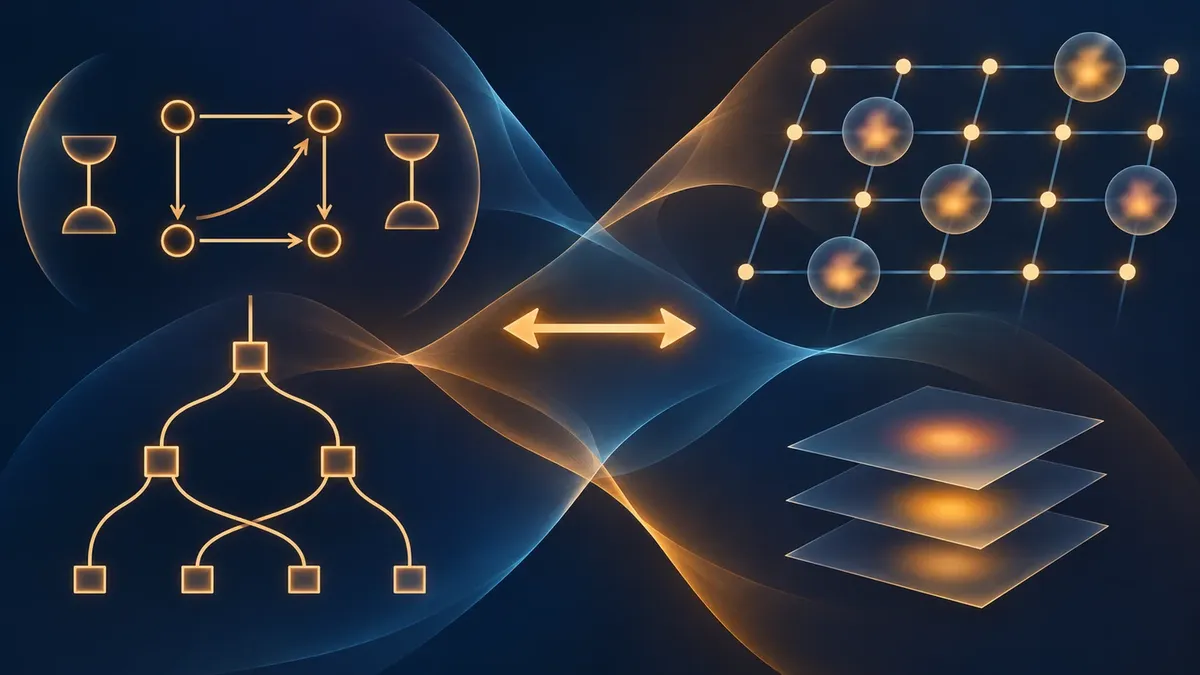
Can abstract mathematical rules for combining and braiding topological operators be realized in quantum systems described by mixed states? Kobayashi, Prem and Yu report a theoretical construction linking every braided fusion 2-category to a (3+1)-dimensional mixed state, while identifying a criterion for intrinsically mixed-state topological order.
The question behind the construction
Ryohei Kobayashi, Abhinav Prem and Matthew Yu study how braided fusion 2-categories relate to mixed-state topological order in (3+1) dimensions—that is, three spatial dimensions plus time. These categories are mathematical structures whose data can describe how topological operators combine and braid. The authors ask how such data connect to symmetries and anomalies, and whether they can be realized in mixed-state theories.
The paper focuses on bosonic theories. The authors note that this includes theories that admit an emergent fermion among their line operators. That qualification is part of the stated scope, rather than a claim that the construction covers every possible theory of matter.
From category data to mixed states
The authors relate the data that parameterize braided fusion 2-categories to strong higher-form symmetries and their anomalies, which they use to characterize mixed-state topological order. They describe concrete lattice models and identify how the categorical data are physically encoded in those models.
They also formalize a general construction: decoherence followed by strong and weak gauging. Their central mathematical claim is that every braided fusion 2-category arises through this construction as the category of topological operators of a (3+1)D mixed state. This is a theoretical realization claim, not evidence that a particular material or device has been observed to host the resulting order.
What makes an order intrinsically mixed-state?
The abstract distinguishes mixed-state topological orders generally from those it calls intrinsically mixed-state. According to the authors, the latter are identified by strong higher-form symmetries whose anomalies cannot be realized in any (3+1)D gapped ground state. In other words, the stated criterion is an obstruction to realizing those symmetries in that ground-state setting; it is not a claim that all mixed-state order is impossible in a gapped ground state.
The authors report a further feature they say has no (2+1)D counterpart: an intrinsically mixed-state order can have topological operators that braid non-degenerately and still carry a gravitational anomaly. This is a claim about the structure of the theory and its operators, not a measured gravitational effect. The abstract states the result but does not provide the examples or derivation details needed to explain how it is established.
What the evidence can—and cannot—tell us
This account is based on the paper’s abstract, not a full examination of its technical arguments. The abstract does report lattice examples, a formal general construction, the bosonic focus and the claimed criterion for intrinsic mixed-state order. It does not give the detailed assumptions, derivations, or examples needed to assess the construction independently. Those details would require consulting the full paper.
The source is an arXiv preprint. Its claims should therefore be presented as the authors’ reported theoretical results; the available information does not establish any further review status or experimental realization. Related-search results are incomplete and do not independently verify or refute the paper. The construction is best understood as a proposed mathematical framework connecting category data, symmetries and mixed-state topological operators—not as a physical map or an experimental discovery.
- mixed-state topological order
- braided fusion 2-categories
- higher-form symmetries
- quantum anomalies
- topological operators
Related reading
Automatically matched by shared topic keywords. These links do not imply that the sources agree or establish a consensus.