TRANSMISSION // 2610.02982v2
When PLC Code Runs, Does the Factory Task Actually Work?
Source published
PLCWorld evaluates AI-generated industrial control programs in simulation, measuring task completion and specified safety violations under registered conditions.
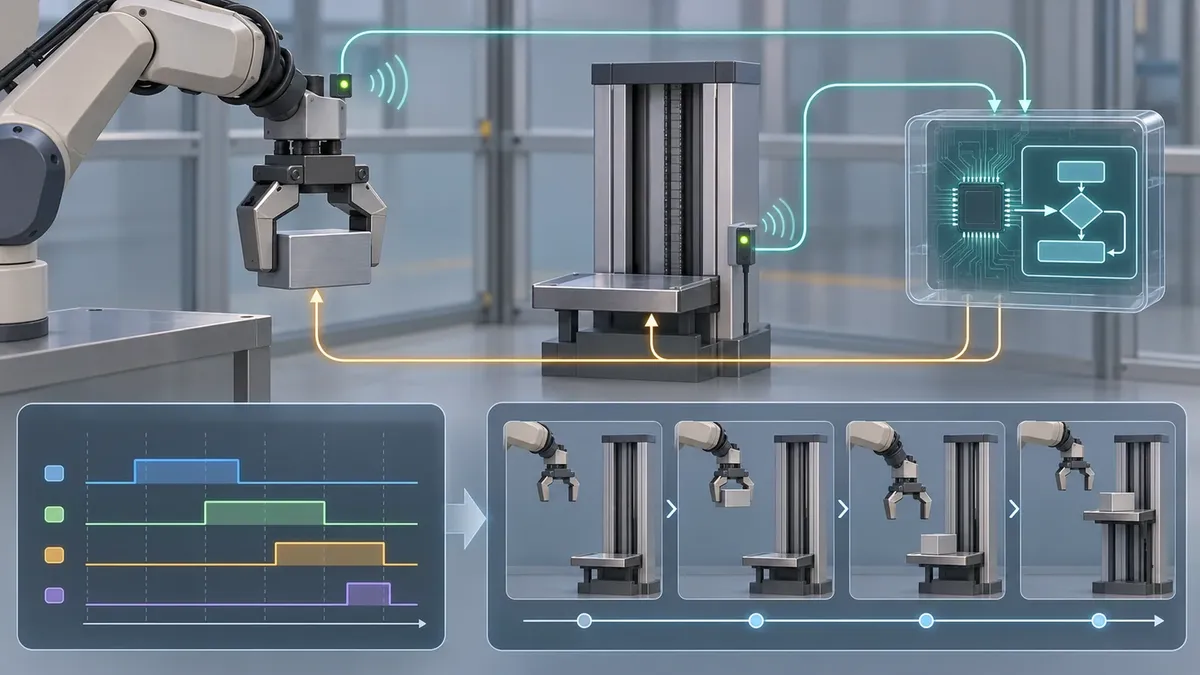
A controller can issue commands in the wrong sequence. PLCWorld tests AI-generated programs against simulated machines and workpieces, showing that passing an initial check does not guarantee task completion or rule out specified safety violations.
The gap between code and action
Programmable logic controllers, or PLCs, run equipment such as motors, conveyors and grippers. Their programs read sensor signals and issue commands, often in a repeating cycle. But a command is not the same as a completed action: a gripper may need time to secure a part before a lift begins, and a shared machine may be unavailable when another operation needs it.
That makes it hard to judge AI-written PLC code by checking only whether it looks plausible or runs. The more consequential question is what happens to equipment and workpieces as the program operates. In PLCWorld: Benchmarking LLM-Generated PLC Programs in Closed-Loop Plant Simulation, researchers introduce a benchmark designed to test that question.
A simulated feedback loop
PLCWorld runs programs written in Structured Text, a language used for industrial control, in a loop with a simulated plant—the equipment and process being controlled. At each controller scan, the program reads inputs and produces outputs. The plant then updates its simulated state, and that state determines the sensor feedback available on the next scan.
Feedback is generated from what the simulated equipment has done, rather than supplied as a fixed sequence of sensor readings. A program must respond to the evolving situation, not merely produce commands in an expected order.
The benchmark contains 100 synthetic tasks in two areas: Motion Control and Material Handling. Together, they cover 473 task-condition pairs. Conditions vary features such as starting states, device timing or external inputs within specified ranges. Difficulty is defined by the scope of control dependencies: Hard tasks involve dependencies between independent jobs sharing resources. The authors caution that difficulty groups also differ in task configurations, so their scores do not isolate the effect of dependency scope alone.
PLCWorld reports two outcomes separately. Task Success asks whether the required plant state and events occur by the deadline, including any required ordering or state retention. Safety Violation records breaches of the safety constraints specified for a task. A task can fail without a recorded violation, or succeed while a violation occurs. The benchmark also reports Execution Gap: among cases whose programs pass a common submission-profile and input/output check, the share that nevertheless fails the task or incurs an observed violation.
Harder tasks exposed persistent failures
The researchers tested six language models on direct code generation, with three independent generations per task and no execution feedback or revision. They also adapted four generation-and-verification workflows, using GPT-5.5 as a shared model backbone for those comparisons.
For direct GPT-5.5, Task Success was 83.96% on Easy cases and 24.51% on Hard cases. Other tested models and workflows also showed lower success on Hard than on easier task groups. These results describe performance on this benchmark; because the groups differ in more than dependency scope, they do not show that complexity alone caused the decline.
The four adapted workflows showed mixed changes in completion and specified safety violations, with no consistent plant-level gains across task groups under their configured budgets. In one example, a generated program and its generated verification properties agreed about a sensor’s meaning, but both interpreted it incorrectly. The controller waited for confirmation that could occur only after the action it was waiting to perform. The simulated workpiece never transferred.
What the benchmark can—and cannot—show
The team reports several validation steps: four practitioners reviewed the task specifications; reference and alternative programs were tested; 542 targeted counterexamples were checked; specification-to-evaluator alignment was audited; and Structured Text execution was compared with an independent runtime on a tested subset. These checks support the benchmark’s design, but do not establish that its simulated plant captures every real machine or possible program behavior.
PLCWorld’s plant models are task-specific abstractions, not full physics simulations: they do not explicitly model contact forces or mechanical deformation. The authors say plant responses have not been validated against measurements from physical equipment. Runtime testing covers a supported Structured Text subset, not every vendor’s implementation. The tasks are synthetic, and confidential source programs and engineering documents used for industrial grounding are not publicly released, limiting independent inspection of that grounding.
A recorded absence of a safety violation means only that none of the specified violations was observed under the tested conditions; it is not safety certification. Unmodeled hazards and untested operating conditions remain outside the evaluation. The article is available on arXiv, and its code and benchmark are linked from the paper. PLCWorld offers a way to test an important distinction: code that passes an initial check may still fail when controlling a changing simulated process.
- PLCWorld
- programmable logic controllers
- large language models
- industrial automation
- Structured Text
- simulation
- AI benchmarking
- control-system safety
Related reading
Automatically matched by shared topic keywords. These links do not imply that the sources agree or establish a consensus.
Checking AI commands before connected devices act
Source published
Shared keywords: large language models
Can an AI Agent Remember the Right Thing at Work?
Source published
Shared keywords: ai benchmarking
A benchmark tests AI predictions of cyclic peptides
Source published
Shared keywords: ai benchmarking
Why the Same Seed Can Make a Different AI Image
Source published
Shared keywords: ai benchmarking
A Better Way to Measure AI Survey Simulations
Source published
Shared keywords: large language models