TRANSMISSION // 2610.02889v2
GRB 220627A: A Long Burst With a Mixed Signal
Source published
A time-resolved study finds that GRB 220627A’s changing spectrum resembles a magnetar candidate, while its extreme energy favors a blue-supergiant collapsar.
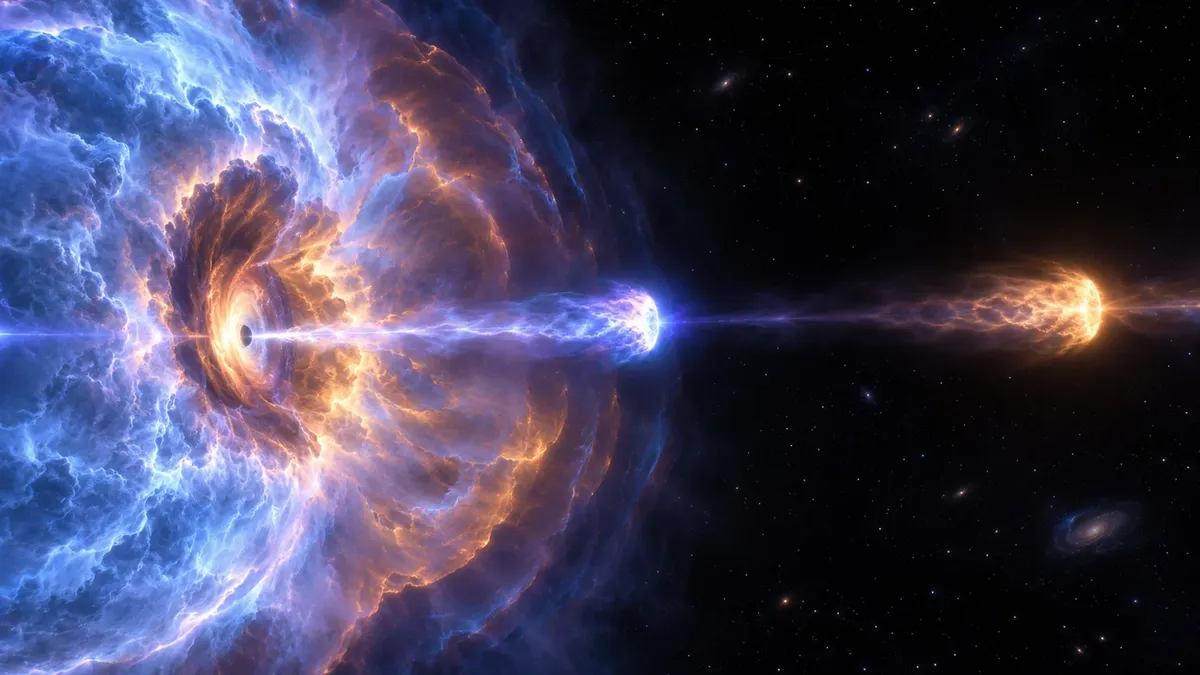
Gamma-ray bursts usually last seconds to minutes. GRB 220627A arrived in two episodes separated by roughly ten minutes, raising a puzzle: what powered such prolonged activity, and can the burst’s changing spectrum reveal its source? A study using Fermi data finds clues pointing in different directions—and argues that the burst’s energy is crucial to interpreting them.
Gamma-ray bursts are brief flashes of high-energy radiation from distant cosmic explosions. Some last far longer than usual: in these “ultra-long” bursts, emission can continue for around a thousand seconds or more. Their extended activity is difficult to explain with a central engine that switches off quickly, and astronomers are still debating what powers them.
GRB 220627A offers an unusually long view. Detected by NASA’s Fermi observatory in June 2022, it produced two bright episodes separated by about 600 seconds with no emission detected above the relevant instrument background. The event’s total prompt activity spans roughly 1,100 seconds. A new study by Ayush Garg and colleagues asks how the burst’s spectrum changed over time, and what those changes can—and cannot—say about its origin.
Dividing the burst into episodes
The team analysed observations from Fermi’s Gamma-ray Burst Monitor (GBM), which records gamma rays across a broad energy range, and its Large Area Telescope (LAT), which detects higher-energy photons. For GBM, they fitted models to the recorded spectra in short time intervals rather than treating each episode as a single event. To help select those intervals, they used HOP and Bayesian-block techniques, which identify changes in the signal’s brightness. They also compared the results with time-resolved observations of two other ultra-long bursts, GRB 091024A and GRB 130925A, associated in the literature with magnetar and blue-supergiant collapsar scenarios, respectively.
A Comptonized power-law model—a curved description of the gamma-ray spectrum—fit the prompt GBM emission across the analysed intervals. The spectrum changed between episodes. In the study’s time-integrated fits, the low-energy spectral index was about −0.70 in episode one and −1.29 in episode two. The authors interpret this shift as consistent with a change from slower to faster synchrotron cooling, a process in which energetic electrons lose energy by emitting radiation. It is an interpretation of the fitted spectra, not a direct observation of the electrons themselves.
The first episode also produced detected GeV emission in Fermi-LAT data, including a reported photon with an energy of 15.7 GeV. The study reports no significant LAT detection during the second episode. These observations add information about how the emission changed, but do not, on their own, identify the progenitor.
Why the spectrum does not settle the source
The spectral evolution resembles that of GRB 091024A, the magnetar candidate in the authors’ comparison. That similarity matters: it shows why a changing spectrum alone can be an ambiguous guide to the object powering a burst. The comparison is limited to a small number of other ultra-long bursts with suitable two-episode Fermi observations; it cannot establish a general rule for the whole population.
The authors argue that the energy budget points more strongly toward a different explanation. They estimate an isotropic-equivalent energy of about 1.6 × 10⁵⁴ ergs. “Isotropic-equivalent” means the energy inferred as if the burst radiated equally in all directions; a gamma-ray burst is thought to emit in jets, so this is not necessarily its true total energy. The paper says this inferred value exceeds the maximum energy available in its magnetar spin-down model, and therefore favours a collapsar: the collapse of a massive star, in this case a blue supergiant with an extended envelope. In that picture, material falling back toward the central object could sustain activity over a long period.
The paper also reports possible thermal components in some intervals, based on fits that add a blackbody to the main spectral model. The authors associate these with emission from a jet and surrounding cocoon, but such model-dependent components are not definitive proof of a blue supergiant. The paper’s broader interpretation also draws on earlier radio observations that it describes as supporting a cocoon. Those observations are supporting context, not measurements made by this prompt-emission analysis.
A preference, not a verdict
The findings do not mean the spectrum has uniquely identified the progenitor. Indeed, the authors’ central point is that magnetar-like spectral evolution can occur even when other evidence favours a collapsar. Their conclusion rests on combining spectral behaviour with energetic arguments and other reported signatures. The inference depends on model assumptions, including the available energy in the proposed magnetar scenario, and observations that are not conclusive can admit alternative interpretations. The roughly 600-second gap is consistent with a lull in detectable emission; it does not by itself prove that the central engine stopped and restarted.
This account is based on the supplied paper text and abstract. The paper is presented as an arXiv preprint, and the supplied material does not establish its peer-review status. Its extracted text also contains formatting problems and some inconsistent descriptions of the time intervals and analysis, so detailed claims should be checked against the original figures and tables. The study is a detailed analysis of one rare burst, not a population-wide test. Further observations and independent analyses will be needed to determine how securely its clues distinguish among possible engines.
- gamma-ray bursts
- ultra-long GRBs
- GRB 220627A
- Fermi
- blue supergiant
- collapsar
- magnetar
- time-resolved spectroscopy
Reviewed cross-references
These connections were reviewed by a model, not independently fact-checked by a human. Similarity does not imply agreement; consult the original papers and the evidence below.
Early X-rays may help reveal what powers gamma-ray bursts
Shared method: Both studies analyze time-resolved gamma-ray-burst spectra: Garg et al. segment GRB 220627A’s prompt emission for spectroscopy, while Ierardi et al. fit spectra across the X-ray steep-decay phase in 23 candidate collapsars. The shared approach is temporal spectral analysis; the phases, instruments, models, and samples differ, so this is not a direct methodological replication.
Model review: · openai-codex/gpt-6-luna
Evidence and provenance
Selected excerpts, not complete papers. PDF extraction can omit figures or damage equations, tables and reading order; sources may be preprints.
2610.02889v2 — Original paper
Excerpt reference:
static/papers/2610.02889v2.md:17-70
Basis: Paper text
Source SHA-256:4991a2e10ed7f552fc885c0835a9b8637723dd350395a918ded79ee441e3f75e2611.12945v1 — Original paper
Excerpt reference:
static/papers/2611.12945v1.md:191-248
Basis: Paper text
Source SHA-256:613540e6ff80ac126f0e68e41a50264d9bc02198f498e49ee02a7527c3b5f68a
Related reading
Automatically matched by shared topic keywords. These links do not imply that the sources agree or establish a consensus.
Early X-rays may help reveal what powers gamma-ray bursts
Source published
Shared keywords: gamma ray bursts
Gamma-ray bursts offer a high-redshift test of cosmic expansion
Source published
Shared keywords: gamma ray bursts
Could a magnetar power GRB 241030A’s early X-rays?
Source published
Shared keywords: gamma ray bursts
One Gamma-Ray Burst, Two Different Signatures
Source published
Shared keywords: gamma ray bursts
A search for long gamma-ray bursts without supernovae
Source published
Shared keywords: gamma ray bursts