TRANSMISSION // 2610.02300v2
Why global safety signals can miss the mark
Source published
A study finds that shared unsafe subspaces may miss varied harmful meanings and that higher-rank removal can disrupt benign representations. It tests CALM, a prompt-routed alternative.
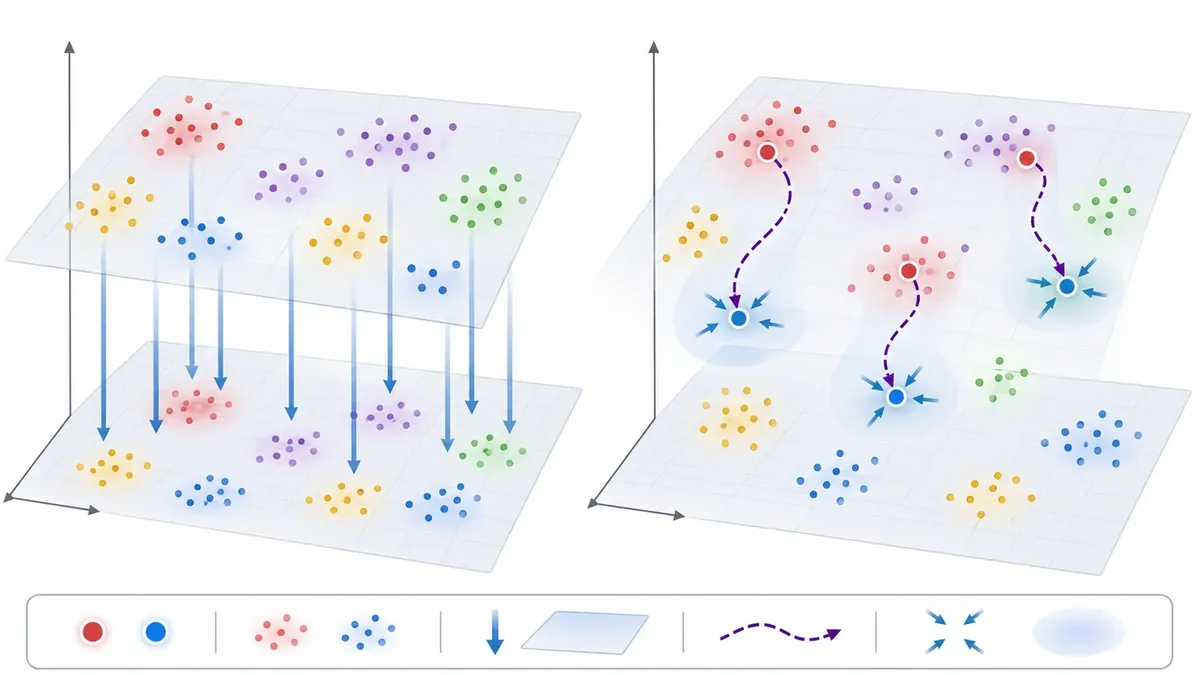
Text-to-image safeguards must reduce harmful outputs without unnecessarily changing legitimate prompts about topics such as medicine, history or sport. Park, Lee and Shim examine the limits of reusable unsafe directions and subspaces, then evaluate a prompt-specific approach called CALM.
Text-to-image models turn written prompts into images, but their flexibility also makes them difficult to safeguard. Some training-free methods use a reusable safety direction or subspace: a geometric signal in a model’s representations that is applied across prompts. Park, Lee and Shim ask whether unsafe meanings share a compact, transferable structure that can be targeted without disturbing nearby benign meanings.
Their paper, Keep It CALM: Analyzing the Limits of Global Unsafety in Text-to-Image Generation, reports a coverage–selectivity trade-off. A compact pooled unsafe subspace transfers unevenly to harmful categories it was not built from. Broadening the subspace does not close that held-out-category coverage gap, while it reduces preservation of benign representations, particularly for meanings near unsafe boundaries.
Testing reusable unsafe subspaces
The researchers analyze representations from frozen text encoders—the components that convert prompts into numerical features. They construct lexical sets spanning seven broad unsafe categories, alongside general benign controls and allowed, safety-adjacent topics such as combat sports, historical conflict and medical emergencies.
They test whether category subspaces remain stable when the sampled terms change, whether different unsafe categories share compact structure, and whether a subspace built from some categories covers a held-out category. They also measure how projection affects benign meanings, using embedding similarity and preservation of nearby terms in the representation space.
The analysis finds that estimated category subspaces vary with the sampled terms, and that different unsafe categories show little compact overlap. In leave-one-category-out tests, pooled subspaces cover held-out categories less well than the categories used to construct them; increasing rank does not eliminate this gap. Meanwhile, safety-adjacent benign terms cross a learned unsafe boundary more often than general benign controls. Projection also disrupts their representations more, and higher-rank projection further reduces benign preservation.
These geometric diagnostics concern text-encoder representations, not image outputs directly. The paper’s analysis is particularly relevant to projection-based methods such as SAFREE; it should not be read as showing that every safeguard uses the same mechanism or has the same limitations. The authors report qualitatively similar geometric trends using two other text encoders, but also conduct separate, direct evaluations of generated images.
CALM’s prompt-specific approach
The proposed method, CALM (Counterfactual Adaptive Local Modulation), is training-free: it intervenes during generation rather than retraining the image model. It uses matched unsafe and benign text anchors. For a given prompt, CALM routes to a small set of categories with evidence of unsafe meaning. It then minimally adjusts token representations that violate the relevant safe-side boundaries, moving them toward their matched benign counterparts. During denoising, it also suppresses residual components aligned with the routed unsafe directions.
In other words, CALM replaces a single prompt-independent removal target with prompt-routed corrections based on unsafe–benign pairs. The paper says it does not use an external safety classifier, reward model or image-level feedback. If no category passes its routing threshold, CALM makes no correction. This is a defined behavior of the method, not a guarantee that routing will recognize every unsafe prompt.
What the image tests show—and their limits
The main experiments use Stable Diffusion v1.4 and compare CALM with other safeguards on harmful-prompt benchmarks. The authors report that CALM has the lowest attack-success and toxicity rates across those benchmarks, while maintaining strong prompt-fidelity and benign-utility measures in the reported tests. On a multi-category evaluation of 379 prompts, a vision-language model judge gives CALM a lower mean unsafe rate than the unprotected model. The paper also reports lower unsafe-generation measures after adapting CALM to four newer backbones.
These findings are tied to the tested models, prompts, metrics and settings. Some evaluations use automated classifiers or vision-language model judges, which can misclassify images; an additional judge is reported for one multi-category evaluation, but this is not comprehensive human review. Benchmark results do not establish performance against every prompt or attack. The authors say adaptive white-box attacks remain challenging and describe CALM as one layer of protection, not a complete defense. They also identify cultural and policy blind spots in defining harmful content and constructing the fixed anchor bank, and suggest extending the geometric analysis to denoiser representations as future work.
The paper text labels the work as a NeurIPS 2026 paper, while the supplied record identifies an arXiv version. That label is reported here as stated in the paper; the record alone does not independently verify publication or peer-review status. This account is based on the supplied paper text and record, not an independent audit. The study’s broader point is that evaluating safeguards means considering both suppression and preservation—and that prompt-specific correction is a promising approach within the limits tested.
- text-to-image generation
- AI safety
- CALM
- diffusion models
- inference-time safeguards
- counterfactual correction
Related reading
Automatically matched by shared topic keywords. These links do not imply that the sources agree or establish a consensus.
A diffusion model may need guidance only while it is reading the prompt
Source published
Shared keywords: diffusion models, text to image generation
Can a One-Step Image Generator Learn Preferences Without Losing the Plot?
Source published
Shared keywords: diffusion models, text to image generation
A Prompt-Level Safety Net for Image Generators
Source published
Shared keywords: ai safety, text to image generation
Can an image model forget a concept without losing its skills?
Source published
Shared keywords: ai safety, diffusion models
A Simpler Route to Diffusion-Model Distillation
Source published
Shared keywords: diffusion models