TRANSMISSION // 2610.00666v2
Can AI Judges Follow Vision Criteria?
Source published
VisionQ tests whether vision-language models can compare computer-vision results by a named criterion. Judges often match authors’ claims, but controls suggest they may rely little on the criterion and can change picks when options move.
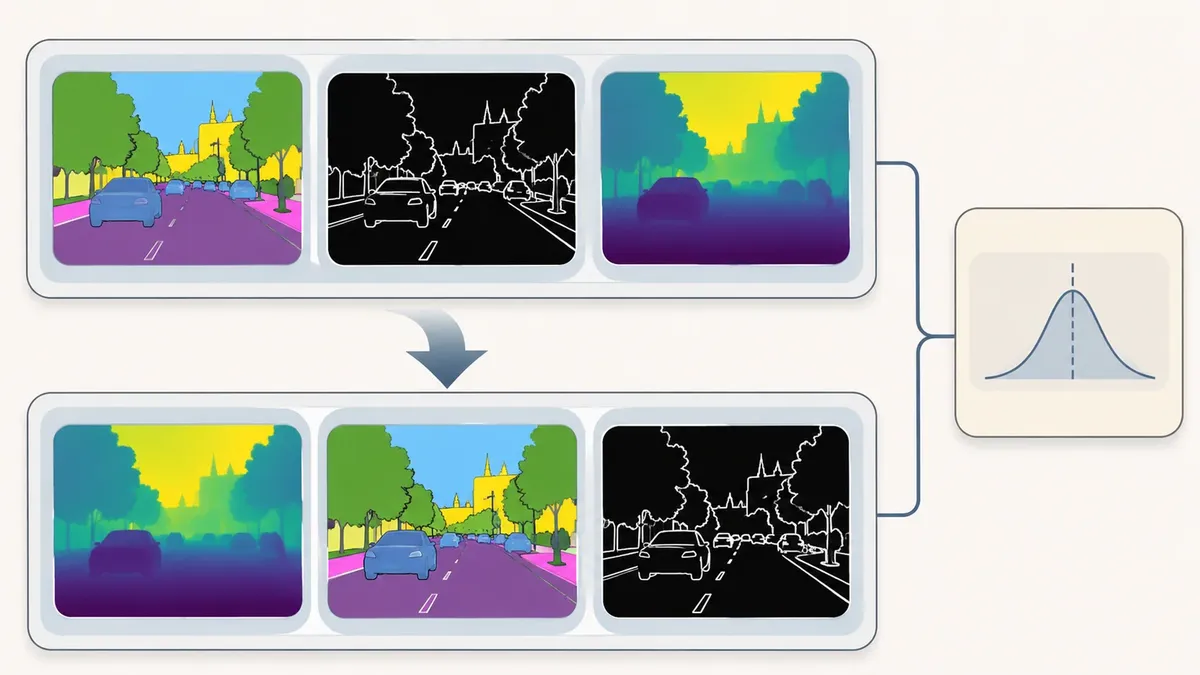
An AI judge can pick the image a paper calls best without actually assessing the quality named in the question. VisionQ tests that distinction—and finds that agreement with authors’ claims is not enough to show criterion-specific judgment.
Computer-vision papers often place results from several methods side by side and say which does best on a particular quality, such as preserving fine detail, matching a prompt or reconstructing a shape. Can a vision-language model (VLM)—an AI system that processes images and text—make these comparisons reliably? More specifically, does it judge the stated quality, or select the output that looks best overall?
The researchers created VisionQ to examine this question. Their broader corpus contains 1,409 papers from CVPR and ICCV, two major computer-vision conferences. From papers with annotated comparison figures, they assembled blind multiple-choice questions showing two to four outputs from the same comparison. Each question asked which output was best on a named criterion while hiding method names, captions and authors’ claims. The scored VisionQ-Bench contains 309 questions from 109 papers—not from all 1,409 papers.
For each question, the answer key was the winner claimed in the source paper. That makes the key traceable, but does not make it independently established truth. The researchers describe authors’ claims as expert judgment, not ground truth. Two annotators linked comparisons to the relevant claims, with a third resolving disagreements. The questions cover criteria including object form, image appearance, scene layout, reference fidelity and prompt matching.
The team tested 21 VLM judges. Gemini 3.1 Pro had the highest score: it selected the authors’ claimed winner on 68.6% of questions, compared with an estimated chance rate of 32.2%. This exceeded the tested no-reference image-quality methods, which score images without a reference. The result measures agreement with authors’ claims; by itself, it does not establish that a judge correctly assessed the criterion in the question.
To investigate what judges relied on, the researchers ran input controls on six models. When they replaced the images with blank tiles or an unrelated comparison, scores fell near chance. The judges therefore depended on the displayed images. But removing the named criterion reduced accuracy by only 1.6 to 8.7 percentage points across those models: they retained most of their score. Asking which output was “better overall” produced a similar pattern. This suggests that image-based agreement did not necessarily mean the judge was following the specific criterion.
Option order mattered too, though the effect depends on how it is measured. Across reordered versions, average accuracy changed only modestly, from 1.6 points lower to 3.7 points higher for the six controlled judges. Yet the models did not always choose the same crop when its position changed. The same-crop rate ranged from 20.4% for Gemma-4-E4B to 64.7% for Gemini 3.1 Pro. When researchers instead took a plurality vote across orders, scores fell clearly for the two smallest controlled judges—by 8.7 points for Gemma-4-E4B and 6.1 points for Gemma-4-26B-A4B. This does not mean every model simply preferred the last option; the study found different patterns across judges.
The team also asked two computer-vision-literate raters to judge 126 questions without seeing the source claims. On questions where both raters chose the authors’ winner, Gemini 3.1 Pro still disagreed on about one in five. This offers a check on the key, but the study was limited: it involved two raters, and some questions were difficult to judge from the images alone. On questions that included a reference image, adding it improved scores for several larger judges, suggesting context can matter when judging fidelity to a source.
Finally, the researchers trained VisionQ-Judge, a 4-billion-parameter model fine-tuned from Gemma-4-E4B-it. Training included each question with options in every cyclic order, placing the claimed winner in different positions. On test questions from papers excluded from training, accuracy rose from 50.4% for the base model to 61.0%. The trained judge’s answers placed the last option less often: its last-option share fell from 50.7% to 43.9%, while the answer key was last in 38.8% of test questions. That is a reduction, not elimination, of the tendency. The trained model also retained most of its accuracy when the criterion was removed. Training improved performance, but did not resolve the central issue of criterion sensitivity.
The study’s scope is specific: static comparison figures from CVPR and ICCV papers published in 2023 and 2024. It does not establish how judges perform on video, interactive 3D results or other fields. The benchmark also has few questions for some criteria: Scene Layout has eight and Prompt Match has 22, making scores for those categories less certain. And because the answer key comes from authors’ claims, it may favor the source paper’s own method—a limitation the researchers acknowledge.
The paper is identified as an arXiv preprint; the supplied source does not establish independent peer-review status. The authors report that the benchmark, code and model weights are available for further testing. For now, the central lesson is limited but practical: VLMs can often agree with published comparisons, but that agreement alone does not show they judged the quality the question named.
- vision-language models
- computer vision
- AI evaluation
- benchmark
- visual comparison
- criterion sensitivity
Reviewed cross-references
These connections were reviewed by a model, not independently fact-checked by a human. Similarity does not imply agreement; consult the original papers and the evidence below.
A more demanding reliability test for AI vision judges
Supporting evidence: Both studies show why a judge’s overall correctness score does not establish robustness to changes in how evidence is presented: VisionQ reports answer changes when computer-vision outputs are reordered, while GridWM-Judge reports presentation and encoding sensitivities for judgments of MiniGrid trajectories. The evidence supports this limited reliability concern across two different diagnostic settings; it does not establish that the same sensitivity mechanisms or rates apply across them.
Model review: · openai-codex/gpt-6-luna
Evidence and provenance
Selected excerpts, not complete papers. PDF extraction can omit figures or damage equations, tables and reading order; sources may be preprints.
2610.00666v2 — Original paper
Excerpt reference:
static/papers/2610.00666v2.md:170-245
Basis: Paper text
Source SHA-256:b31fbf4f31b8561b3fc70242ffff9ed2cc9ed3daec10cd95b55b22feaf50a8fe2611.13596v1 — Original paper
Excerpt reference:
static/papers/2611.13596v1.md:13-69
Basis: Paper text
Source SHA-256:99202aac55e2873d8ffa82ad6b7084e0481ac814f5f855ab6270e48185312bd32611.13596v1 — Original paper
Excerpt reference:
static/papers/2611.13596v1.md:4876-4939
Basis: Paper text
Source SHA-256:99202aac55e2873d8ffa82ad6b7084e0481ac814f5f855ab6270e48185312bd3
Related reading
Automatically matched by shared topic keywords. These links do not imply that the sources agree or establish a consensus.
Why AI Can Find an Object in 2D but Miss Its Depth
Source published
Shared keywords: computer vision, vision language models
Robot safety looks different outside the chat window
Source published
Shared keywords: ai evaluation, vision language models
How an AI agent builds a 3D object from video
Source published
Shared keywords: computer vision, vision language models
Why visual features help AI reason about camera movement
Source published
Shared keywords: computer vision, vision language models
Why Object-Detection AI Reacts to Wording
Source published
Shared keywords: ai evaluation, computer vision