TRANSMISSION // 2609.40322v2
MatLoom turns material descriptions into editable programs
Source published
MatLoom represents generated materials as compact, editable layer programs rather than images alone. Its abstract reports stronger prompt-alignment scores than three diffusion baselines in several comparisons, with ties and other limits to keep in mind.
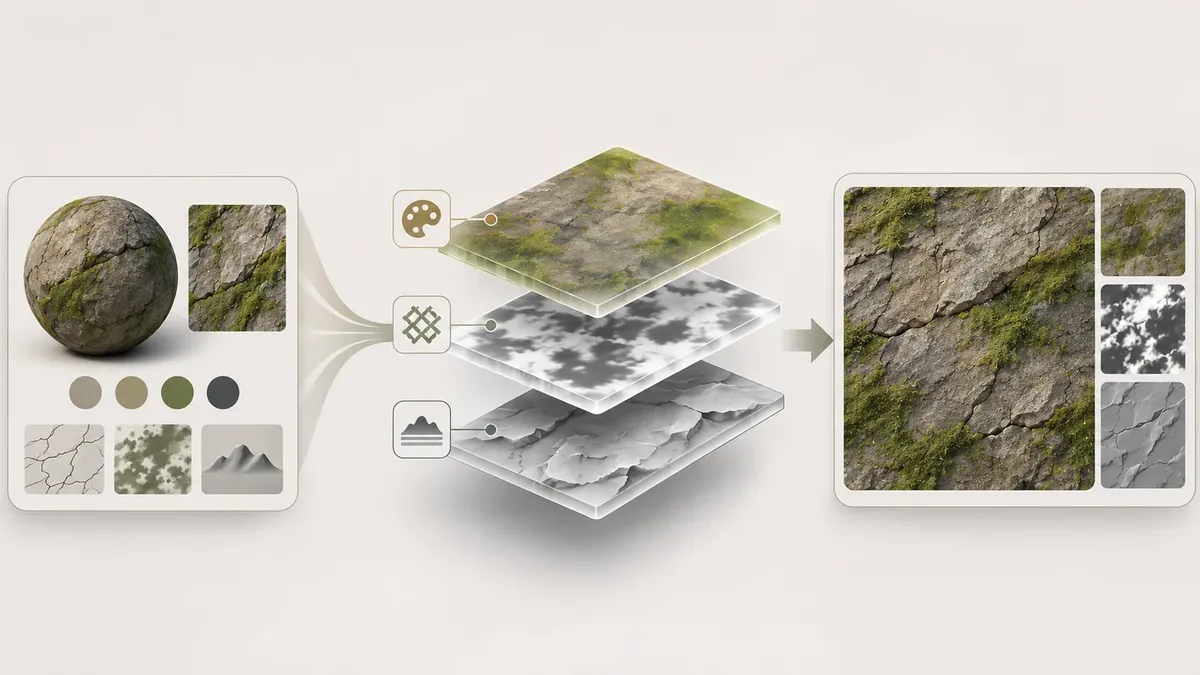
A realistic-looking surface is useful, but a designer may also need to know how its color, pattern and relief were built. MatLoom is a proposed way to generate both: material maps and a compact program that can be inspected and edited.
Text-to-material systems aim to turn descriptions into digital surface appearances. But a finished image does not show how its pattern, color or surface relief was constructed. MatLoom, a system introduced in an arXiv preprint, tackles that gap by generating materials as compact programs as well as rendered outputs.
The researchers describe a layer-oriented language in which each program combines alpha-masked layers. Shared spatial expressions specify where a layer appears and how it affects physically based rendering (PBR) channels—the maps that describe properties such as color and surface detail. A standalone interpreter turns the program into material maps, while named fields and layer parameters remain available for later editing.
The system uses pretrained language models without task-specific fine-tuning. According to the abstract, it can repair programs with parser guidance, critique designs using previews, and search different noise seeds while keeping the rest of a candidate’s source fixed. The abstract does not provide enough detail to assess exactly how these stages were implemented or how much each contributed.
For evaluation, the authors report a curated benchmark of 141 prompts and six model backbones. They compared MatLoom configurations with three diffusion baselines using four flat-layout prompt-alignment metrics. The best-performing configuration had higher mean scores on all four, according to the abstract. Under a feasible equal-budget selection setup—including best-of-10 sampling judged with the same quick scorer—the advantage remained in seven of eight metric-layout comparisons; staged CLIPScore was a statistical tie.
Those qualifications matter. The authors also report a per-metric oracle bound over the same ten samples: this uses test labels, information unavailable in ordinary selection, and narrows the judge margins to 6.1 points for flat layouts, with a statistical tie for staged layouts. The abstract further says MatLoom’s initial programs already exceeded the baselines’ mean BLIPScore, before critique or seed search. This is a result on that reported metric, not evidence that the system is better for every use or evaluation method.
A small human comparison offers another perspective. In a blind four-way study with 30 participants and 20 prompts, MatLoom renders received 59.2% of choices, versus 19.3% for the most-preferred baseline. This describes preferences in that particular study, not a general measure of material quality. The authors also report a median retained-program length of 21 lines when pooled across backbones, suggesting that the representations can remain compact.
The broader idea is to treat a generated material as both an appearance and a recipe. That could make a result easier to understand and revise, though the abstract does not establish how well the approach transfers to other workflows, prompt collections or production needs. It also does not give enough methodological detail to judge benchmark curation, statistical testing or implementation choices independently. This account is based on the paper’s abstract, not a full-paper review; the work is an arXiv preprint and should be treated as preliminary rather than settled evidence.
- MatLoom
- text-to-material generation
- procedural materials
- pretrained language models
- computer graphics
- PBR
Reviewed cross-references
These connections were reviewed by a model, not independently fact-checked by a human. Similarity does not imply agreement; consult the original papers and the evidence below.
PhyCAD trains AI-generated CAD designs against geometry and physics checks
Shared method: Both systems generate executable programs and use automated feedback: MatLoom uses parser-guided repair and preview-based critique for material programs, while PhyCAD uses program execution, geometric checks, and FEM verification to train CAD generation. This is a limited methodological overlap, not evidence that their representations, feedback objectives, or results are comparable.
Model review: · openai-codex/gpt-6-luna
Evidence and provenance
Selected excerpts, not complete papers. PDF extraction can omit figures or damage equations, tables and reading order; sources may be preprints.
2609.40322v2 — Original paper
Excerpt reference:
static/papers/2609.40322v2.md:104-150
Basis: Paper text
Source SHA-256:86b4b55d3301b90c1307672c6475e6f3159dc946efb87f04d36e9d0718352e3f2611.09401v1 — Original paper
Excerpt reference:
static/papers/2611.09401v1.md:181-227
Basis: Paper text
Source SHA-256:78bdf3c083717de5a492050e9b4c2d3058f198c04b9aa2f2c31ed809587889d3