TRANSMISSION // 2609.38984v2
How Sparse-WAM Speeds Up Robot World-Action Models
Source published
Sparse-WAM selectively computes future-image regions linked to robot actions. Tests report faster inference with mostly preserved task success, alongside trade-offs and limits.
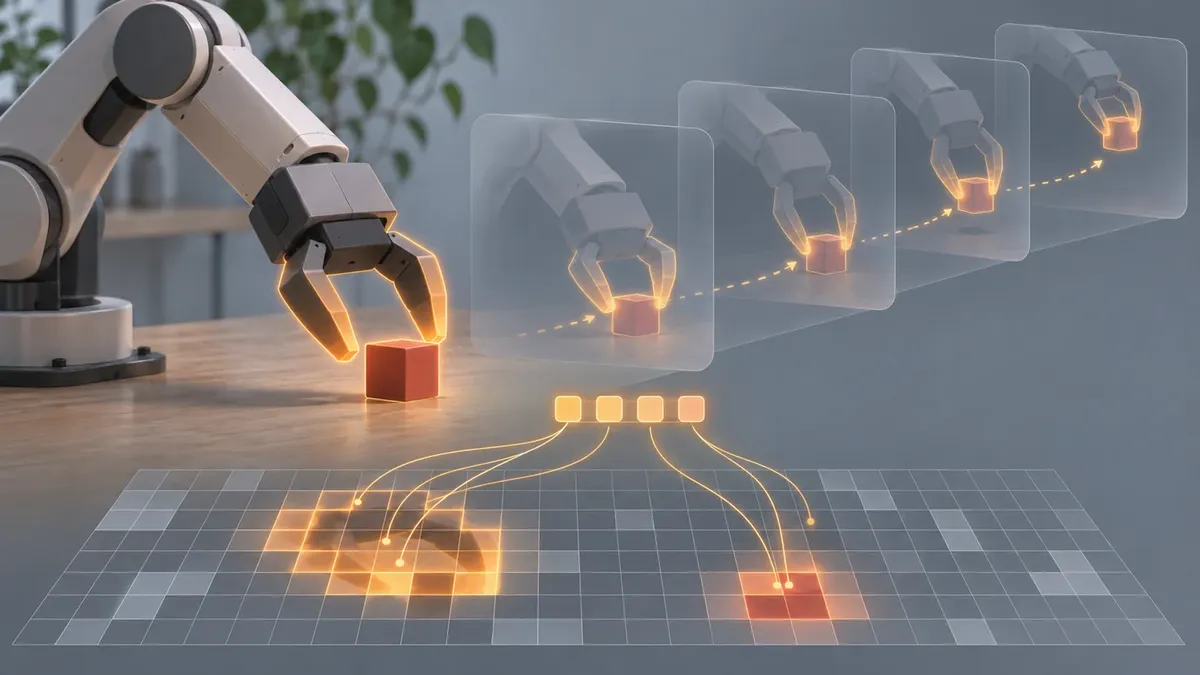
World-action models imagine future scenes while planning robot actions, but repeatedly processing every visual token can be costly. Sparse-WAM uses attention from action predictions to select which parts of those imagined scenes to compute in detail.
World-action models (WAMs) try to predict both what a robot should do and how the scene may change as it acts. That combination can help connect visual understanding to control, but it can also be computationally expensive: during iterative denoising, the model repeatedly processes many tokens representing future video frames. Could it spend less effort on regions that matter less for its actions, without substantially harming task performance?
A paper by Xinling Xie and colleagues proposes Sparse-WAM, a method for doing that. The method is described as training-free: Sparse-WAM itself does not require additional training to select tokens and run sparsely. That does not mean every evaluated backbone was used without fine-tuning. For the real-world experiments, the researchers fine-tuned FastWAM-Joint on their collected task data. The work is an arXiv preprint, not evidence of peer-reviewed validation.
Selecting imagined regions
The researchers focus on attention: a mechanism that lets parts of a model’s representation draw information from other parts. In the WAMs studied, action tokens can attend to tokens representing predicted future frames. The team examined where this action-to-future attention was concentrated and how it changed during denoising.
They report substantial overlap in attention patterns between consecutive denoising steps, even though the future representations themselves continued to change. Attention also varied from one future frame to another. This suggests two useful ideas: reuse selections across nearby denoising steps, but allow different frames to retain different spatial regions.
Sparse-WAM applies both. It retains frame-specific “core” tokens associated with action-relevant regions, alongside shared spatial anchors intended to preserve context that matters across frames. The method keeps all observation and action tokens; it sparsifies computation over future-frame tokens instead.
A companion execution engine, called Pilot, aims to keep the selection process from eating up the savings. It scores attention during an existing full-computation step rather than adding a separate model pass, then reuses token selections and related information across denoising steps. The omitted visual tokens are not simply removed from the sampling process: their updates use cached predictions, while action predictions are recomputed at each step.
What the tests found
The paper evaluates three WAM configurations: FastWAM-Joint and two Cosmos 3 variants. Tests use the LIBERO and RoboLab-120 simulation benchmarks, a perturbed version of LIBERO called LIBERO-Plus, and three real-world manipulation tasks on an AgileX Cobot Magic platform. Timing tests were conducted on an NVIDIA RTX 4090, with reported speedups measured against dense eager inference unless otherwise stated.
On LIBERO, Sparse-WAM achieved about 1.98 times the inference speed and an average success rate of 98.45%, compared with 98.75% for dense inference. On RoboLab-120, reported speedups were about 1.85 times for Cosmos 3 Edge and 1.81 times for Cosmos 3 Nano Policy. Average success rates were 23.00% versus 22.90% for dense inference on Edge, and 35.50% versus 36.75% on Nano. Success did not move in the same direction for every model and benchmark; the method does not guarantee unchanged performance.
In the real-world tests, the reported average success rate was 75.00% with Sparse-WAM and 77.78% with dense FastWAM-Joint, while inference was about 2.08 times faster. The three tasks were object packing, cup stacking, and battery assembly. These results cover a limited set of tasks and a particular robot setup—not broad deployment across robots or environments.
There is also a clear speed–performance trade-off. In a pruning-ratio experiment on Cosmos 3 Nano, more aggressive pruning increased speed but reduced success. On LIBERO-Plus, the authors report that environmental perturbations can make token rankings less reliable, and that more frequent full refreshes can improve success while reducing acceleration. Attention is therefore a proxy for relevance in these tests, not a guarantee that every retained region is essential or every discarded one unimportant.
What remains uncertain
The authors identify several limits: evaluation covered three WAMs, and inference benchmarks used an RTX 4090. They call for tests on more model architectures and other hardware, including resource-constrained devices, and for token selection that adapts better to changing conditions. Faster inference on one GPU does not, by itself, establish lower energy use, safe real-time control, or better outcomes in everyday settings.
Overall, Sparse-WAM offers a targeted way to reduce repeated computation in imagined futures by using action-related attention. Its benchmark results suggest faster inference while keeping success close to the dense baseline in several tested settings. How well that balance carries over to other robots, models, and hardware remains an open question. The findings described here come from an arXiv preprint and should be treated as preliminary.
- robotics
- world-action models
- robot inference
- sparse computation
- attention
- robot manipulation
Reviewed cross-references
These connections were reviewed by a model, not independently fact-checked by a human. Similarity does not imply agreement; consult the original papers and the evidence below.
A smarter cache could help robot models act faster
Supporting evidence: Both papers report that training-free methods can reduce inference costs in evaluated world-action models while largely preserving task success: Sparse-WAM reports roughly 1.8–2.0× speedups, and ReActWAM reports 1.41–5.44× GPU speedups with minimal success-rate degradation. These results support that bounded observation, but the methods, models, benchmarks, and hardware differ, so they are not a direct comparison.
Model review: · openai-codex/gpt-6-luna
Evidence and provenance
Selected excerpts, not complete papers. PDF extraction can omit figures or damage equations, tables and reading order; sources may be preprints.
2609.38984v2 — Original paper
Excerpt reference:
static/papers/2609.38984v2.md:13-68
Basis: Paper text
Source SHA-256:16974d72796c617109ab8a56a2041eb9ed5fd491583e66b6d70c6d190bb2e2f82611.27372v1 — Original paper
Excerpt reference:
static/papers/2611.27372v1.md:13-87
Basis: Paper text
Source SHA-256:54bd69e8e8e3dad1c4678fc3a3161841b6a207180a18790f21134b6f51651b58
Related reading
Automatically matched by shared topic keywords. These links do not imply that the sources agree or establish a consensus.
A smarter cache could help robot models act faster
Source published
Shared keywords: robot inference, robot manipulation, world action models
How MAWAM imagines teamwork for robots
Source published
Shared keywords: robot manipulation, world action models
A Robot’s World Model Built from Spikes and Keypoints
Source published
Shared keywords: robot manipulation, world action models
Can a Robot Learn a New Task by Watching One Video?
Source published
Shared keywords: robot manipulation, world action models
DexWAC: Teaching robots to act, predict and evaluate
Source published
Shared keywords: robot manipulation, world action models