TRANSMISSION // 2609.38316v2
Can the Sun test dark matter behind LZ’s unusual recoil?
Source published
A theoretical study uses solar capture and IceCube’s neutrino limits to test electroweak dark matter models proposed to explain an unusually energetic recoil reported by LZ. The constraints depend on the particle model and assumed Galactic dark matter speeds; a faster-moving tail can change which models remain viable.
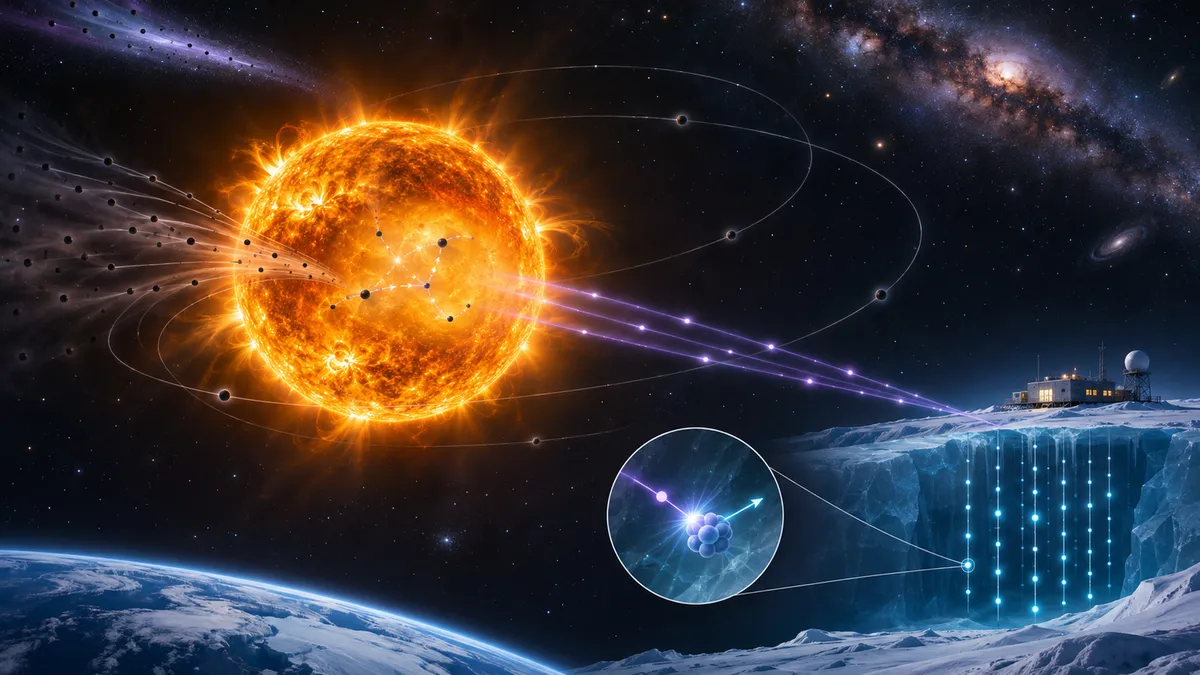
A single high-energy nuclear recoil reported by the LZ dark matter experiment has prompted several possible explanations, including particles that scatter by changing into a slightly heavier state. A new preprint asks whether such particles could also be captured by the Sun, and whether their annihilation there would produce neutrinos detectable by IceCube.
Dark matter has not been directly identified. One well-studied possibility is a particle that interacts through the electroweak force, which also governs familiar particles such as W and Z bosons. In some models, dark matter can scatter off a nucleus only by becoming a heavier partner. The energy needed for that transition depends on a small mass difference, called the splitting, δ.
That threshold can limit terrestrial direct-detection searches, particularly searches using xenon nuclei: if the splitting is too large, a halo particle may not have enough energy to trigger the transition. The Sun’s gravity accelerates incoming dark matter, potentially allowing scattering at splittings beyond the reach of terrestrial detectors. A particle that loses enough energy can become bound to the Sun. What happens next depends on the model: captured particles can lose more energy and move inward, but in some cases their orbital evolution stalls before they reach the solar core. If captured particles annihilate, the resulting processes can produce high-energy neutrinos, which IceCube searches for.
What the researchers calculated
Juan P. Luengas, Maxim Pospelov and Harikrishnan Ramani extend earlier solar-capture calculations for Higgsino dark matter to a wider range of electroweak multiplets—particle families with different electroweak properties. They study both fermionic and scalar candidates, calculating solar capture, subsequent energy loss and annihilation, and the implications for a neutrino signal.
The authors compare their predicted solar signal with IceCube limits. They also examine how the models fit the single 248-keV nuclear recoil reported by LZ. For this comparison, they consider two assumptions about dark matter speeds near the Solar System: the Standard Halo Model and an alternative with an enhanced high-speed tail associated with the Large Magellanic Cloud (LMC). The paper treats the LZ event as a possible signal to test, not as proof of a dark matter detection.
Solar limits and a halo-dependent interpretation
For higher-representation multiplets, the authors report that IceCube constrains the splitting to roughly 350 keV or greater across dark matter masses up to 100 TeV. The precise bounds vary with mass and model details. Doublets require separate treatment: their energy loss and capture-to-annihilation evolution can depend strongly on uncertain loop-induced elastic scattering. In particular, some captured populations may not reach thermalization in the Sun within its lifetime.
Assuming thermal freeze-out—a standard early-universe process for setting the dark matter abundance—and Standard Halo Model speeds, the authors find that most electroweak dark matter models are disfavoured as explanations of the LZ event. This is not a blanket exclusion: the paper identifies exceptions among very high-representation multiplets, and the doublets have distinct constraints.
The alternative halo model changes the comparison. An enhanced high-speed tail can raise the splitting preferred by the LZ recoil above the solar bounds for many multiplets, leaving more possibilities open. In the authors’ analysis, the solar capture bound changes little between these halo assumptions because capture is mainly sensitive to the slower part of the velocity distribution. The assumed local dark matter speeds therefore matter especially when interpreting the LZ event.
What the result does—and does not—show
These are model-based constraints, not a dark matter detection or evidence that dark matter caused the LZ event. The conclusions depend on assumptions about the dark matter abundance, velocity distribution, particle interactions and evolution inside the Sun. The doublet results are particularly sensitive to how loop-induced scattering is treated. For scalar candidates, a tree-level Higgs interaction, if present, could also strengthen the solar constraint.
This work is a theoretical preprint on arXiv. The evidence available here does not establish its peer-review status, so its conclusions are best understood as results of the authors’ analysis rather than settled consensus. Further observations from LZ and neutrino telescopes could test parts of the picture, while better knowledge of the Galactic high-speed tail could refine comparisons between solar bounds and direct-detection signals.
- dark matter
- electroweak WIMPs
- solar capture
- IceCube
- LZ
- inelastic scattering
- Large Magellanic Cloud
Related reading
Automatically matched by shared topic keywords. These links do not imply that the sources agree or establish a consensus.
Could dark matter’s cosmic history shape a rare LZ recoil?
Source published
Shared keywords: dark matter, inelastic scattering
Electron signals could extend LZ’s search for lightweight dark matter
Source published
Shared keywords: dark matter
Neutrino flavor changes could reshape tests of dark matter interactions
Source published
Shared keywords: dark matter
Cosmic-ray boosts sharpen model-dependent limits on lightweight dark matter
Source published
Shared keywords: dark matter
A close galactic encounter could bend the Large Magellanic Cloud’s bar
Source published
Shared keywords: large magellanic cloud