TRANSMISSION // 2609.37128v2
How AI agents turn successes and failures into reusable skills
Source published
SkillCome compares multiple attempts at the same task and stores patterns across tasks to revise an AI agent’s written instructions. Its reported benchmark gains are promising, but some results depend on evaluation quirks.
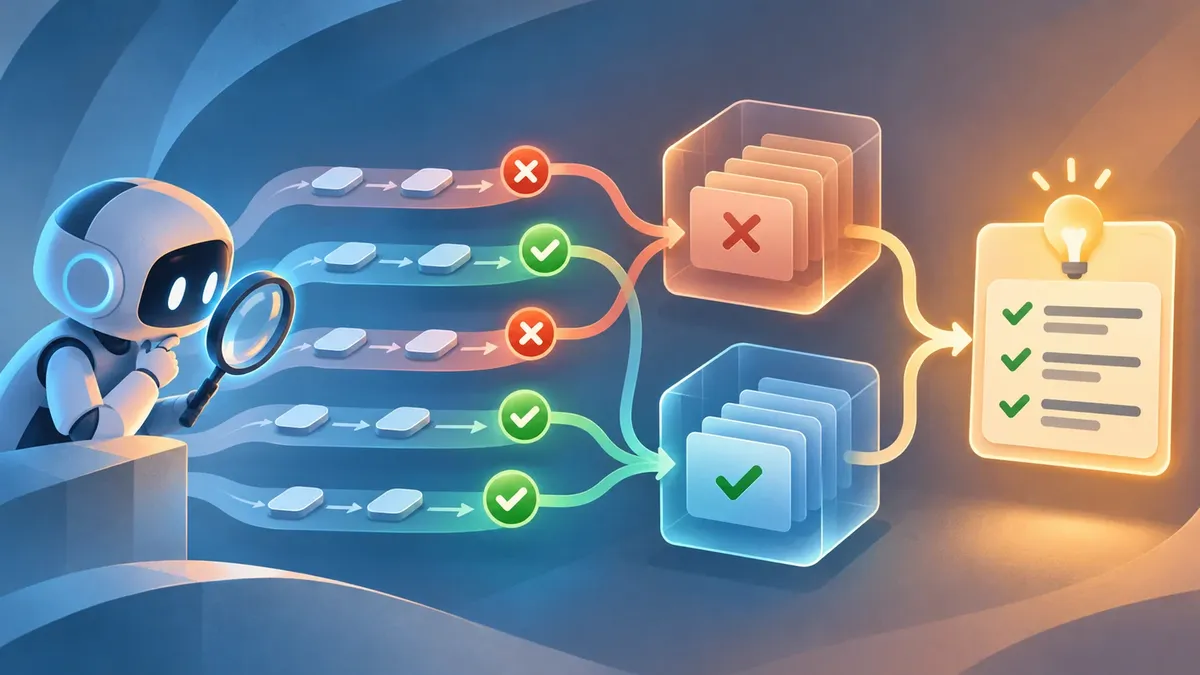
An AI agent can fail for a small procedural reason: deleting spreadsheet rows in the wrong order, for example, can shift row numbers and cause later deletions to hit the wrong places. A new preprint proposes a way to help agents learn such lessons from several attempts, rather than trying to infer a fix from one success or failure alone.
Learning from more than one attempt
Many AI agents use written “skills”: instructions and procedures supplied alongside a task. Researchers are exploring ways to update those skills using the agent’s own experience. The challenge is that a single attempt can be hard to interpret. A failed run may contain many actions, and it is not always clear which one caused the failure. A successful run can be just as ambiguous: which parts should become reusable advice?
In the preprint SkillCome: Group Contrast Skill Optimization with Dual Memory, Haolin Li and colleagues propose comparing several attempts at the same question. Their central idea is straightforward: when some attempts succeed and others fail, the successful attempts provide concrete examples of what the agent did differently.
The paper illustrates this with spreadsheet editing. To delete rows immediately above every occurrence of a marker, an agent should work from the bottom of the sheet upward. Deleting rows near the top changes the positions of rows below, making the original row numbers unreliable. The authors show how contrasting a successful script with a failed one can produce a practical skill instruction about deletion order.
How SkillCome works
The system keeps the agent’s model weights fixed. Instead, it revises an external skill document. One model, the “target,” performs tasks using the current skill; an “optimizer” examines the resulting attempts and proposes edits. The two roles may use the same or different language models.
For each training question, SkillCome generates multiple attempts under the same skill. The paper’s default is eight attempts per question. A task-specific evaluator labels each attempt successful or unsuccessful. When a group includes both outcomes, the optimizer compares them, looking for differences in actions or procedures that might explain the outcomes. It also examines successful and failed attempts separately, so groups without a mix can still contribute to ordinary success or failure reflection.
The method adds two stores of concise patterns, which the paper calls dual memory. Failure memory records recurring problems; contrast memory holds lessons drawn from successful-versus-failed comparisons. As new questions are processed, a pattern can gain support from different question groups. The optimizer uses these records when suggesting later edits, rather than treating each batch as wholly new evidence. Candidate skill changes are tested on a validation set and kept only if the measured score improves.
What the authors report
The authors evaluate SkillCome on six benchmarks covering question answering, mathematical reasoning, document and spreadsheet tasks, and an interactive household simulation. They test five target models, using either the target itself or a stronger model as the optimizer. The reported comparisons include no skill, a starting skill, and several other skill-evolution methods.
Across the main results table, SkillCome has the highest reported score in 26 model–benchmark combinations. The authors report an average improvement of up to 5.69 points over the next-best method, SkillOpt, and gains of up to 27.23 points over no skill for some model settings. These are benchmark results, not evidence that every agent will improve by the same amount in everyday use.
A component-removal test provides evidence that both parts may matter: removing memory from SkillCome lowered results in all the tested pairs in that ablation, while adding memory to a different method produced mixed results. The authors also report some transfer of learned skills to related models or datasets. Such transfer was not uniform; for example, a model-specific formatting correction did not automatically transfer to a model with a different formatting problem.
Limits and open questions
The results depend on the chosen tasks, models, evaluators, and training setup. Most benchmark test sets are relatively small, and the paper says several were evaluated over four runs to reduce the effect of variation; SearchQA was evaluated once. The study does not establish that the same gains will hold in open-ended real-world settings.
One result deserves particular care. On the LiveMath benchmark, some questions contain a “meta-option” that is labeled correct whenever it appears. The authors found that one model’s learned skill often told it to select this option without solving the underlying math. This raised benchmark accuracy, but the paper explicitly warns that it should not be interpreted as an equivalent improvement in mathematical reasoning. It is a useful example of how a system can learn a test-set pattern rather than the broader ability researchers might hope to measure.
SkillCome is described in a preprint, which may not have undergone peer review. The paper reports that code is available, but independent reproduction and evaluation would help establish how robust the results are. Its experiments suggest that comparing multiple outcomes and accumulating evidence can help refine written agent skills; they do not settle how reliably those lessons generalize beyond the tested conditions.
- AI agents
- large language models
- agent skills
- skill evolution
- AI benchmarks
- machine learning
Reviewed cross-references
These connections were reviewed by a model, not independently fact-checked by a human. Similarity does not imply agreement; consult the original papers and the evidence below.
Teaching AI agents to patch their skills with code
Shared method: Both papers evolve reusable agent skills using execution trajectories: SkillCome contrasts successful and failed rollouts and uses memory to guide revisions, while PASE distills experience across trajectories into patches to skill documents and associated programs. Their update mechanisms differ, so this is a connection in trajectory-driven skill evolution, not evidence that either method outperforms the other.
Model review: · openai-codex/gpt-6-luna
Evidence and provenance
Selected excerpts, not complete papers. PDF extraction can omit figures or damage equations, tables and reading order; sources may be preprints.
2609.37128v2 — Original paper
Excerpt reference:
static/papers/2609.37128v2.md:138-181
Basis: Paper text
Source SHA-256:afb95ccb0d96158f93b525224f316a78e3da2e00b74b9fa6d807166012157ee72611.14019v1 — Original paper
Excerpt reference:
static/papers/2611.14019v1.md:255-378
Basis: Paper text
Source SHA-256:455552bdd02c90fe15a1397363c2bf21a67746046f295d403c6734a0267e22d9
Related reading
Automatically matched by shared topic keywords. These links do not imply that the sources agree or establish a consensus.
When AI Skills Learn from the Tools They Use
Source published
Shared keywords: agent skills, ai agents, ai benchmarks, skill evolution
Teaching AI agents to patch their skills with code
Source published
Shared keywords: agent skills, ai agents, large language models
How SkillBoost aims to limit AI skill overfitting
Source published
Shared keywords: agent skills, ai agents, large language models
Can AI solver skills transfer between optimization problems?
Source published
Shared keywords: ai agents, large language models, skill evolution
MetaSkill gives AI agents a reusable playbook for using skills
Source published
Shared keywords: agent skills, ai agents, large language models