TRANSMISSION // 2609.37024v2
A language-based bridge between genes and neuron activity
Source published
LangPatch uses paired neuron measurements and shared text embeddings to connect gene expression with electrophysiology. Its abstract reports stronger prediction and cross-modal alignment than evaluated methods, while leaving important details unavailable here.
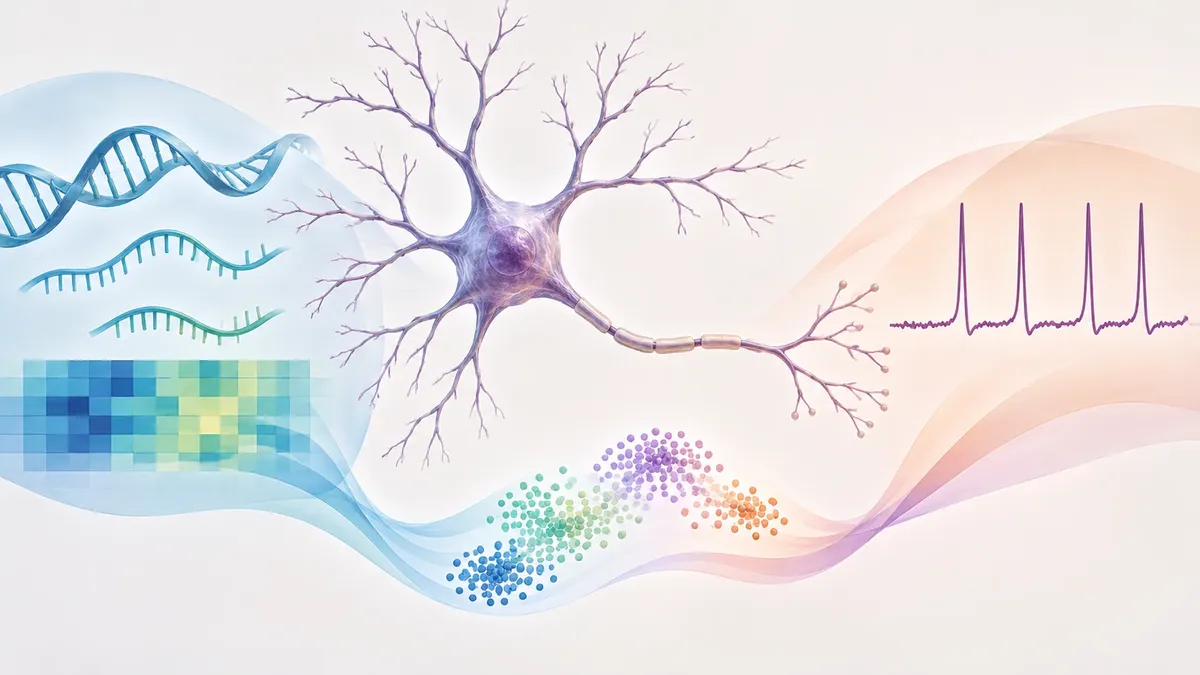
A neuron’s genes and electrical behavior describe different sides of its biology. A new preprint asks whether language-model representations can help connect them—and reports promising results across mouse and human datasets.
Connecting two views of a neuron
A neuron can be described by the genes it expresses and by how it behaves electrically. These measurements offer complementary clues about cell identity and function, but combining them is a challenge: gene expression is molecular data, while electrophysiology records properties such as a cell’s electrical responses.
The study introduces LangPatch, a machine-learning framework designed to link the two. It uses Patch-seq data, which pairs gene-expression and intrinsic electrophysiology measurements from the same neuron. The researchers’ central question is whether a language-based representation can help a model translate between these data types and generalize across datasets.
Turning measurements into a shared representation
LangPatch starts with pretrained representations from GenePT, a model for gene-related information. It also turns electrophysiological profiles into verbal descriptions. A frozen text encoder embeds both the gene descriptions and those verbalized profiles. A context adapter and projection modules then connect the representations, and paired contrastive learning trains the model to bring corresponding molecular and electrical measurements into alignment.
In plain terms, the method gives the two kinds of measurements a shared language-based interface. Because the training data pairs both measurements from the same cells, the model can learn which molecular and electrical patterns go together.
What the abstract reports
The authors evaluated LangPatch across mouse visual cortex, mouse motor cortex, and human cortex cohorts. They report that it achieved the highest mean transcriptome-to-electrophysiology prediction correlation among the foundation-model and representation-learning methods they evaluated. The abstract also says it outperformed other baselines on most of the tested endpoints for predicting transcriptomic family, cell type, cortical layer, and marker-gene expression from electrophysiology.
For held-out cross-modal alignment in the two mouse cohorts, the reported FOSCTTM scores were 0.107 and 0.135. The abstract compares these with 0.208 and 0.222 for JAMIE, an existing Patch-seq cross-modal imputation method. These figures are reported results for the study’s evaluations; they should not be read as guarantees of performance on other data.
The authors also report transfer across brain areas, laboratories, and species. A model trained on mouse visual cortex retained approximately 70% of its correlation when predicting electrophysiology in motor cortex and 47% in human cortex. A model trained on human cortex retained 63% when predicting mouse electrophysiology. The abstract says the method also worked with electrophysiological features from another laboratory without retraining.
Promising, but not a settled result
These findings suggest that a shared language-based representation may be useful for relating molecular and functional descriptions of neurons. They do not establish that language itself explains the biological relationship, or that the approach will work equally well for all brain regions, laboratories, or species. Prediction and alignment are measures of model performance, not evidence that one type of measurement causes the other.
There are also limits to what can be concluded from the available source. This account is based on the paper’s abstract, not a full examination of its methods, cohort sizes, statistical uncertainty, or detailed comparisons. The source is an arXiv preprint, and its peer-review status is not established here. The abstract describes the work as a building block for future multimodal neuroscience models; further scrutiny and replication would help show how broadly the results hold.
- LangPatch
- Patch-seq
- transcriptomics
- electrophysiology
- neuroscience
- contrastive learning
- foundation models
Reviewed cross-references
These connections were reviewed by a model, not independently fact-checked by a human. Similarity does not imply agreement; consult the original papers and the evidence below.
BrainBind compares EEG and fMRI video retrieval—and exposes limits on unseen episodes
Shared method: Both studies use contrastive learning to align paired inputs in a shared embedding space: LangPatch aligns Patch-seq transcriptomes with electrophysiology, while BrainBind maps synchronized EEG and fMRI to video embeddings. The modalities and evaluation tasks differ, so this is a methodological connection, not evidence that one study validates the other.
Model review: · openai-codex/gpt-6-luna
Evidence and provenance
Selected excerpts, not complete papers. PDF extraction can omit figures or damage equations, tables and reading order; sources may be preprints.
2609.37024v2 — Original paper
Excerpt reference:
static/papers/2609.37024v2.md:158-260
Basis: Paper text
Source SHA-256:d9dbd16e58e2ebd8c41a4f6022963ed21e8215aafb647e6c379bbbf7345c2c2c2611.05581v1 — Original paper
Excerpt reference:
static/papers/2611.05581v1.md:372-415
Basis: Paper text
Source SHA-256:c5613919778ae956dba34be6427f5af8531f130b1acf8362814765d02cdc8db0
Related reading
Automatically matched by shared topic keywords. These links do not imply that the sources agree or establish a consensus.
FusionCLIP learns from paired plasma videos and diagnostic signals
Source published
Shared keywords: contrastive learning
Can one AI encoder handle pictures, video and sound?
Source published
Shared keywords: contrastive learning
AI moral choices shift when models take a role in a video game
Source published
Shared keywords: foundation models
A 360-degree image can map a room—but not every surface
Source published
Shared keywords: foundation models
Do AI Models of Brain Signals Find the Same Patterns?
Source published
Shared keywords: foundation models