TRANSMISSION // 2609.36630v2
Where Does an AI Agent’s Learning Persist?
Source published
An abstract-only survey proposes a framework for studying how knowledge transfers between AI agents and where it persists: in models, artifacts, or harnesses. It also reviews ways to assess retention, causal attribution, and usefulness without continued teacher support. The supplied evidence describes the survey’s scope, not comparative results showing which strategies work best.
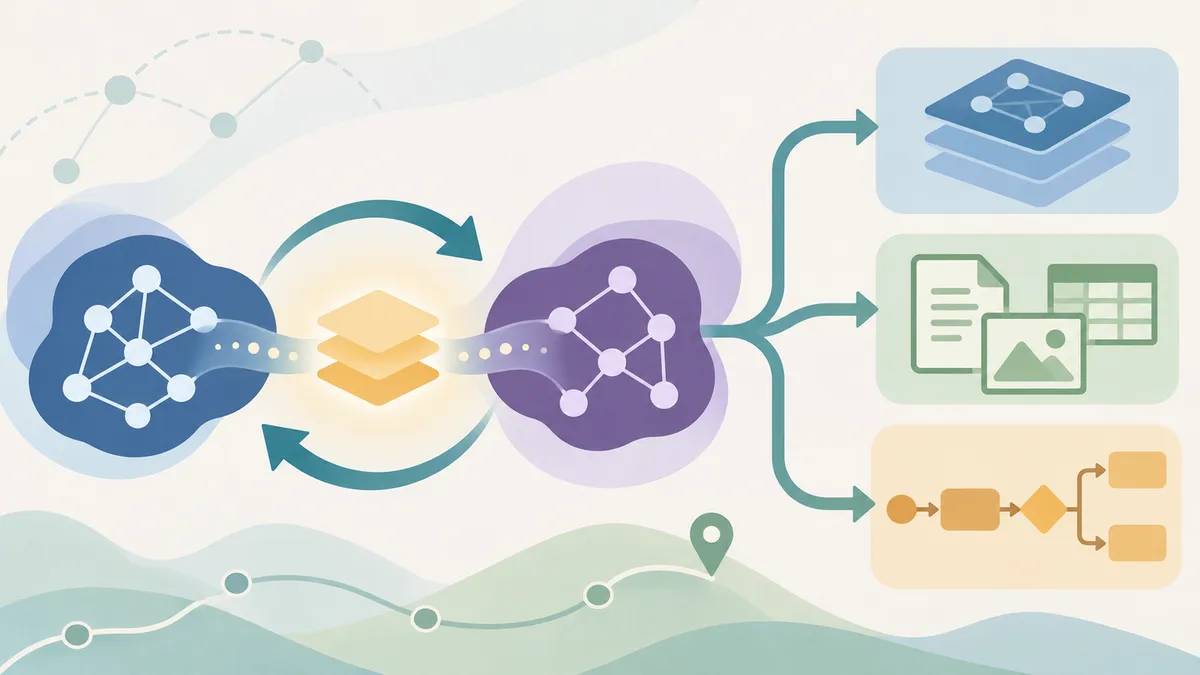
When one AI agent learns from another, what is transferred—and where does that knowledge remain? A survey proposes a framework for asking these questions across models, artifacts, and harnesses.
Looking beyond the model
Knowledge distillation uses a teacher-student framework to transfer capabilities at reduced cost. It has been widely studied for large language models (LLMs). But agents can do more than generate a response: they may solve tasks through sustained, closed-loop activity, where actions and subsequent results feed into the ongoing process. The authors argue that studying transfer only at the model level misses other possible places for knowledge to persist.
In A Comprehensive Survey of Agent Distillation across Models, Artifacts, and Harnesses, the authors define agent distillation as persistent knowledge transfer between teacher and student agents. They distinguish experience used during transfer from knowledge retained for reuse, then organize knowledge by its substrate—the category in which it persists: models, artifacts, or harnesses.
The abstract names these categories but does not define their contents in detail. It therefore supports a broad map, not specific claims about what belongs in each category or how a particular transfer method works.
A framework, not a contest of methods
The survey says it analyzes transfer paths across these substrates, including hybrid strategies that combine them. It also reviews benchmarks and evaluation protocols addressing three questions: whether transferred knowledge is retained; whether an improvement can be causally attributed to the transfer; and whether the agent remains useful in deployment without further teacher support.
These are the survey’s topics, not reported findings that particular approaches succeed on those tests. The abstract provides no benchmark scores, head-to-head comparisons, or evidence that one substrate is more effective than another. Its contribution, as presented there, is a unified way to organize and examine agent knowledge transfer—not a demonstration that agents can continually improve or that any strategy is best.
What the abstract leaves open
The authors say existing surveys have largely examined model distillation and agent-system design separately, limiting comparison of transfer strategies across agent components. Their proposed taxonomy aims to provide a shared basis for such comparisons and for developing efficient, adaptable agents.
This account is limited to the paper’s abstract. The full survey’s detailed taxonomy, review methods, cited evidence, and analysis cannot be assessed from the supplied material. The source is an arXiv preprint; the evidence provided does not establish peer review. For now, the framework offers useful questions: what knowledge is transferred, where does it persist, and can the student use it without the teacher? The abstract alone cannot answer which approaches perform best.
- AI agents
- knowledge distillation
- agent distillation
- language models
- evaluation
- preprint
Reviewed cross-references
These connections were reviewed by a model, not independently fact-checked by a human. Similarity does not imply agreement; consult the original papers and the evidence below.
Better AI agent instructions start with studying the agent
Supporting evidence: The survey classifies reusable artifacts as a substrate for persistent agent knowledge; SAT provides a specific example, reporting that saved skill libraries retained gains after the teacher left. This supports the bounded claim that skills can preserve useful guidance for later tasks, not that all artifacts do so or that the survey independently tested SAT.
Model review: · openai-codex/gpt-6-luna
Evidence and provenance
Selected excerpts, not complete papers. PDF extraction can omit figures or damage equations, tables and reading order; sources may be preprints.
2609.36630v2 — Original paper
Excerpt reference:
static/papers/2609.36630v2.md:1202-1313
Basis: Paper text
Source SHA-256:8e5f26485f0e2421303d6b80c08ee6f7fd95398f90ac96311f39c018024469d22611.13144v1 — Original paper
Excerpt reference:
static/papers/2611.13144v1.md:74-122
Basis: Paper text
Source SHA-256:3fe648a70906da78780e8fe499c7a7d07bd181256908c4f260a2c73efda89ee5
Related reading
Automatically matched by shared topic keywords. These links do not imply that the sources agree or establish a consensus.
AI agents may not need every reasoning trace their teachers produce
Source published
Shared keywords: ai agents, knowledge distillation, language models
Training-time coaching helps compressed AI agents recover lost accuracy
Source published
Shared keywords: ai agents, knowledge distillation, language models
Turning a mixture of experts into a dense language model
Source published
Shared keywords: knowledge distillation, language models
Teaching diffusion models to do more with fewer decoding steps
Source published
Shared keywords: knowledge distillation, language models
Compressing Small Language Models: When Combining Techniques Helps—and When It Fails
Source published
Shared keywords: knowledge distillation