TRANSMISSION // 2609.35980v3
A Radio Transient Reveals an Accreting White Dwarf
Source published
ASKAP J1448−68 is an accreting white-dwarf binary, new observations suggest. Its radio pulses may track the orbit, but the timing link and the system’s subtype remain uncertain.
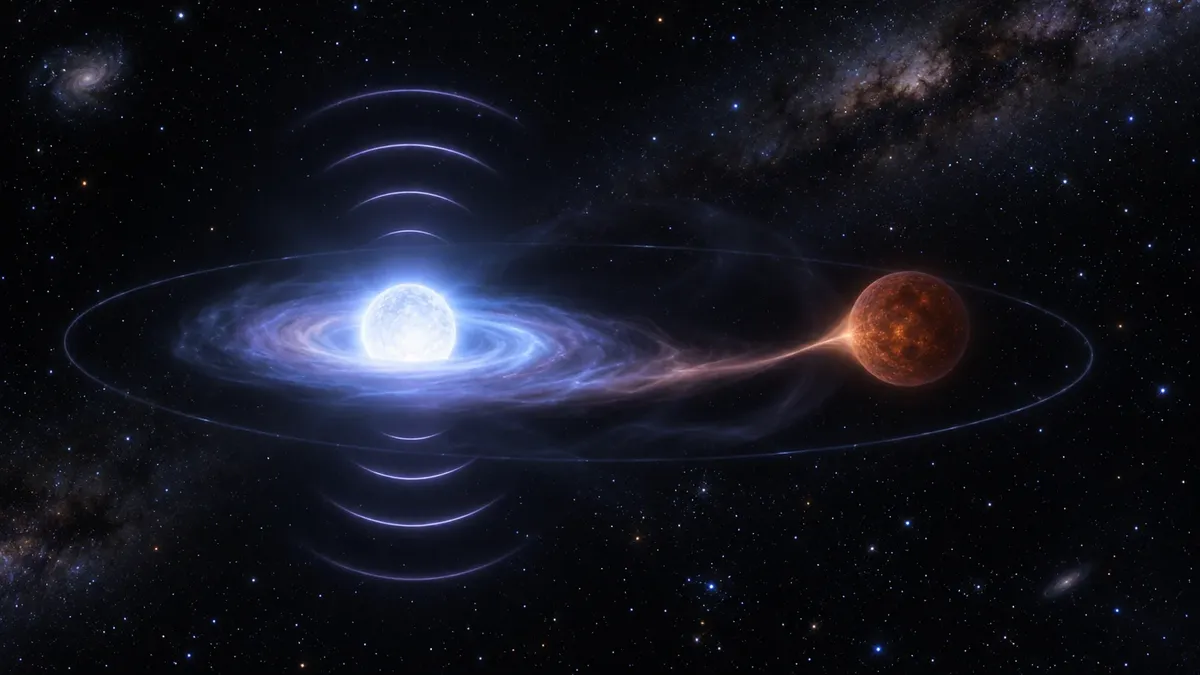
Long-period radio transients produce bright pulses on timescales of minutes to hours, but their engines remain a puzzle. New observations identify ASKAP J1448−68 as a white dwarf drawing material from a low-mass companion—and raise, without proving, the possibility that its radio rhythm is tied to the pair’s orbit.
Long-period radio transients (LPTs) produce bright, highly polarized radio pulses that recur over minutes to hours. Their slow rhythms do not fit the usual picture of pulsars, and astronomers are still working out what powers them. Leading ideas include slowly rotating magnetars and white dwarfs interacting magnetically with a companion.
A new study examines ASKAP J1448−68. The authors conclude that it is a cataclysmic variable: a close binary in which a white dwarf pulls material from a low-mass companion. This adds evidence that some LPTs are associated with interacting white-dwarf binaries. It does not, by itself, explain how the radio pulses are produced.
Reading the system’s changing light
To investigate the source, researchers combined new optical and infrared observations with earlier measurements. They used the Magellan Baade telescope to take optical spectra, which separate light by wavelength and reveal emission lines from gas. Repeated exposures let the team track shifts in those lines. Optical images taken over time with Gemini South were used to measure brightness changes, while infrared observations helped constrain the companion.
The spectra show hydrogen and helium emission lines, indicating energetic gas. The lines shift in a pattern consistent with orbital motion. A model of those shifts gives an orbital period of about 98.6 minutes, consistent within the reported uncertainty with the previously measured radio pulse period of about 93.9 minutes.
The authors infer that the shifting lines most likely arise in an extended stream of material flowing from the companion toward the white dwarf. The measured motion is too large for the lines to come from the white dwarf itself or a symmetric disk around it; their width also argues against an origin solely on the companion’s irradiated surface. This supports an accreting binary, but the stream is an interpretation of the spectra, not a directly imaged feature.
A possible magnetic system, not a settled subtype
The similar optical and radio periods suggest that the radio pulses may be modulated by the orbit. They do not establish that the periods are identical. Radio timing relies on sparse observations and pulses with variable shapes; the optical and radio data were collected years apart. The authors also cannot rule out radio emission tied to a beat between the orbit and the white dwarf’s unknown spin. The available timing does not establish the orbital phase at which the pulses occur.
The system’s precise subtype is also uncertain. In a magnetic cataclysmic variable called a polar, the white dwarf’s magnetic field can channel accreting material. But ASKAP J1448−68 lacks detectable helium II emission, often seen in magnetic systems during high-accretion states. The paper therefore rules against classifying it as a high-accretion-state polar or intermediate polar; it does not show that the white dwarf lacks a magnetic field. The authors suggest a lower or intermediate accretion state as one possibility.
Optical observations show irregular brightness fluctuations at roughly the 10% level. Such flickering is associated with accretion and supports that interpretation. The observations covered only about 1.2 orbital cycles in each optical band, however, and the team found no significant periodic signal in that short time series.
Could ASKAP J1448−68 be a “period bouncer”—a cataclysmic variable that has passed its shortest orbital period and is evolving toward longer periods? Its ultraviolet-to-infrared brightness fits better with the tested model of a relatively cool white dwarf and a very low-mass, possibly substellar companion than with the tested model of an ordinary M-dwarf donor. But the system’s distance is not securely known, limiting what can be inferred about the companion. The authors say the existing photometry cannot establish a period-bouncer identity.
The broader question is how varied LPT sources are and what generates their radio pulses. This study makes a case for an accreting white-dwarf binary and shows that LPT emission can be present without evidence for a bright, high-accretion state. More radio timing, longer spectroscopic monitoring, and deeper infrared observations could clarify the orbit, magnetic behavior, and nature of the companion.
The findings are reported in a preprint, a paper shared before final journal publication. The supplied manuscript identifies itself as a 2026 preprint and includes incomplete publication-status placeholders, so its conclusions should be treated as provisional. The authors say the spectroscopic and photometric data will be available upon reasonable request. These results concern one source; they do not provide a general explanation for all long-period radio transients.
- long-period radio transients
- ASKAP J1448−68
- cataclysmic variables
- white dwarfs
- radio astronomy
- binary stars
Reviewed cross-references
These connections were reviewed by a model, not independently fact-checked by a human. Similarity does not imply agreement; consult the original papers and the evidence below.
A radio transient with a surprisingly cool companion
Supporting evidence: Mo et al. identify ASKAP J1448−68 as a cataclysmic variable, a white dwarf accreting from a low-mass companion, and Knigge et al. identify ASKAP J1745−5051 as both a long-period radio transient and a magnetic cataclysmic variable. These separate cases support the bounded conclusion that long-period radio transients can be associated with accreting white-dwarf binaries; they do not establish a shared radio-emission mechanism or how common this association is. Both papers are preprints, and the excerpts are selected.
Model review: · openai-codex/gpt-6-luna
Evidence and provenance
Selected excerpts, not complete papers. PDF extraction can omit figures or damage equations, tables and reading order; sources may be preprints.
2609.35980v3 — Original paper
Excerpt reference:
static/papers/2609.35980v3.md:15-68
Basis: Paper text
Source SHA-256:661b854bdd89423d9cd9c3427a61068766108cca18864a2570ef4a2103197c4e2606.28993v2 — Original paper
Excerpt reference:
static/papers/2606.28993v2.md:12-101
Basis: Paper text
Source SHA-256:9e7b04d46670d5b6b24d50fe909dc9b8d6af155c82dbc1f23293ad46dda42752
Related reading
Automatically matched by shared topic keywords. These links do not imply that the sources agree or establish a consensus.
Radio surveys reveal a faint signal from IX Velorum
Source published
Shared keywords: cataclysmic variables, radio astronomy, white dwarfs
Weighing a magnetic white dwarf through hot gas and a companion’s motion
Source published
Shared keywords: binary stars, white dwarfs
A radio transient with a surprisingly cool companion
Source published
Shared keywords: binary stars
Gaia Diagram Seeks Cataclysmic Binary Candidates
Source published
Shared keywords: cataclysmic variables, white dwarfs
A white dwarf’s two clocks in 47 Tuc
Source published
Shared keywords: cataclysmic variables, white dwarfs