TRANSMISSION // 2609.35969v2
A near-infrared bump may help trace galaxies’ fading star formation
Source published
Models suggest a broad feature near 1.6 micrometres may add clues about when galaxies stop forming stars—but its meaning depends strongly on how models represent aging stars.
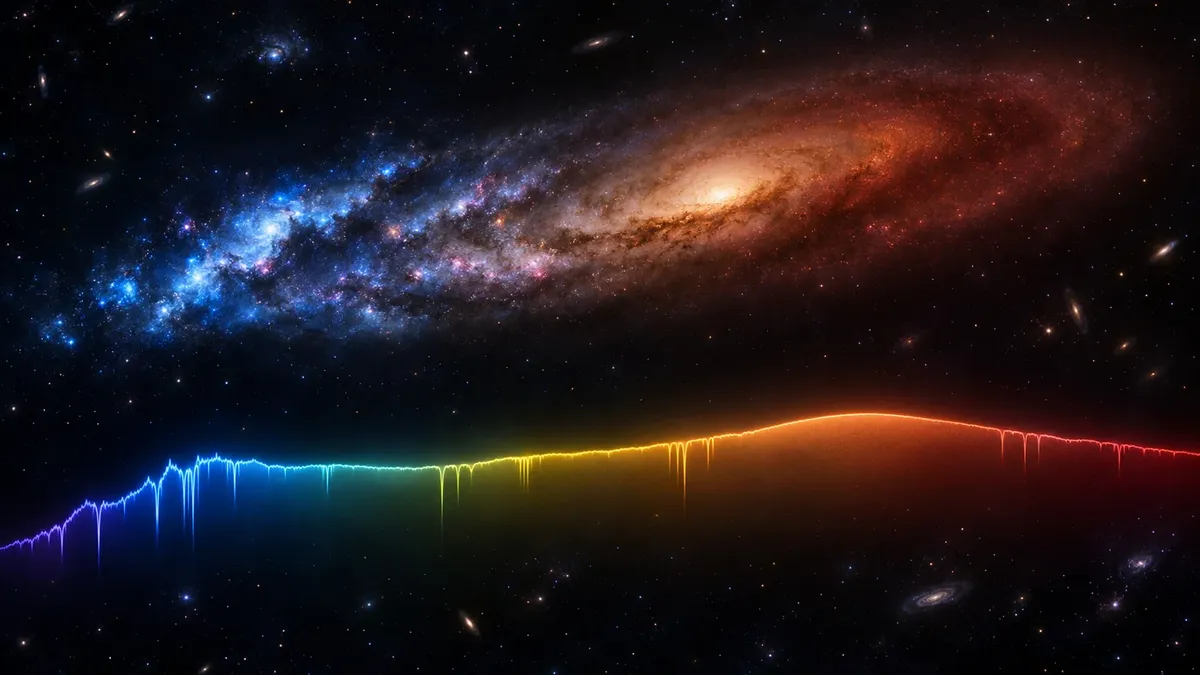
When a galaxy’s star formation declines, its changing starlight can preserve clues about how quickly that transition happened. Researchers tested whether a broad near-infrared feature—the 1.6-micrometre H⁻ bump—could add information beyond familiar optical indicators, while also revealing uncertainty in models of aging stars.
A feature with a model-dependent story
Galaxies stop making stars at different rates, and astronomers use their light to investigate when and how that happens. One established clue is the strength of the 4000-angstrom break, called D4000; another is absorption from hydrogen at Hδ. This study examines whether a broad feature around 1.6 micrometres, known as the H⁻ bump, can add a different kind of evidence.
The bump comes from a minimum in the opacity of negative hydrogen ions in cool stars’ atmospheres. Near that wavelength, light can emerge from deeper, hotter layers. The feature’s apparent strength also depends on surrounding molecular absorption and on which stars dominate a galaxy’s light.
That matters because thermally pulsing asymptotic giant branch stars, or TP-AGB stars, can contribute substantially to near-infrared light in intermediate-age populations. Models differ in how much light these stars contribute and which spectra represent them. The bump is therefore not simply a clock: it may also help test the assumptions behind stellar-population models.
Comparing models and simulated histories
The researchers compared several stellar-population model families, including models based on the empirical X-shooter Spectral Library (XSL) and calculations using Flexible Stellar Population Synthesis (FSPS). They examined how the bump changes with population age and metallicity, and compared it with D4000 and Hδ.
They also built composite populations with modeled star-formation histories that included declining star formation. In controlled FSPS experiments, they varied the TP-AGB contribution while matching the histories and metallicities. This helps isolate the effect of TP-AGB assumptions, but these simulations are not a direct record of real galaxies.
Finally, the team measured the bump and D4000 in publicly available JWST/NIRSpec spectra of 47 selected quiescent galaxies at redshifts between 1.1 and 1.8. They compared the measurements with model predictions. This selected sample is not a census of all galaxies.
A temporary signal, not a stand-alone answer
The bump varied markedly across model families. XSL-based models and some other models with substantial TP-AGB contributions produced a stronger feature at intermediate ages; E-MILES showed only weak age dependence. In FSPS tests, increasing modeled TP-AGB light strengthened the intermediate-age bump. The spectra assigned to TP-AGB stars also mattered, not just their total light.
In XSL-based simulations, the bump strengthened temporarily after rapid quenching and then weakened. In one modeled history it was strongest about 0.3 billion years after quenching began. Faster quenching produced a more pronounced signal in the tested histories. By contrast, D4000 and Hδ changed monotonically in the modeled transition. Combining the bump with these optical indicators could add information about where a population is in that transition, though interpretation depends on the model and star-formation history.
In an FSPS classification test, adding the bump improved recovery of the simulated rapid-quenching class when the assumed measurement precision was high. At 0.005-magnitude bump precision, completeness rose from about 0.40 to 0.49, and purity from about 0.61 to 0.65. These results come from the study’s simulated setup; they do not establish performance on a general population of real galaxies.
The JWST comparison is also preliminary. The measurements broadly overlapped a model configuration with empirical TP-AGB templates more than a TP-AGB-free control. This is consistent with stronger TP-AGB contributions in these systems under the models tested, but does not identify a unique TP-AGB prescription or prove that the bump reveals individual galaxies’ quenching histories.
What remains uncertain
The simulations cover a limited set of smooth or abruptly declining star-formation histories. Real galaxies can experience bursts, rejuvenation, or repeated changes. The mock classifier was trained and tested within the same model framework and did not include model mismatch or correlated measurement errors, so its gains may not carry over unchanged to observations.
Dust, nebular emission, active galactic nuclei, and emission lines near the feature could also complicate measurements. The paper reports that different JWST spectral-reduction methods can affect index measurements. Because the predicted changes in the bump are small, calibration and continuum placement matter.
The study is an arXiv preprint, so its findings should be treated as provisional, not as a settled result. The authors provide code and figure data, but larger samples and tests across more varied stellar-population models and star-formation histories are needed. For now, the H⁻ bump looks most useful as a complementary clue—and as a test of how well models describe aging stars—rather than as a stand-alone measure of when a galaxy stopped forming stars.
- galaxy quenching
- H⁻ bump
- TP-AGB stars
- JWST NIRSpec
- stellar population models
- near-infrared spectroscopy
Related reading
Automatically matched by shared topic keywords. These links do not imply that the sources agree or establish a consensus.
Five observations that could sharpen our picture of early galaxies
Source published
Shared keywords: galaxy quenching
What dust can reveal about galaxies that stopped making stars
Source published
Shared keywords: galaxy quenching
A Proposed Infrared Instrument Could Trace the Milky Way’s History
Source published
Shared keywords: near infrared spectroscopy
WASP-12 b’s Dayside Favors an Oxygen-Rich Atmosphere
Source published
Shared keywords: near infrared spectroscopy