TRANSMISSION // 2609.35149v4
Testing AI agents after deployment changes
Source published
An arXiv paper proposes checking whether agents meet explicit requirements after changes to their models, tools or user context. Three diagnostic audits illustrate why aggregate scores may miss failures.
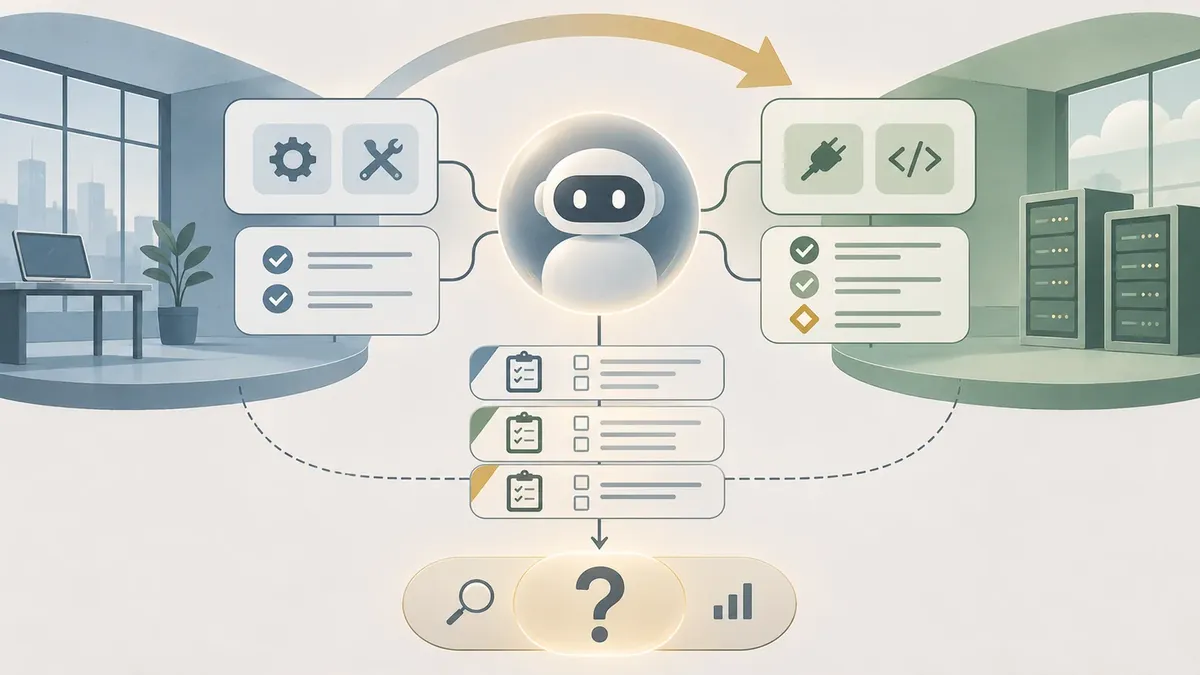
An AI agent may keep running after a deployment change yet no longer meet the needs of its new setting. The paper proposes judging readiness against explicit, versioned requirements—and uses three diagnostic audits to illustrate why a single score may not tell the whole story.
When “still running” isn’t “still working”
An agent can remain operational after a change to its model, tools or users and still lose capabilities needed in its new setting. The paper calls readiness checking agent calibration: qualifying an agent against a versioned deployment contract.
The contract specifies requirements such as basic capabilities, end-to-end reachability, technical and professional precision, and acceptance by intended users. For each requirement, a source-to-destination map records what should be preserved, changed, added or retired.
A contract and evidence
Experts supply benchmarks, positive and negative examples, annotated trajectories and cost limits. These guide revisions to prompts and context, tool calls and other harness settings, or an external compact policy, while the foundation model remains frozen. Candidate revisions are evaluated against fixed acceptance criteria using independent evidence.
The authors also propose comparing the costs of maintaining a harness with and without an external policy. Their accounting includes annotation, training, serving, review and rework. The abstract does not report a completed cost comparison.
Three diagnostic audits
The abstract describes three audits that illustrate possible blind spots; they do not establish that the proposed calibration process improves deployed agents.
On a 100-item intent task, each of two compared models solved cases the other missed. In a 60-record synthetic financial-reporting fixture, five records passed a numeric proxy but failed the reporting contract. In a target-only WebMall snapshot, quota interruptions affected 132 of 171 attempts.
The authors say these observations motivate paired reruns, checkpoint replay, and separate measurement of repaired cases and newly failed cases. The abstract does not report those follow-up measurements. Nor do the audits establish that one system is generally better or that the observed patterns occur at the same rate in real deployments.
What remains uncertain
The paper specifies controlled experiments to test whether calibration increases accepted deliveries at a given cost. The abstract does not report that this proposition has been established. It also provides too little detail to assess the audits’ representativeness or how well their findings might generalize.
This account is based on the abstract alone, so the experimental design, acceptance criteria, statistical analysis and further limitations cannot be assessed. The source is an arXiv preprint; the supplied record does not establish its review status. The framework is best read as a proposed way to define and audit agent readiness, not as proof that a particular calibration method is effective.
- AI agents
- agent calibration
- deployment change
- AI evaluation
- acceptance contracts
- arXiv
Reviewed cross-references
These connections were reviewed by a model, not independently fact-checked by a human. Similarity does not imply agreement; consult the original papers and the evidence below.
A valid JSON answer can still be wrong
Supporting evidence: Both papers distinguish a preliminary technical check from destination-level acceptance: the origin describes synthetic financial records that passed a numeric proxy but failed the reporting contract, while Shapiro et al. report task-score flags among schema-valid outputs. The comparison is bounded: their tasks and scoring procedures differ, and the latter paper says its automated flags are candidates, not human-confirmed semantic error rates.
Model review: · openai-codex/gpt-6-luna
Evidence and provenance
Selected excerpts, not complete papers. PDF extraction can omit figures or damage equations, tables and reading order; sources may be preprints.
2609.35149v4 — Original paper
Excerpt reference:
static/papers/2609.35149v4.md:13-60
Basis: Paper text
Source SHA-256:48514f76ee949549063814c570bbcb7003edb0ebda34e32b1d44dcdf0dfefaee2611.27106v1 — Original paper
Excerpt reference:
static/papers/2611.27106v1.md:1097-1148
Basis: Paper text
Source SHA-256:97eb96dc042813c09962bcb96e00c92b637d7102b76f13e805de16de17ca2d63
Can AI Build and Improve Business Agents?
Supporting evidence: Both motivate qualification using evidence beyond an agent builder’s own checks. The origin calls for independent evidence against fixed acceptance criteria; Srivastava et al. report that models often saturated their internally built evaluations yet failed held-out tasks. This is a related motivation, not a direct test of the origin’s calibration procedure, and the benchmark uses simulated business environments and its own task metrics.
Model review: · openai-codex/gpt-6-luna
Evidence and provenance
Selected excerpts, not complete papers. PDF extraction can omit figures or damage equations, tables and reading order; sources may be preprints.
2609.35149v4 — Original paper
Excerpt reference:
static/papers/2609.35149v4.md:61-110
Basis: Paper text
Source SHA-256:48514f76ee949549063814c570bbcb7003edb0ebda34e32b1d44dcdf0dfefaee2611.25360v2 — Original paper
Excerpt reference:
static/papers/2611.25360v2.md:15-94
Basis: Paper text
Source SHA-256:bdb0d832c4109955b13382ac1760d6b3c6e3b713d52d25acee5d784faeddeb92
Related reading
Automatically matched by shared topic keywords. These links do not imply that the sources agree or establish a consensus.
Can AI Build and Improve Business Agents?
Source published
Shared keywords: ai agents, ai evaluation
AI web agents often scrape despite site rules—and sometimes refuse when allowed
Source published
Shared keywords: ai agents, ai evaluation
Why AI-Agent Interventions Help—or Fail
Source published
Shared keywords: ai agents, ai evaluation
How should AI agents be tested before they run materials experiments?
Source published
Shared keywords: ai agents, ai evaluation
Can AI Agents Audit Brand Websites Reliably?
Source published
Shared keywords: ai agents, ai evaluation