TRANSMISSION // 2609.34113v3
GUI Agent Failures Cluster in Tested Tasks
Source published
GUITAR groups screens by their role in a task to identify recurring failure points, then tests whether targeted guidance helps in the evaluated mobile and web tasks.
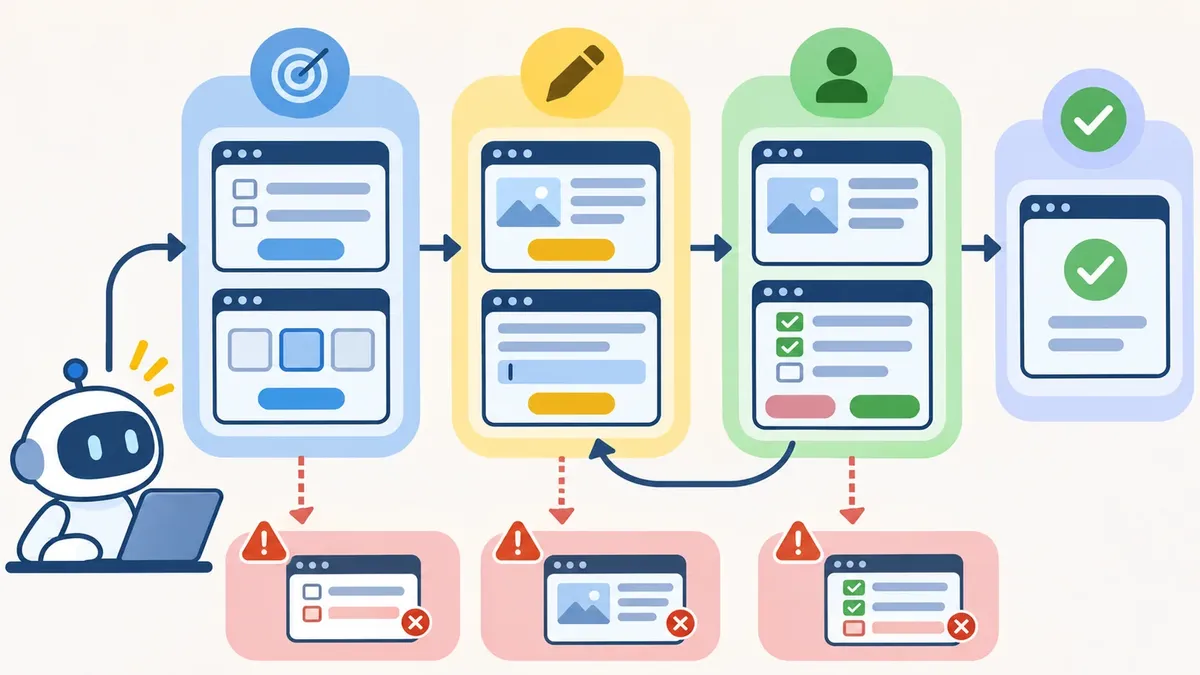
An overall score can show that an AI agent failed without revealing where it went wrong. GUITAR links screens by what they let an agent do, then looks for failure hotspots across task attempts. Its results describe a limited set of tested apps and websites—not every interface or agent.
A graphical-interface agent might handle many screens well but repeatedly stumble at one awkward search page or decision point. A single overall success score can hide that pattern, especially when common screens dominate evaluation and rarer screens receive little attention. GUITAR, a framework proposed by Shaoqing Zhang and colleagues, asks whether grouping screens by their function can make failures easier to find and address.
The central idea is to describe a screen by its role in a task, not just its appearance. Two screens that look different might serve the same function; two similar-looking screens might require different next steps. GUITAR uses the task goal, actions and trajectory context to build a State Transition Graph, or STG. Each node represents a functional state, and each directed link represents a transition between states during an interaction.
This gives researchers two ways to inspect errors. State-level analysis asks where agents tend to fail. Transition-level analysis asks which move between states is error-prone. The distinction matters: an agent could struggle with an action on a particular kind of screen, while another could reach that screen reliably but choose the wrong next step. An aggregate score can blur those patterns together.
Turning trajectories into a map
The authors tested eight GUI agents on six main tasks: three Android-app tasks from AndroidControl and three website tasks from Mind2Web. GUITAR converts interaction trajectories—sequences of screens and actions—into a shared graph. Its five-stage construction process uses vision-language models to caption screens, abstract trajectories into functional states, combine those states into a graph, reconcile differences between trajectories, and assign individual screens to graph states. The paper also reports analyses on three additional AndroidControl tasks in an appendix.
The researchers counted how failures were distributed across states, then tested whether identified bottlenecks could help improve performance. During inference, they provided targeted guidance when an agent appeared to be in a state with a high historical error rate. They compared this with guidance applied uniformly and tested guidance on trajectories held out from graph construction. Some main analyses used a manually verified graph; separate tests evaluated automatically constructed graphs.
Failures clustered in the evaluated settings
Across the main evaluation settings, 20% of states accounted for an average of 60.4% of failures. In these tasks, errors were concentrated in a relatively small portion of the interface workflow rather than spread evenly across states. The graph also allowed the researchers to inspect difficult transitions, not only screens associated with errors. This is an average across the tested settings, not a claim that all agents fail at the same points: the paper reports variation among agents and tasks.
Targeted guidance improved task success rate by an average of 2.8 percentage points in the primary experiment. Applying guidance uniformly to all states instead reduced the average score by 3.2 percentage points, according to the paper. In a three-fold test using automatically built graphs and trajectories held out from graph construction, targeted guidance produced an average gain of 1.88 percentage points across seven agents. Outcomes varied: some agent-task combinations tied or declined in the held-out evaluation.
These tests suggest that diagnosed bottlenecks can be useful for intervention, but they do not show that every failure has one simple cause. The authors report that guidance sometimes retrieved states that were not bottlenecks, that the guidance model could fail to generate useful sub-goals, and that agents did not always act correctly even when given a suitable sub-goal.
What the results do—and don’t—establish
GUITAR depends on correctly grouping screens by functional role. The authors report that the main failure rankings were generally stable when comparing automatic with manually verified graphs. Still, assigning screens can be difficult: post-hoc correction rates ranged from 0% to 25.3% across the six main tasks. Incorrect assignments could affect which states appear to be bottlenecks.
The scope is limited. The held-out test used new trajectories from the evaluated task environments; it does not establish transfer to unseen apps, websites or domains. Graphs are built offline from a fixed set of reference trajectories, so rare states absent from that data may not be represented, and interface changes may require rebuilding the graph. Guidance gains also varied across models and tasks.
The supplied source is an arXiv preprint; its reported results have not been independently established here. GUITAR offers a structured way to ask not just whether an interface agent failed, but where difficulties repeatedly arose in the tested tasks. Whether that approach remains useful in more varied, changing interfaces is an open question.
- GUI agents
- artificial intelligence
- AI evaluation
- state transition graphs
- failure diagnosis
- AndroidControl
- Mind2Web
Reviewed cross-references
These connections were reviewed by a model, not independently fact-checked by a human. Similarity does not imply agreement; consult the original papers and the evidence below.
MedUIGym tests whether AI can navigate clinical software
Supporting evidence: Both studies report that aggregate task scores can obscure actionable failure patterns: GUITAR finds failures concentrated in a minority of functional states across its tested mobile and web tasks, while MedUIGym reports frequent wrong-control or wrong-record errors in clinical EHR workflows. This supports the bounded point that finer-grained diagnosis can reveal where GUI agents fail; the environments and analyses differ, so the findings do not establish the same failure distribution.
Model review: · openai-codex/gpt-6-luna
Evidence and provenance
Selected excerpts, not complete papers. PDF extraction can omit figures or damage equations, tables and reading order; sources may be preprints.
2609.34113v3 — Original paper
Excerpt reference:
static/papers/2609.34113v3.md:477-602
Basis: Paper text
Source SHA-256:8e5287933b237af68ff1d13528f13a72842b679aaafc0f07c4418771886cc3092611.30983v1 — Original paper
Excerpt reference:
static/papers/2611.30983v1.md:1049-1098
Basis: Paper text
Source SHA-256:5a00052c42dafde457ce2a1d8029bbb98688252e023bfbe447ae3f20d3b32b8c
Related reading
Automatically matched by shared topic keywords. These links do not imply that the sources agree or establish a consensus.
Why GUI agents can be right—and still fail
Source published
Shared keywords: ai evaluation, artificial intelligence, gui agents
When a GUI agent knows what to do—but clicks the wrong thing
Source published
Shared keywords: gui agents
Teaching GUI Agents to Assemble—and Repair—3D Machines
Source published
Shared keywords: artificial intelligence
How local mistakes travel through AI teams
Source published
Shared keywords: ai evaluation
MedUIGym tests whether AI can navigate clinical software
Source published
Shared keywords: gui agents