TRANSMISSION // 2609.34047v2
Can AI recognize a building across photos and plans?
Source published
ARCH-B tests whether multimodal AI can match the same building across photographs, floor plans, elevations and other architectural images. Results vary widely by model and task.
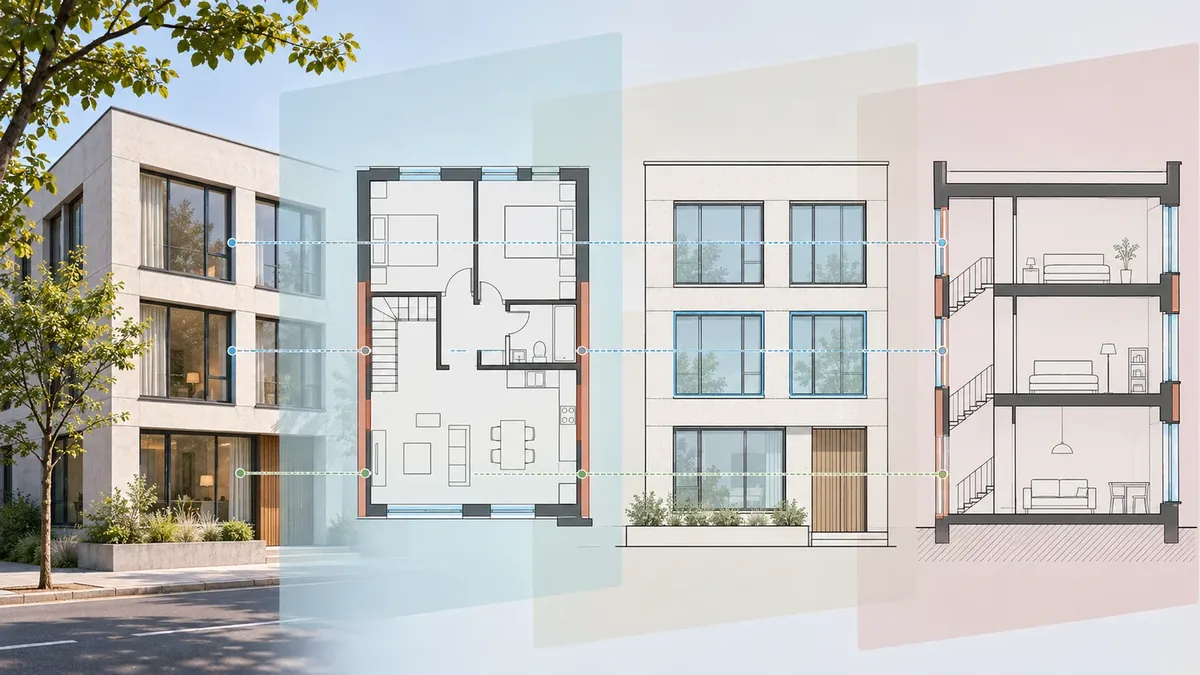
A building can look very different in a street photograph, a floor plan and an elevation drawing. ARCH-B is a benchmark designed to test whether AI models can connect those representations—and where that ability still breaks down.
A floor plan is an abstract map of rooms and walls. A photograph shows a building from one particular viewpoint. Recognizing that both depict the same place requires more than spotting similar colors or shapes: it means linking visual clues across different ways of representing a building.
That is the challenge behind ARCH-B, a benchmark introduced by researchers Kieran Sagar Parikh and Jose Luis García del Castillo y López. Their question is whether multimodal AI models can recognize building identity across photographs, floor plans, elevations, sections and renderings. The study also compares model performance with answers from people who were not recruited as architectural experts.
A benchmark built from linked building images
The researchers assembled a corpus of 3.9 million images from real-estate listings and architecture-project websites. Crucially, images remained linked to their listing or project, allowing the team to identify pictures and drawings associated with the same building. The corpus included 58,000 floor plans.
From this collection, the team generated multiple-choice questions in 11 task categories, or archetypes. Some ask which photograph matches a floor plan; others ask participants to find an out-of-place image among pictures and drawings, or to match an interior with an exterior. Each question has four answer choices, so a random guess has a 25% chance of being correct.
To make the questions less trivial, the researchers used image embeddings—a way of representing images as numerical patterns—to find visually similar incorrect choices. They generated 2,200 candidate questions and screened them with four multimodal models. Questions answered correctly by no more than two of those models went to manual review. Two researchers checked every question in the final benchmark, rejecting items they considered ambiguous, unsolvable or inconsistent with the intended task. The resulting ARCH-B set contains 354 questions.
The team evaluated 25 multimodal models, scoring whether each returned the correct answer choice. They also gathered 5,830 valid responses from non-expert human participants recruited online in the United States. Participants each answered 10 questions from one archetype.
Strong results overall, uneven performance by task
Model accuracy ranged from 10.45% to 83.90% across the benchmark. The highest score was achieved by Gemini 3.1 Pro Preview. The study’s response-weighted human baseline was 35.35%, above the 25% chance level for four-choice questions but well below the best model result.
That comparison needs care: the human participants were non-experts, and the authors say their results may reflect unfamiliarity with architectural drawings, limited attention or architectural inexperience. The study does not establish how architects or other trained readers would perform.
Scores also depended on the kind of visual link being tested. Models did comparatively well at identifying an outlier among mixed representations and matching photographs of the same building. Floor-plan-to-photograph matching was a weaker area. The average model accuracy was 58.78% when choosing a floor plan from photographs, but 44.14% when choosing a photograph from floor plans. The authors describe this as an asymmetry between the two directions of matching—not proof of why it occurs.
People and models also differed in which task categories were difficult. Their ranking of archetypes by difficulty was only weakly correlated (Spearman’s ρ = 0.33). In other words, a category that tended to challenge people was not necessarily one that most challenged models.
What the results can—and cannot—tell us
ARCH-B is a diagnostic test of visual correspondence across architectural media, not a general measure of architectural intelligence. Its fixed four-choice format tests selecting an answer, not producing a detailed explanation, locating evidence in an image or working through a real design task. Scores can also depend on whether a model produces an answer in the required format: the paper reports that some systems had low valid-response rates, so their overall scores partly reflect response failures rather than only mistaken visual choices.
The benchmark’s construction brings useful safeguards, including visually similar distractors, manual checks and a held-out analysis. In that analysis, questions that fewer screening models had solved also tended to be harder for other evaluated models. But the set is still a curated sample drawn from particular online sources and question types. The authors note that future versions could test more drawing forms, image conditions and building contexts.
The paper is an arXiv preprint; the source provided here does not establish that it has undergone peer review. Its results are evidence about the models, benchmark and evaluation setup reported in this study—not a final verdict on how AI or people understand architecture in general.
- multimodal AI
- architectural images
- computer vision
- AI benchmark
- floor plans
- visual correspondence
Reviewed cross-references
These connections were reviewed by a model, not independently fact-checked by a human. Similarity does not imply agreement; consult the original papers and the evidence below.
Why visual features help AI reason about camera movement
Supporting evidence: Both studies identify limitations in visual reasoning across representations or views: ARCH-B reports weaker performance on floor-plan-to-photograph matching, while LatentParse reports gains on camera-related multi-view questions when encoder features are converted into relation evidence. These results are compatible with cross-view alignment being challenging, but the tasks and evaluations differ, so they are not a direct comparison.
Model review: · openai-codex/gpt-6-luna
Evidence and provenance
Selected excerpts, not complete papers. PDF extraction can omit figures or damage equations, tables and reading order; sources may be preprints.
2609.34047v2 — Original paper
Excerpt reference:
static/papers/2609.34047v2.md:13-89
Basis: Paper text
Source SHA-256:2284aab046e9ad110a51bb215198dea1025607d3681d286ae131cb5bd3363ff42611.31021v1 — Original paper
Excerpt reference:
static/papers/2611.31021v1.md:216-278
Basis: Paper text
Source SHA-256:e672a316539ac2a7ea721d00580e2a5ceefe52b3d41b2b43de1ec4e72df7f806
Related reading
Automatically matched by shared topic keywords. These links do not imply that the sources agree or establish a consensus.
HighwayVerse Tests AI Across the Inspection Chain
Source published
Shared keywords: ai benchmark, multimodal ai
How MVAgent coordinates AI to understand multiple videos
Source published
Shared keywords: multimodal ai
When AI Rebuilds a Document, Looking Right Is Not the Same as Being Right
Source published
Shared keywords: multimodal ai
What a visual AI benchmark reveals about confidence
Source published
Shared keywords: multimodal ai
How AI Can Build an Image from Several Visual Clues
Source published
Shared keywords: computer vision, multimodal ai