TRANSMISSION // 2609.33418v2
A White-Noise Test That Adapts to the Data
Source published
A proposed statistical test is designed to work whether a time series has a fixed number of variables or a number that grows with the sample. Its adaptive bootstrap aims to handle both settings without requiring users to decide in advance which one applies.
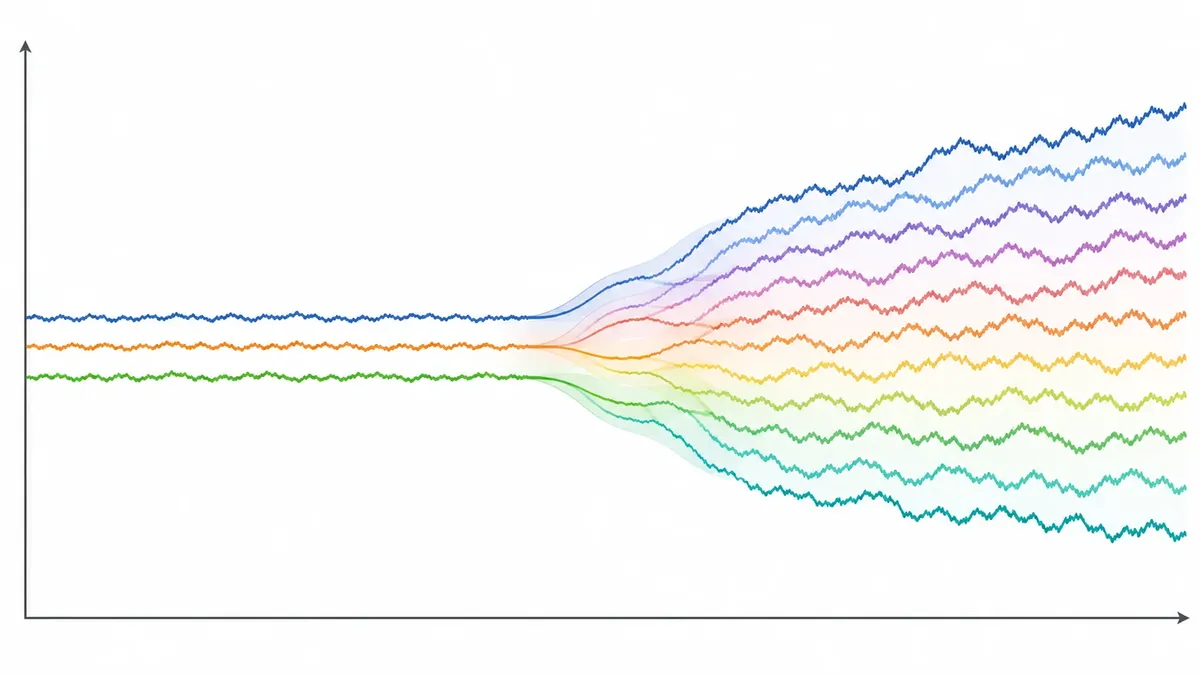
When analyzing several time series together, researchers may want to know whether their observations behave like white noise: uncorrelated over time, in a simplified sense. A new method targets this question even when the number of series changes with the amount of data.
One test for two statistical settings
White noise is a basic reference point in time-series analysis. If observations show no meaningful time dependence, a white-noise model may be appropriate; evidence against it can signal patterns that a model should account for. For multivariate data, the question becomes more complicated as the number of series—the dimension, often written as p—can vary.
The paper, by Jinyuan Chang, Jing He, Weiming Li and Chen Lin, proposes an L₂-type test for this setting. It is intended to cover two cases: a fixed number of series as the sample grows, and a number of series that itself grows with the sample size. The abstract reports that the test statistic behaves differently in these two regimes, a change the authors describe as a phase transition.
Why adaptivity matters
In practice, choosing which regime applies may be difficult. The authors therefore propose an adaptive bootstrap procedure: a resampling-based way to calibrate the test that is designed to provide one testing procedure across both regimes. In broad terms, a statistical test compares observed data with what would be expected under a null hypothesis—in this case, the white-noise hypothesis. Bootstrap methods use resampled data to help determine how unusual the observed result is.
The abstract says numerical experiments found good finite-sample performance compared with existing methods in the literature. It does not provide specific performance measures, experimental settings, or a detailed account of which methods were compared, so those results cannot be assessed more closely from the available evidence. The authors also report that the procedure has been implemented in the R package HDTSA.
What the evidence does—and does not—establish
The central contribution described here is a method intended to handle uncertainty about whether dimension is fixed or growing. The abstract supports that summary, but does not give enough detail to explain the test’s formula, the bootstrap’s precise steps, the assumptions required for validity, or how performance varies across data conditions. It also does not establish that the method will outperform alternatives in every application.
This account is based on the paper’s abstract rather than its full text. The work is identified as an arXiv preprint; the supplied material does not establish peer-review status. The abstract’s encouraging description of numerical experiments should therefore be read as a report of the authors’ results, not as independent confirmation. Readers seeking to apply the method would need the full paper to inspect its assumptions, simulations, and guidance for practical use.
- white noise
- time series
- high-dimensional statistics
- statistical testing
- bootstrap
Related reading
Automatically matched by shared topic keywords. These links do not imply that the sources agree or establish a consensus.
A regression method for extreme-value patterns
Source published
Shared keywords: high dimensional statistics
When Is an AI Bias an Interaction?
Source published
Shared keywords: statistical testing
When a quantum battery needs an entangled measurement
Source published
Shared keywords: white noise
A Statistical Test for Where Treatment Effects Vary
Source published
Shared keywords: statistical testing
When a Watermark Test Goes Blind
Source published
Shared keywords: statistical testing