TRANSMISSION // 2609.33412v2
A Recurrent State Helps AI Plan Its Next Moves
Source published
A vision-language-action model reuses a scene image and updates a compact internal state as it plans. In three benchmark tasks, the approach scored well, though its evidence is limited to specific test settings.
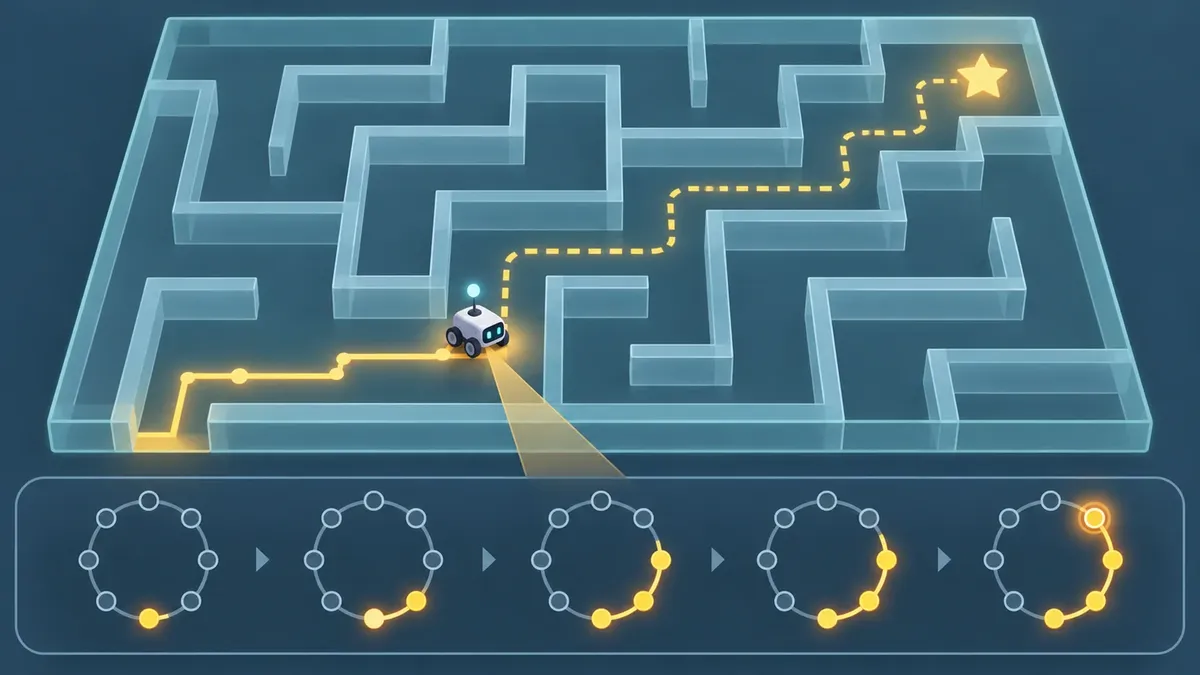
Planning several moves from a single image is difficult when a model must keep track of what changes and what stays put. A preprint proposes separating the fixed scene from an evolving internal state, and tests that idea in grid navigation and object-interaction benchmarks.
A robot planning several moves from one image faces a bookkeeping problem: the room or maze mostly stays the same, but the robot’s position and task progress change with every action. If a model has to redraw the scene, translate it into words, or rely on intermediate hidden representations, it may lose information about where it is. That can make a plan drift off course before the robot gets another chance to observe its surroundings.
A new preprint proposes a different approach, called State-Space Visual Reasoning (SSVR). Its central idea is to keep the initial visual and language context fixed, while updating a separate internal state as each planned action is chosen. The authors test whether this division can make open-loop planning—planning a sequence before acting—more accurate and efficient.
Keep the scene, update the state
The system uses Qwen2.5-VL-7B-Instruct as its vision-language backbone. It encodes the starting image and instruction once and stores them in a cache for reuse. A recurrent neural network module, a gated recurrent unit (GRU), maintains a learned state that changes after each predicted action. At each step, the model uses that state together with the cached scene and instruction to choose its next action; the action then updates the state.
The researchers trained and evaluated the approach on three simulated tasks: FrozenLake, where routes must avoid hazards; Maze, which tests navigation around walls; and MiniBehavior, which includes phased interactions such as picking up and placing an object. They compared SSVR with other methods, including text-based, image-generation-based and latent-reasoning approaches. Performance was measured by exact match (EM), which requires matching a shortest optimal action sequence, and progress rate (PR), which measures how much of an optimal sequence is followed before a mistake.
Strong scores in the tested tasks
The preprint reports EM/PR scores of 99.5%/99.6% on FrozenLake, 96.3%/98.0% on Maze and 83.9%/90.6% on MiniBehavior. The authors report that these results exceeded those of the evaluated comparison methods on the same tasks. MiniBehavior had lower scores than the two navigation tasks, suggesting that performance varied with task type.
The paper also tests changes to prompts and images. On Maze, paraphrasing the instruction produced similar results. Flipping images or inverting their colors caused modest declines in reported scores, while shrinking difficult maze images hurt performance more. In a FrozenLake-to-Maze transfer test, a model trained on FrozenLake achieved 33.6% EM and 38.3% PR on Maze; this is evidence of transfer in that particular setup, not a general measure of how well the method adapts to unfamiliar environments.
Efficiency results need a specific qualification. In a benchmark timing test on one Maze case, cached SSVR completed decoding rollouts faster than the evaluated baselines. The reported maximum was 98.58 times faster than VPRL. That figure applies to the paper’s timing protocol, which used a prebuilt cache and excluded preprocessing and cache construction from the rollout timing. It should not be read as a general speed advantage in every deployment.
What remains uncertain
These results come from simulated benchmark tasks and a particular model, training setup and evaluation protocol. They do not establish that the method will perform similarly on physical robots, in changing real-world environments, or across different model architectures. Open-loop plans also cannot respond to unexpected events unless another system supplies feedback. The paper describes additional tests with local navigation and feedback, but those are separate from the main benchmark results.
SSVR’s strong scores support the authors’ proposal that separating fixed visual context from an action-updated state can be useful for these planning tasks. They do not show that this design resolves the broader challenges of reliable long-horizon robot planning. The work is an arXiv preprint, not evidence of peer-reviewed consensus; its claims should be judged alongside further independent evaluation and replication.
- robot planning
- vision-language-action models
- recurrent state
- open-loop planning
- artificial intelligence
Related reading
Automatically matched by shared topic keywords. These links do not imply that the sources agree or establish a consensus.
PhiJEPA tests whether AI can infer hidden visual features
Source published
Shared keywords: robot planning
Why more accurate world models may not plan better
Source published
Shared keywords: artificial intelligence, robot planning
Eight tokens to help a world model plan
Source published
Shared keywords: artificial intelligence, robot planning
Could AI World Models Help Plan Mars Terraforming?
Source published
Shared keywords: artificial intelligence
How robots can plan their own adaptations
Source published
Shared keywords: robot planning