TRANSMISSION // 2609.32782v4
A model that tracks changing ICU physiology
Source published
A response-aware model forecasts short-term ICU physiology. Overall performance was comparable to other models, with gains on selected measures that were changing; it does not establish treatment effects or clinical benefit.
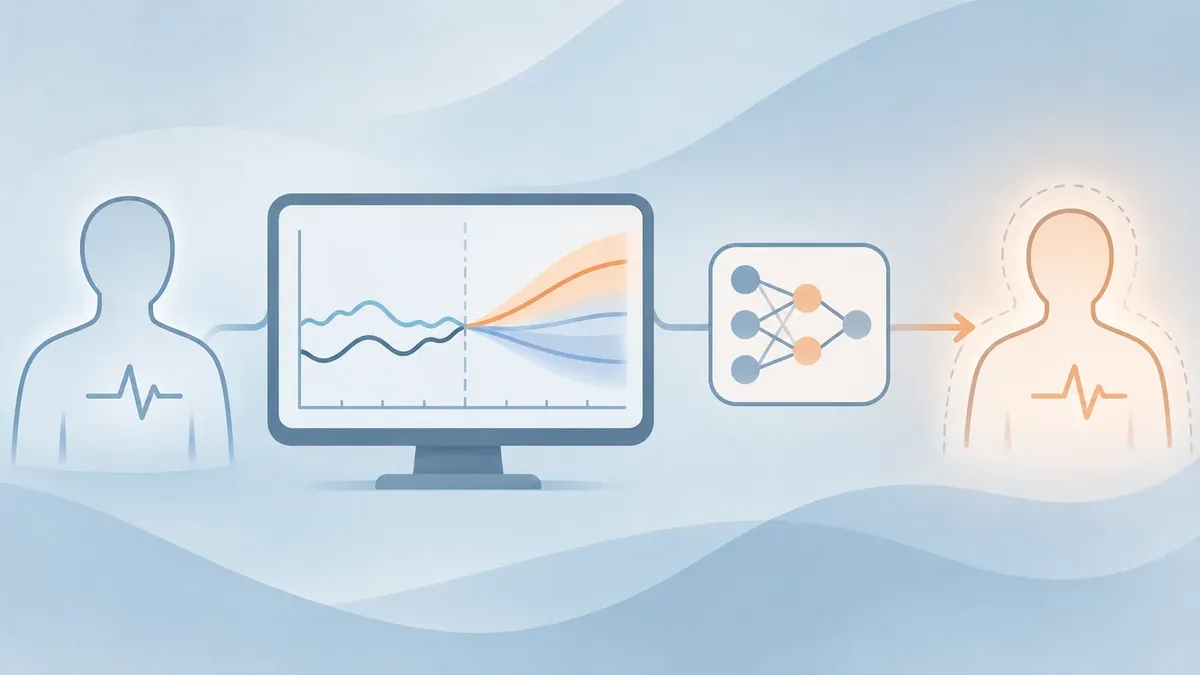
Why might people receiving the same respiratory support follow different physiological paths? Researchers tested a model that explicitly represents predicted changes as it forecasts ICU measurements. Its overall results were comparable to existing approaches, while selected metrics favored it for measurements that were changing.
In an intensive care unit, respiratory support can range from room air and conventional oxygen to high-flow nasal cannula or non-invasive ventilation. Patients receiving the same type of support may nevertheless follow different short-term physiological paths. Xiaolei Lu and Shamim Nemati’s study asks whether explicitly representing predicted physiological change can help a model forecast those paths.
The researchers’ motivation is that many patient-dynamics models represent change through the predicted next state. They propose instead to feed a separate representation of predicted change into the model’s internal state update. This is the study’s framing, not a claim that other models cannot represent change.
How the model works
The model takes in recent physiological measurements, respiratory-support history and settings, and patient characteristics. It summarizes these into an internal representation of the patient’s current state. At each step, it predicts a physiological change, uses that change to estimate the next state, and updates its internal representation before forecasting again.
The predicted change is divided into state-dependent baseline dynamics and a respiratory-support-associated deviation. Room air is the reference condition. During training, a penalty encourages the support-associated component to be small during room-air periods, but does not require it to be zero.
This decomposition is a modeling choice, not an estimate of what respiratory support caused. The records are retrospective and treatment was not randomly assigned; clinical factors influencing support may not all be captured in the data.
Testing six-hour forecasts
The study used de-identified electronic health records from adults in intensive care. Models were trained and selected using data from one institution, then evaluated on a later period from that institution and on a cohort from another institution. Each forecast used six hours of observed history to predict the next six hours. At testing, predictions were generated step by step without access to future measurements.
The researchers compared the model with a persistence baseline, which carries the latest measurement forward, and with learned recurrent and clinical world-model approaches. They measured prediction error across the full forecast and at individual hours. They also assessed targets with changes above a specified threshold and examined results by respiratory-support type and selected physiological variables. Evaluation was limited to target measurements available in the records.
Comparable overall results, selected gains on changing measurements
Overall trajectory-prediction performance was comparable across the proposed model and other learned approaches, rather than consistently better for one model. The strongest results varied by cohort and forecast hour. On validation data, for example, MedDreamer-WM had lower error in the first three forecast hours, while the proposed model had lower error in hours four through six. On external data, SepsisAgent-WM had the lowest overall error.
For targets with changes above the study’s threshold, the proposed model achieved selected gains. Its reported RMSE improvement over persistence was 10.1% on validation data and 9.7% on the later-period cohort; on external data, it tied Action-GRU at 4.2%. Other comparisons differed by metric: MedDreamer-WM had the lowest external-cohort mean absolute error for these targets. Results across individual physiological variables also varied, although the authors report improvements across multiple measures rather than just one.
The pattern is consistent with the idea that explicitly passing predicted change into the state update may help during multi-step forecasting. But these experiments assess prediction of recorded physiology. They do not show that the model identifies biological mechanisms or selects better treatment.
What remains uncertain
The study is retrospective and does not evaluate patient outcomes or clinical decisions. Because respiratory support was observed rather than randomized, the model’s support-associated component cannot establish what would have happened under a different support strategy. The authors identify counterfactual analysis and treatment decision modeling as future work.
The records included missing measurements, which the researchers handled using training-data-based imputation; forecasts were scored where target measurements were available. The external cohort tests performance beyond the training institution, but cannot guarantee generalization to other hospitals, patient groups, or care practices. NIV subgroups contained relatively few evaluation windows. That count is an editorial reason for caution when interpreting subgroup results, rather than a limitation explicitly identified by the authors. The paper also notes that residual bias and under-representation may remain.
This preprint presents a research framework, not a validated clinical tool. The underlying clinical data are restricted; the authors say implementation and evaluation materials will be released subject to data-use limits. Any clinical use would require further validation, assessment of failure modes, clinical oversight, and regulatory review. For now, the contribution is a forecasting design that makes predicted physiological change an explicit part of updating an ICU model’s internal patient state.
- clinical AI
- ICU forecasting
- respiratory support
- patient dynamics
- physiological change
- machine learning
Reviewed cross-references
These connections were reviewed by a model, not independently fact-checked by a human. Similarity does not imply agreement; consult the original papers and the evidence below.
ICare-DT improves ICU forecasts with new data—but treatment prediction remains unproven
Supporting evidence: Both studies report ICU forecasting results consistent with the bounded proposition that forecasts can benefit from representing evolving patient-specific physiology: Lu and Nemati report more consistent gains on changing physiological targets, while Li et al. report improved forecasts after assimilating each patient’s new measurements. The evidence is not a direct replication: the studies use different models, cohorts and forecasting outcomes, and Li et al. note that the gain was not shown to come from information beyond the last measured value.
Model review: · openai-codex/gpt-6-luna
Evidence and provenance
Selected excerpts, not complete papers. PDF extraction can omit figures or damage equations, tables and reading order; sources may be preprints.
2609.32782v4 — Original paper
Excerpt reference:
static/papers/2609.32782v4.md:590-634
Basis: Paper text
Source SHA-256:5b2b8e7a4920ab536b9af50fde66d5826e25a57dc81c6702dd6e16d2643e861c2609.32782v4 — Original paper
Excerpt reference:
static/papers/2609.32782v4.md:635-681
Basis: Paper text
Source SHA-256:5b2b8e7a4920ab536b9af50fde66d5826e25a57dc81c6702dd6e16d2643e861c2611.09712v1 — Original paper
Excerpt reference:
static/papers/2611.09712v1.md:13-88
Basis: Paper text
Source SHA-256:63db287098f9c2831d62565e32a4e6189e4746684b90a67cbf71aebc1e89af8f2611.09712v1 — Original paper
Excerpt reference:
static/papers/2611.09712v1.md:2453-2557
Basis: Paper text
Source SHA-256:63db287098f9c2831d62565e32a4e6189e4746684b90a67cbf71aebc1e89af8f
Related reading
Automatically matched by shared topic keywords. These links do not imply that the sources agree or establish a consensus.
Why Clinical AI Needs Statistical Guardrails
Source published
Shared keywords: clinical ai, machine learning
How Well Can EEG Models Spot Unfamiliar Seizure Types?
Source published
Shared keywords: clinical ai, machine learning
Why chart-reading guidance can help AI—and still reveal errors
Source published
Shared keywords: clinical ai
When Clinician Edits Help—and When They Could Teach AI to Make Things Up
Source published
Shared keywords: machine learning
When AI Judges Start Shaping Clinical AI
Source published
Shared keywords: clinical ai