TRANSMISSION // 2609.32254v2
Why learning a repeating signal can go wrong
Source published
A study of periodic trajectories finds that learning them directly can stumble over phase drift. Separating waveform shape from period may help, though the evidence here is limited to the abstract.
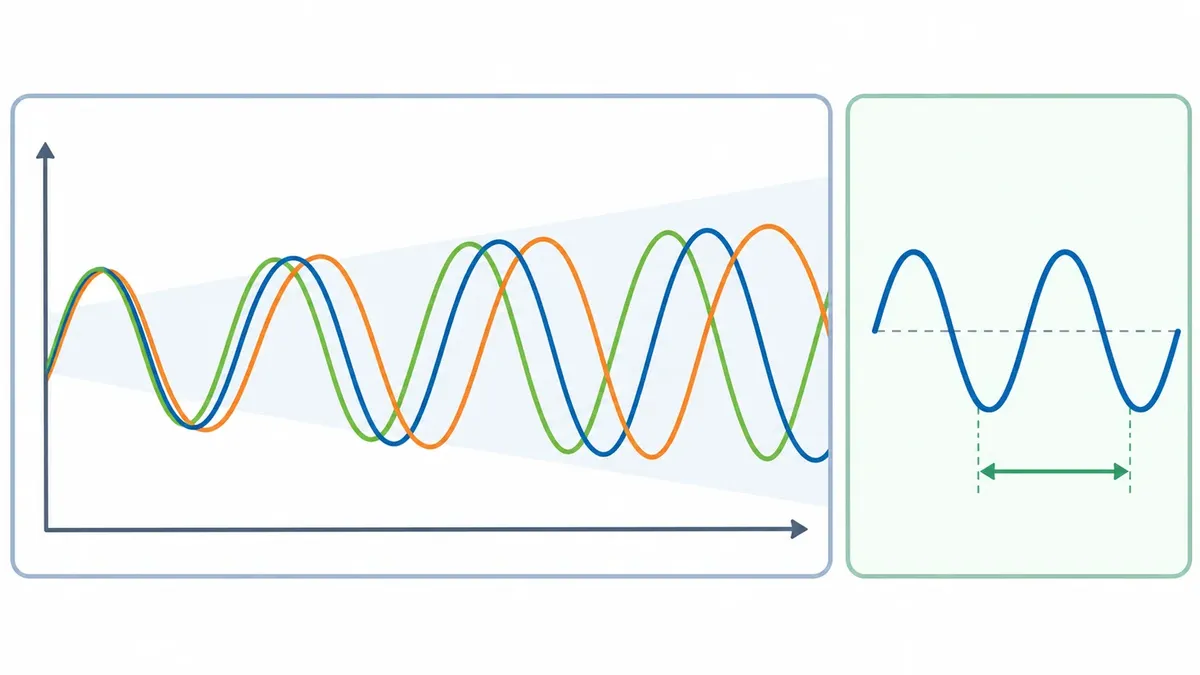
Many physical systems repeat: a pendulum swings, a chemical reaction cycles, or a simulated field oscillates. Machine-learning models can be trained to predict such trajectories, but the way the data are recorded may make the task harder than it looks. A preprint by Kaixin Zheng and Anita Layton argues that phase alignment and a different representation can address two related sources of error.
When a repeating pattern is hard to predict
A periodic trajectory is a system’s changing state over time when that state repeats on a cycle. Researchers who train machine-learning models to predict these trajectories face choices about when to start recording and how much time to include. One seemingly cautious strategy is to simulate long enough for initial transients to fade, then record a window containing at least one full period for every trajectory.
The paper Why Directly Learning Periodic Trajectories Can Fail argues that these choices can make trajectories difficult to learn—even when the underlying periodic orbits change regularly as system parameters change. The work studies operator learning: training a model to map system inputs or parameters to a solution, rather than solving each new case from scratch.
How phase can accumulate error
The authors identify a shared difficulty: small differences in frequency accumulate over time. As a result, the phase—the position within a repeating cycle—can change rapidly with the system parameters. A model that cannot follow that changing phase may make large prediction errors, even if the overall patterns look similar.
This helps explain two problems described in the abstract. First, trajectories recorded without phase alignment generalize poorly, including on examples drawn from the training distribution. Aligning their phases substantially improves that in-distribution performance. But alignment alone does not solve the second problem: models trained to predict over a fixed physical-time window still have large errors when asked about trajectories whose periods fall outside the training range.
The authors frame these failures in terms of limits on prediction accuracy. They say phase variation produces a population mean-squared-error (MSE) floor in both settings: a residual error level that a predictor cannot get below under the conditions they analyze. For fixed-window prediction, they also derive a lower bound for individual samples. The abstract does not give the bound’s formula or numerical size, so its practical magnitude cannot be assessed from the available source material.
Separating cycle shape from cycle length
The paper then examines a representation designed to avoid those difficulties: predict an aligned, normalized waveform and its period separately. Put simply, the model learns the shape of one cycle on a standardized time axis, while a separate target describes how long the cycle takes in real time. The authors say they establish regularity of these separated targets under assumptions on the ordinary differential equations (ODEs) governing the system. More regular targets are, in principle, easier for a learning method to approximate.
According to the abstract, experiments show that this approach avoids both identified failures in ODE systems and in a partial differential equation (PDE) case study. That is a reported result, not evidence that the representation works for every periodic system, dataset, or learning architecture. The abstract does not specify the models, data sizes, evaluation metrics, or exact ODE and PDE examples, making it impossible here to judge the scope or strength of the experiments in detail.
What the evidence does—and does not—show
The central lesson is about representation: a repeating solution may be easier to learn when its timing and shape are handled separately, rather than asking one predictor to reproduce a raw signal over a fixed span of physical time. The study also distinguishes two remedies. Phase alignment helps with in-distribution generalization, while the authors’ decoupled representation is proposed to address both that issue and errors on periods outside the training range.
There are important limits to this account. The source available for this article is the paper’s abstract, not its full text. We therefore cannot independently inspect the mathematical assumptions, experimental design, comparisons, or qualifications behind the claims. The work is an arXiv preprint, which may not have undergone peer review; its presence there is not itself a guarantee of validation. The reported findings should be read as the authors’ conclusions pending examination of the full paper and further assessment.
For now, the result is best understood as a focused warning for people building scientific prediction models: more complete-looking simulation data do not necessarily make a learning problem easier. How a trajectory is aligned and represented can matter as much as how much of it is recorded.
- periodic trajectories
- operator learning
- phase alignment
- scientific machine learning
- ordinary differential equations
- preprint
Reviewed cross-references
These connections were reviewed by a model, not independently fact-checked by a human. Similarity does not imply agreement; consult the original papers and the evidence below.
Stretching coordinates helps neural networks learn sharp solution changes
Supporting evidence: Both studies report that changing how a learning problem is represented can make prediction easier: Zheng and Layton find that phase-aligning and time-normalizing periodic ODE trajectories improves learning, while Yu and Oseledets report improved PINN accuracy from coordinate transformations on selected PDE benchmarks. These are distinct transformations, models, and problem settings, so the comparison supports only the bounded idea that representation choices can affect learning difficulty—not that either method validates the other.
Model review: · openai-codex/gpt-6-luna
Evidence and provenance
Selected excerpts, not complete papers. PDF extraction can omit figures or damage equations, tables and reading order; sources may be preprints.
2609.32254v2 — Original paper
Excerpt reference:
static/papers/2609.32254v2.md:13-39
Basis: Paper text
Source SHA-256:68c95ec00bf47690302260fb14e68d6b369d2eb857f2db451329fc566f23205b2609.32254v2 — Original paper
Excerpt reference:
static/papers/2609.32254v2.md:1084-1103
Basis: Paper text
Source SHA-256:68c95ec00bf47690302260fb14e68d6b369d2eb857f2db451329fc566f23205b2611.09053v1 — Original paper
Excerpt reference:
static/papers/2611.09053v1.md:12-69
Basis: Paper text
Source SHA-256:c6277b3ebc352d2be858590c31bca7be21b4bac1ec7a2e7afc81f852c3a6760d
Related reading
Automatically matched by shared topic keywords. These links do not imply that the sources agree or establish a consensus.
Can operator chains help scientific AI handle unfamiliar problems?
Source published
Shared keywords: operator learning, scientific machine learning
Stretching coordinates helps neural networks learn sharp solution changes
Source published
Shared keywords: scientific machine learning
PINNeval asks physics-informed AI benchmarks to test the whole training pipeline
Source published
Shared keywords: scientific machine learning