TRANSMISSION // 2609.31902v2
Choosing a quantum data encoding, with help from an agent
Source published
A new open-source tool recommends quantum data encodings and compares their kernels, but small tests show why its suggestions still need checking.
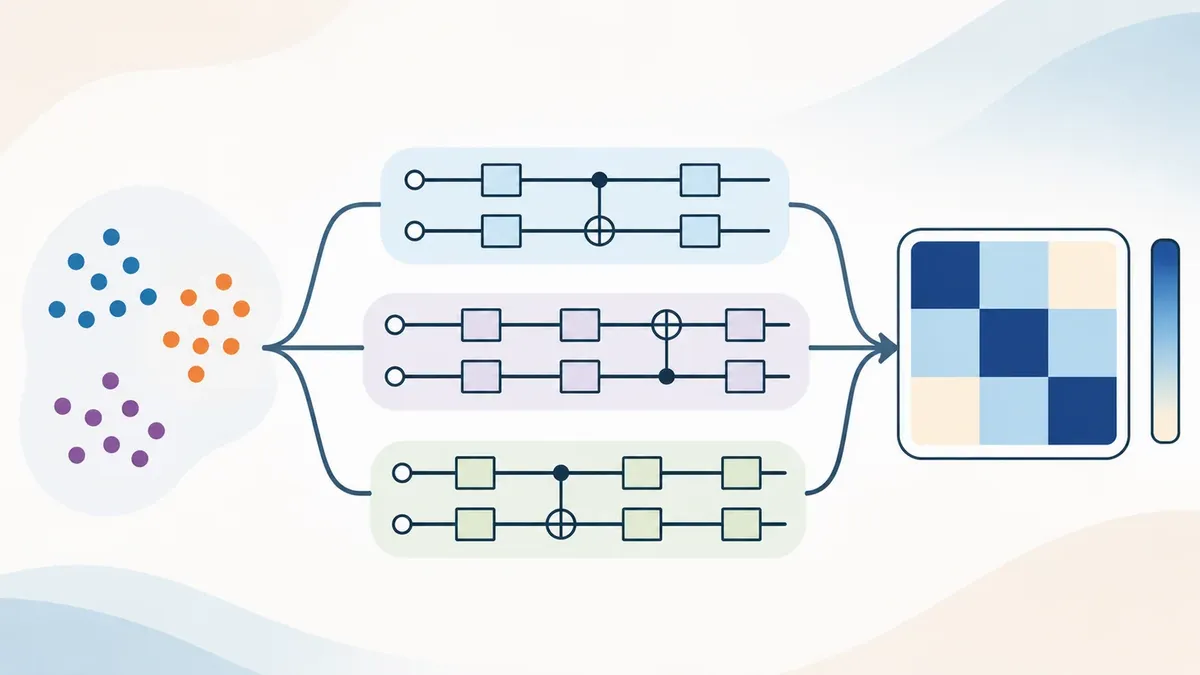
Before a quantum machine-learning model can use ordinary data, it must encode that data into quantum states. A preprint introduces a conversational tool to help choose that encoding, while its own benchmarks reveal that recommendations can miss the strongest-scoring option.
In quantum machine learning, a dataset does not go straight into a quantum circuit. First, its values are mapped into quantum states through a process called data encoding. That choice matters: it shapes the mathematical relationships a model can represent, and affects how many qubits and circuit operations are needed. On today’s noisy quantum hardware, deeper circuits can be especially difficult to run reliably.
A paper by Ana Paula Appel presents Quantum Encoding Agents, an open-source system intended to make this design choice easier to explore. Users can provide data, optionally describe their task, and receive a recommended encoding, a Qiskit circuit, and a natural-language explanation in English or Portuguese. The system can also compare encodings using a quantum-kernel score when class labels are available.
What the tool does
The system implements seven encoding families: amplitude, angle, dense angle, IQP, basis, data re-uploading and custom feature maps. These approaches make different trade-offs. For example, angle encoding is relatively shallow but typically uses one qubit per feature. Amplitude encoding can represent a vector using fewer qubits, but preparing the state can require a deep circuit. There is no universally best option: data type, task and hardware constraints all matter.
The software first profiles the input data and applies a recommendation policy that considers features such as whether values are binary or continuous, the number of features, and hardware limits. For numerical datasets that meet its criteria, it also estimates a quantity called the correlation fractal dimension, then uses a method called FD-ASE to select original columns and set a proposed qubit budget. This is intended to avoid encoding more dimensions than the data’s structure can support in certain quantum-kernel calculations. The paper describes a gate-error threshold of roughly 10⁻³ as part of its hardware-aware policy; this is a rule used by the system, not a guarantee that a circuit will work well on a particular device.
For labelled data, the tool computes a fidelity-based quantum kernel and reports Kernel-Target Alignment (KTA). In plain language, KTA measures how closely the pattern of similarities produced by an encoding matches the class labels: do examples in the same class tend to look similar under this kernel, and examples in different classes less so? It is a screening measure, not a final verdict on a trained model’s performance.
What the tests found
In the benchmark comparisons, the paper reports KTA results primarily from Qiskit’s Aer statevector simulator. These calculations allow encoding comparisons under simulated conditions; they are not, by themselves, demonstrations on quantum hardware. Across the reported examples, KTA scores differed between encodings, showing that the measure can help distinguish their behaviour on a given dataset.
The results also expose limits in the recommendation rules. On the Wine dataset, for example, the data-profile heuristic selected IQP, while dense-angle encoding scored higher on KTA in the reported comparison. For a kernel-classification task, the task-specific rule could promote a custom feature map even when that option performed poorly in some tested comparisons. The authors therefore present empirical scoring as a useful check on a recommendation, not as proof that the agent’s first choice is best.
The paper reports additional experiments with simulated shot noise and a small hardware test on an IBM quantum device. The hardware test involved a small Iris example and a limited set of kernel overlaps, rather than a full kernel matrix across a large dataset. It offers a narrow check against real-device measurements, not broad validation of the complete system or its recommendations.
What remains uncertain
These evaluations do not establish that the tool improves results across a wide range of real-world tasks, or that quantum methods outperform classical machine learning. The paper explicitly frames the system as an engineering aid for encoding selection, not evidence of general quantum advantage. Its discussion notes that text-only descriptions cannot support the numerical fractal-dimension analysis, and that keyword-based profiling can misread ambiguous descriptions. The authors also identify larger on-device kernel tests and more extensive automatic selection as future work.
This work is an arXiv preprint; the supplied source does not establish that it has undergone peer review. The conclusions should therefore be read as a description of a proposed tool and its reported tests. For practitioners, the practical message is modest but useful: encoding choice deserves attention, and a recommendation should be checked against measurements on the actual data and intended hardware.
- quantum machine learning
- data encoding
- quantum kernels
- Kernel-Target Alignment
- quantum computing
- NISQ hardware
Reviewed cross-references
These connections were reviewed by a model, not independently fact-checked by a human. Similarity does not imply agreement; consult the original papers and the evidence below.
Why quantum machine-learning models can lose sensitivity
Supporting evidence: Both papers address loss of useful quantum-kernel or observable sensitivity as representations become too expressive or wide. The encoding-agent paper uses an estimated fractal-dimension budget and benchmark kernel diagnostics; Mondragon-Sampedro and Alvarez-Estevez report that bandwidth scaling mitigates concentration in some moderate regimes, but not for every encoding or highly expressive setting. These are complementary results from different methods and experimental setups, not a direct replication or universal validation of the budget rule.
Model review: · openai-codex/gpt-6-luna
Evidence and provenance
Selected excerpts, not complete papers. PDF extraction can omit figures or damage equations, tables and reading order; sources may be preprints.
2609.31902v2 — Original paper
Excerpt reference:
static/papers/2609.31902v2.md:142-208
Basis: Paper text
Source SHA-256:c86124b037e2102aa1e4aad08159a228570792b6ef42911dc47a3cc857fbcd5b2609.31902v2 — Original paper
Excerpt reference:
static/papers/2609.31902v2.md:976-1044
Basis: Paper text
Source SHA-256:c86124b037e2102aa1e4aad08159a228570792b6ef42911dc47a3cc857fbcd5b2611.27486v1 — Original paper
Excerpt reference:
static/papers/2611.27486v1.md:693-765
Basis: Paper text
Source SHA-256:35a8e8c8ba0e00bfe2fededff7ee70a453425d735589b1ed7cb2e2bc91cfb34e2611.27486v1 — Original paper
Excerpt reference:
static/papers/2611.27486v1.md:483-554
Basis: Paper text
Source SHA-256:35a8e8c8ba0e00bfe2fededff7ee70a453425d735589b1ed7cb2e2bc91cfb34e
Related reading
Automatically matched by shared topic keywords. These links do not imply that the sources agree or establish a consensus.
A feature-aware search for quantum data encodings
Source published
Shared keywords: quantum machine learning
Why quantum machine-learning models can lose sensitivity
Source published
Shared keywords: quantum kernels, quantum machine learning
Can fractal dimension help choose quantum-kernel width?
Source published
Shared keywords: quantum kernels, quantum machine learning
Learning when quantum error mitigation is worth the cost
Source published
Shared keywords: quantum computing, quantum machine learning
Selecting training examples for quantum machine learning
Source published
Shared keywords: quantum machine learning