TRANSMISSION // 2609.31835v2
A remarkably close quasar pair at cosmic dawn
Source published
JWST and Gemini spectroscopy reveal two quasars about 5.6 kiloparsecs apart when the universe was roughly 900 million years old. The authors favor a physical pair, but say lensing is not ruled out.
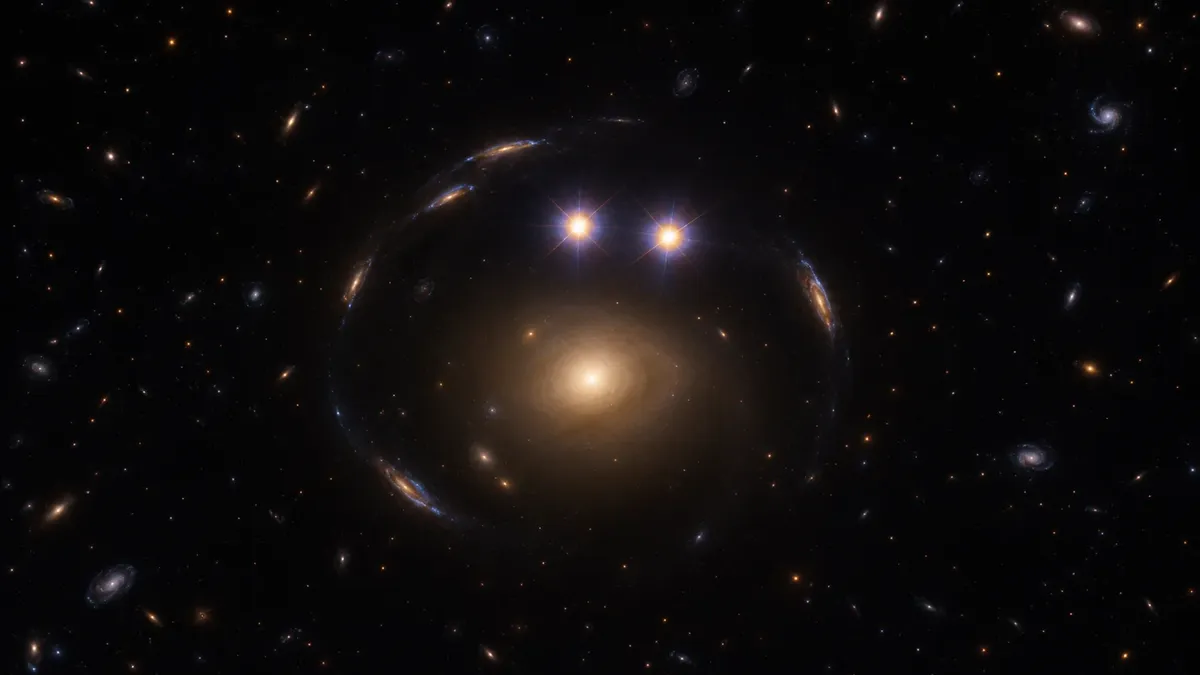
Two brilliant sources appear almost side by side in the early universe. Their close spacing makes them a rare opportunity to study how galaxies and black holes grew—but whether the quasars are truly neighbors remains an open question.
When the universe was about 900 million years old, two quasars appeared just 5.56 kiloparsecs apart in projection—roughly 18,000 light-years. Quasars are powered by matter falling onto supermassive black holes. Finding a close pair so early could help astronomers investigate how massive galaxies and black holes assembled. But first comes a basic question: are these genuinely separate quasars, or could one be a gravitationally lensed image of the other?
A team led by Silvia Onorato reports the discovery in observations from the Aether survey. The pair, named Nāpōwawā‘enakaulua, lies at a redshift of about 6.08. The name was given through the A Hua He Inoa program at the ‘Imiloa Astronomy Center of Hawai‘i; the paper describes it as referring to two celestial bodies, their powerful darkness, and brilliance.
Spectra reveal two active black holes
The researchers identified the companion while inspecting JWST’s NIRSpec integral-field observations of 200 quasars in the Aether survey. They followed up with observations from Gemini’s GNIRS and GMOS instruments. Together, the spectra let the team examine each source’s continuum—the broad glow across wavelengths—and emission lines produced by gas around the black holes.
The quasars are separated on the sky by 0.98 arcseconds, corresponding to a projected distance of about 5.56 kiloparsecs at their redshift. Their measured systemic redshifts are 6.0781 and 6.0785. The paper reports a line-of-sight velocity difference of 15 kilometres per second from the fitted redshifts, but adopts a more conservative uncertainty of about 100 kilometres per second because emission-line measurements can be affected by gas motions. The velocity measurement alone cannot determine their three-dimensional separation.
The spectra also indicate that both sources contain massive, actively feeding black holes. The authors estimate masses of about 1.5 billion and 400 million times the Sun’s mass. Their estimated accretion rates are near or slightly above the Eddington limit, the theoretical rate at which outward radiation pressure balances gravity’s inward pull. These are model-based estimates, not direct weighings: the mass calculations use broad emission lines and carry substantial systematic uncertainty.
A pair—or a lens?
A foreground mass can bend light and make one distant quasar appear as multiple images. Similar redshifts and close positions alone cannot distinguish that scenario from two quasars near each other in space. The team therefore compared spectral features that might retain differences between separate sources.
The narrow [O III] emission lines have similar central velocities, but their broader, blueshifted wings—associated with gas outflows—differ. The authors argue that these differences favor two intrinsically distinct quasars rather than lensed images. They tentatively favor a physical pair, but a candidate foreground galaxy lies near the fainter source, and the paper says lensing cannot yet be ruled out. Detailed lens modelling and further study of the gas dynamics are still needed.
A striking comparison with clustering estimates
The team also asked how often a pair this close might be expected based on quasar clustering measured at much larger separations. Within the Aether sample, they found one companion quasar among 199 targeted fields. Comparing that observation with extrapolated clustering measurements, they report an excess of roughly two to three orders of magnitude over those expectations.
That comparison is suggestive, not a secure measure of how common such pairs are. The reference clustering measurements do not reach the tiny separation of this system, so the authors must extrapolate them. They caution that these extrapolations are unreliable on such scales and that theoretical predictions are uncertain. The excess could point to stronger small-scale clustering, perhaps connected to interactions or a dense environment. But one detected pair cannot establish that mergers trigger quasar activity; a larger sample is needed.
The search also has blind spots: the JWST observations could not resolve pairs below roughly a kiloparsec, and the study did not search for unresolved binaries using double-peaked spectral lines. So the single detected companion does not mean only one close pair exists.
The supplied paper text identifies a version accepted and published in 2026, while the source record identifies an arXiv version. This account describes the findings and caveats in that paper; it does not treat the arXiv record alone as evidence of peer review. The result is an intriguing signpost: two powerful quasar sources appear exceptionally close in the early universe, but whether they are a physical pair—and what that would imply for black-hole growth—remains to be confirmed.
- quasars
- cosmic dawn
- JWST
- black holes
- galaxy mergers
- Aether survey
Reviewed cross-references
These connections were reviewed by a model, not independently fact-checked by a human. Similarity does not imply agreement; consult the original papers and the evidence below.
Why early black holes may need a fast cosmic gas supply
Supporting evidence: Both papers connect early massive quasars with unusually dense environments: Onorato et al. report one close pair whose small-scale clustering exceeds large-scale extrapolations, while Jeon et al. find that rare halos with cold-mode inflow can match the abundance of massive quasars and note consistency with quasar-host clustering. This is contextual support, not a direct test: the pair’s physical association remains tentative, and the halo study is an analytic model rather than a measurement of this pair.
Model review: · openai-codex/gpt-6-luna
Evidence and provenance
Selected excerpts, not complete papers. PDF extraction can omit figures or damage equations, tables and reading order; sources may be preprints.
2609.31835v2 — Original paper
Excerpt reference:
static/papers/2609.31835v2.md:1317-1391
Basis: Paper text
Source SHA-256:ee429d9e316e1aa378e32b37cabb5110724650c5db4cc6a6c6a3cd86597461372609.31835v2 — Original paper
Excerpt reference:
static/papers/2609.31835v2.md:1261-1316
Basis: Paper text
Source SHA-256:ee429d9e316e1aa378e32b37cabb5110724650c5db4cc6a6c6a3cd86597461372609.00115v2 — Original paper
Excerpt reference:
static/papers/2609.00115v2.md:481-548
Basis: Paper text
Source SHA-256:1f4a7f55b17b452d190967361ac2180604507667966c6e14a932d1e884e1507f
Related reading
Automatically matched by shared topic keywords. These links do not imply that the sources agree or establish a consensus.
Why early black holes may need a fast cosmic gas supply
Source published
Shared keywords: cosmic dawn
How well could Roman find quasars from the early Universe?
Source published
Shared keywords: cosmic dawn
Why Astronomers Want a Bigger JWST Survey of the First Galaxies
Source published
Shared keywords: cosmic dawn
Five observations that could sharpen our picture of early galaxies
Source published
Shared keywords: cosmic dawn
A new galaxy-based map of cosmic expansion reaches back to cosmic dawn
Source published
Shared keywords: cosmic dawn