TRANSMISSION // 2609.31826v2
A Lensed AGN Pair, 175 Parsecs Apart in Projection
Source published
MUSE spectra strengthen evidence for two active sources in a distant lensed system. Black-hole mass limits and accretion estimates are approximate and model-dependent.
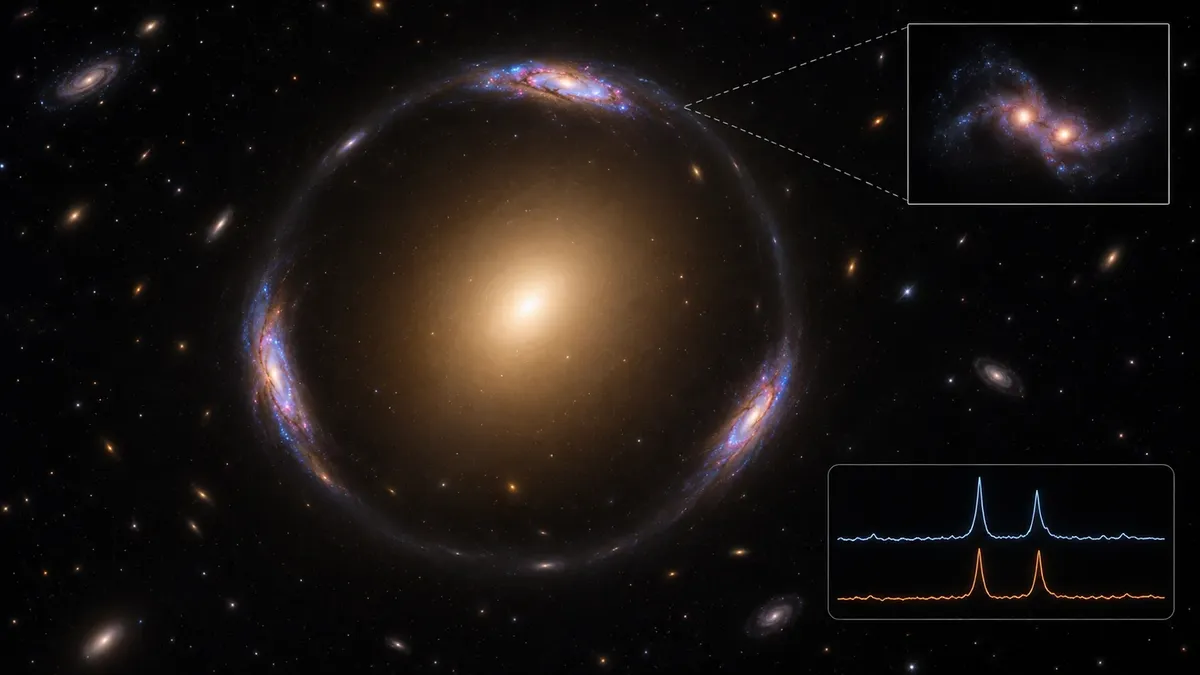
A foreground galaxy bends light from MG B2016+112 into multiple images, offering astronomers a way to study a distant system. MUSE spectra add evidence for two active galactic nuclei whose projected separation is about 175 parsecs—not a direct measurement of their three-dimensional distance. The study also gives approximate black-hole mass lower limits using a relation calibrated for a different type of active galaxy, so those estimates and the inferred accretion rates remain uncertain.
A close pair, seen through a cosmic lens
When galaxies merge, their central supermassive black holes may both become active. Finding such pairs in the distant universe is difficult: their apparent separation can be too small for direct imaging to distinguish. Strong gravitational lensing offers a way to investigate them. A foreground galaxy bends light from a more distant source into multiple images. Interpreting those images to reconstruct the background system requires lens modeling; the images alone do not directly show the two nuclei.
MG B2016+112 is at redshift 3.273. Radio observations and lens modeling associate its light with two radio sources linked to active galactic nuclei, separated by about 175 parsecs in projection—roughly 570 light-years across the sky. This is not a measurement of their full three-dimensional separation. Earlier X-ray observations found X-ray sources coincident with the two radio cores, supporting the two-source interpretation.
The new study asks whether optical spectra provide further evidence for two distinct ionizing sources, and what the system’s emission lines can reveal about its black holes and accretion.
Reading the light from three images
The researchers analyzed archival observations from MUSE, an instrument on the European Southern Observatory’s Very Large Telescope. They extracted spectra from three resolved lensed images, labeled A, B, and C. They corrected for absorption by the local interstellar medium at redshift near zero. Gas near the distant source, at redshift about 3.27, also absorbs some emission: the team masked those affected regions when fitting line profiles, but did not apply the masks when measuring fluxes for line ratios.
The spectra show emission from Ly-alpha, carbon IV, nitrogen V, helium II, and carbon III]. Ly-alpha, carbon IV, and nitrogen V are affected by saturated absorption, making their underlying emission harder to characterize. Helium II and carbon III] are not affected by that saturated absorption. Their ratio is the only ratio the authors treat as unaffected by it.
The helium II-to-carbon III] ratio agrees between images A and B, but differs significantly in image C. In the favored two-source lens model, A and B are images of one source, while C corresponds to the other. The contrast is strong, independent spectroscopic evidence for two distinct ionizing sources. It is not conclusive proof by itself: the authors say their MUSE data cannot quantitatively assess whether extended, ionization-stratified gas could also contribute to the difference. Image C is noisier than A and B, and the paper notes that uncertainties in the measured line ratios are dominated by MUSE’s spectral resolution.
Approximate mass limits, not precise measurements
The team fitted the Ly-alpha and carbon IV emission regions with narrow and broad Gaussian components—shapes used to describe features in a spectrum. From the broad carbon IV components and a virial mass-scaling relation, they estimated lower limits associated with images A, B, and C: about 5.5 million, 6.3 million, and 4.8 million solar masses, respectively. These are three image-associated estimates, not evidence for three separate black holes: A and B are lensed images of one source, and C represents the other in the adopted model.
The estimates are approximate, model-dependent lower limits. The broad components do not establish that the emission comes from the fast-moving gas near a black hole used in this kind of mass estimate. The scaling relation was calibrated for unobscured type-I active galaxies, while this system is classified as type II. The observed 1,350-angstrom luminosities used in the calculation are uncorrected for absorption and therefore underestimated. Non-virial gas motions could also affect the line widths.
The researchers estimated Eddington ratios—the luminosity relative to the theoretical limit for a black hole of a given mass. From MUSE data, they report approximate values of 0.47, 0.51, and 0.04 for A, B, and C. Because A and B represent one source, these are image-based estimates rather than measurements of three independent objects. Estimates using X-ray luminosities are about 0.9 and 1.6 for source 2, associated with A and B, and about 0.5 for source 1, associated with C. These X-ray calculations use a different luminosity measure and a bolometric correction to estimate total output; that correction has substantial uncertainty. The authors treat the X-ray results as an independent check, not precise accretion-rate measurements. The mass lower limits and, for C, uncertainty about whether the adopted average lens magnification applies to the MUSE-emitting region further complicate interpretation.
What comes next
The study concerns one unusual, strongly lensed system. Its interpretation depends on the favored two-source lens model, spectral fitting, and uncertain mass and luminosity estimates. The authors call for deep, spatially resolved near-infrared spectroscopy to measure hydrogen lines such as H-alpha and H-beta, independently revisit the black-hole masses, and investigate the surrounding gas and host galaxy.
The paper is available as an arXiv preprint. The supplied source does not establish its publication or peer-review status. The spectral contrast strengthens the case for two active sources, but the nuclei’s masses and accretion states remain uncertain.
- dual active galactic nuclei
- gravitational lensing
- supermassive black holes
- MUSE spectroscopy
- MG B2016+112
- high-redshift galaxies
Reviewed cross-references
These connections were reviewed by a model, not independently fact-checked by a human. Similarity does not imply agreement; consult the original papers and the evidence below.
A cosmic lens sharpens the view of a distant quasar
Shared method: Both studies use strong gravitational lens models to interpret multiply imaged, high-redshift AGN: the MG B2016+112 study uses an existing source-plane reconstruction and magnifications to interpret its spatially resolved MUSE spectra, while the J1721+8842 study builds a lens model to locate X-ray emission relative to the optical source. The observables and analyses differ, so J1721’s astrometric result is not a direct test of the spectroscopic evidence for two AGN in MG B2016+112.
Model review: · openai-codex/gpt-6-luna
Evidence and provenance
Selected excerpts, not complete papers. PDF extraction can omit figures or damage equations, tables and reading order; sources may be preprints.
2609.31826v2 — Original paper
Excerpt reference:
static/papers/2609.31826v2.md:103-134
Basis: Paper text
Source SHA-256:38d98fbb02946146a8907466a42070f1b1fe86a139fb5b90305eda2b9f65b13d2611.31386v1 — Original paper
Excerpt reference:
static/papers/2611.31386v1.md:12-65
Basis: Paper text
Source SHA-256:296258f991459da8231016d08ddb8736d0b4bfc53317ce3c8df3f83792a6904c
Related reading
Automatically matched by shared topic keywords. These links do not imply that the sources agree or establish a consensus.
Hyperion’s Densest Regions Show More X-ray-Active Black Holes
Source published
Shared keywords: high redshift galaxies, supermassive black holes
Distant galaxy lenses offer a new sample for studying cosmic evolution
Source published
Shared keywords: high redshift galaxies
A proposed deep Webb survey would examine the stars behind distant galaxies’ light
Source published
Shared keywords: high redshift galaxies
How unstable disks may build clumps in early galaxies
Source published
Shared keywords: high redshift galaxies
Two protoclusters, different galaxy trends
Source published
Shared keywords: high redshift galaxies