TRANSMISSION // 2609.28953v2
Using a black hole’s ringdown to examine nonlinear gravity
Source published
An arXiv study estimates a coupling between modeled oscillations in the gravitational-wave event GW250114 and compares it with relativity predictions.
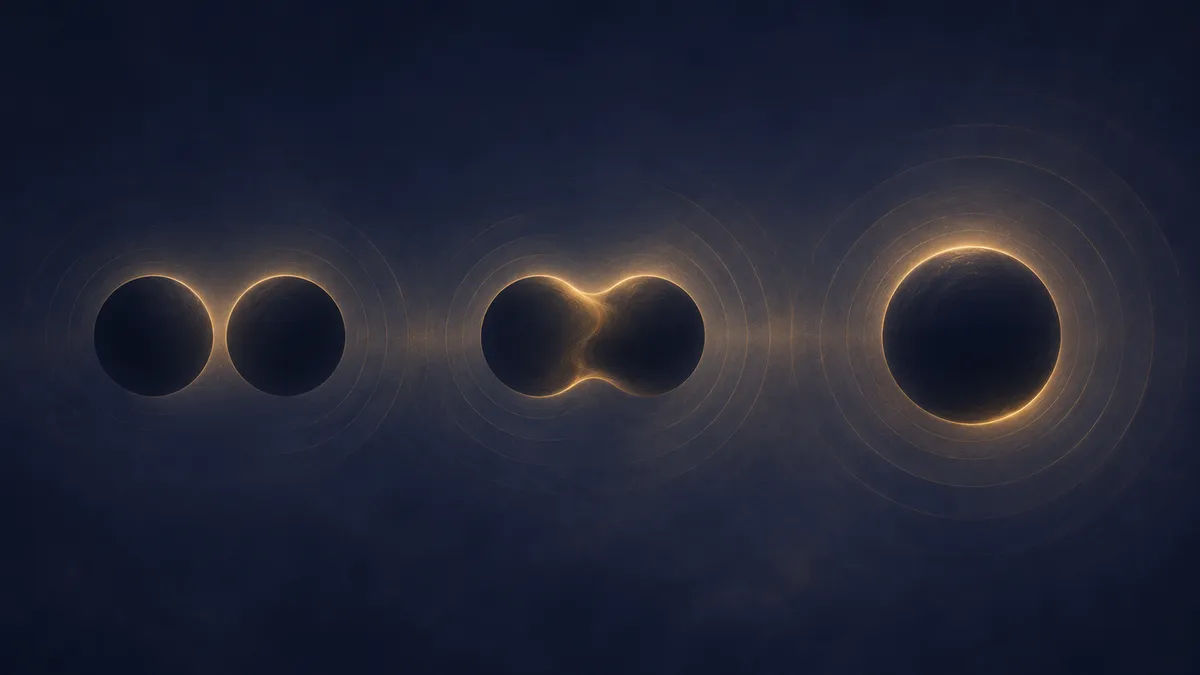
After two black holes merge, the remnant settles down by ringing in gravitational waves. Researchers are asking what that fading signal can reveal about how gravity behaves.
Listening to the settling remnant
A black-hole merger sends ripples through spacetime. After the merger, the newly formed black hole settles into a quieter state. Physicists call the fading gravitational-wave signal from this stage the ringdown. It can be modeled as a combination of characteristic oscillations, or modes, each with its own frequency and decay.
Some predicted contributions arise from nonlinear interactions between simpler modes. In general relativity, gravity itself can participate in producing further gravitational radiation. A quadratic mode is one such predicted contribution. Its amplitude is expected to depend on the amplitudes of its parent modes and on the spin of the remnant black hole.
In an arXiv paper, Yuxin Yang and colleagues analyze the ringdown of the gravitational-wave event GW250114. Instead of only asking whether an additional mode is present, they estimate a coupling coefficient: the ratio linking the amplitude of a modeled quadratic mode to the product of the amplitudes of its parent modes.
A consistency check, not a final verdict
The researchers use Bayesian inference, a statistical method that combines a model and prior assumptions with the observed data to estimate a range of plausible parameter values. Their ringdown model contains two linear modes, labeled 220 and 221, and a quadratic mode labeled 220 × 220. They compare the inferred coupling with predictions based on numerical-relativity fits and second-order black-hole perturbation theory.
The estimated coefficient is consistent with those predictions within the reported uncertainties: none of the comparisons exceeds a 1.3-standard-deviation discrepancy. The present data do not distinguish among the spin-dependent predictions considered. Agreement at this precision is therefore a consistency check, not proof that the predictions are uniquely correct.
The inference fixes the luminosity distance and viewing inclination, changes with the chosen ringdown start time, and could be biased by an unmodeled 440 mode. A quadratic contribution is included in the model, so the inferred coefficient should not be confused with an independent, definitive detection of nonlinear modes. Stronger observations and adequate modeling will be needed to discriminate among competing predictions. The arXiv version says the manuscript was accepted for publication in The Astrophysical Journal after revision following referee comments.
- gravitational waves
- black hole ringdown
- general relativity
- nonlinear modes
Related reading
Automatically matched by shared topic keywords. These links do not imply that the sources agree or establish a consensus.
Neutron Star Tides Could Complicate Tests of Einstein’s Gravity
Source published
Shared keywords: general relativity, gravitational waves
Can a simpler star simulation recover tides in gravitational waves?
Source published
Shared keywords: general relativity, gravitational waves
A single stellar vibration captures much of neutron stars’ tidal response
Source published
Shared keywords: general relativity, gravitational waves
A dark-star model links a mass ceiling to gravitational-wave signatures
Source published
Shared keywords: general relativity, gravitational waves
A simpler strategy holds up in searches for gravitational-wave memory
Source published
Shared keywords: gravitational waves