TRANSMISSION // 2609.25980v2
How Separate Forecasts Become Joint Paths
Source published
Researchers test whether historical patterns can combine time-series model forecasts into multivariate sample paths, without retraining the models.
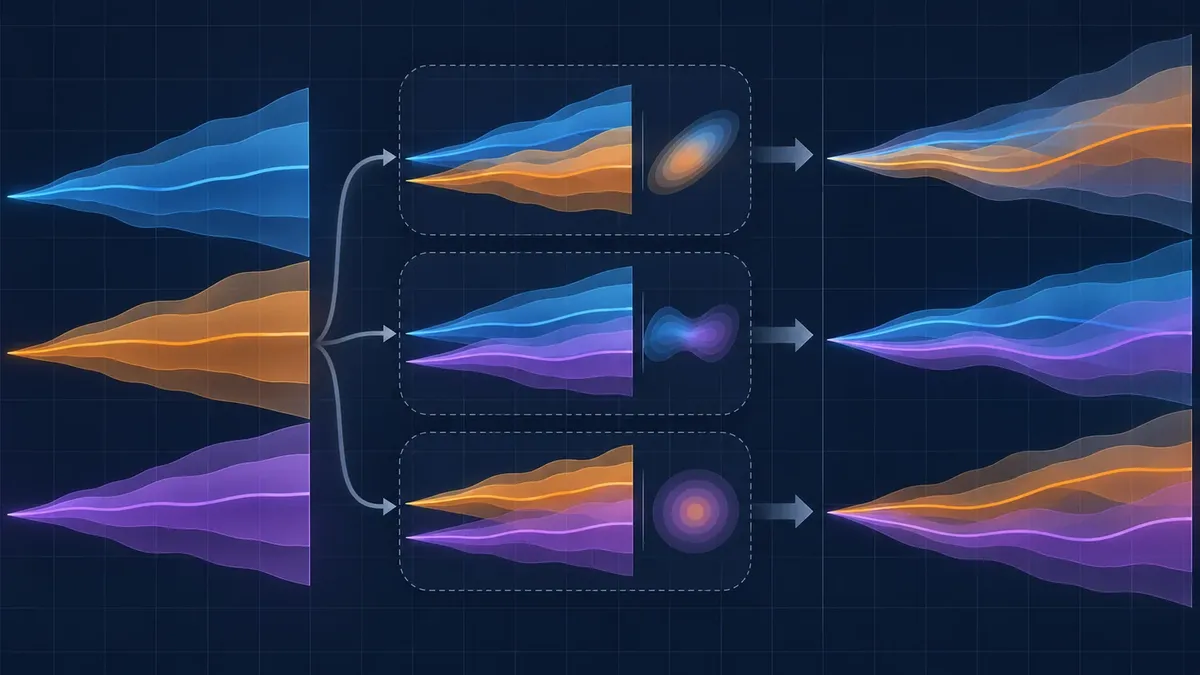
A forecast can describe the likely range for each variable without specifying which outcomes occur together. Researchers tested whether simple, training-free methods can use historical patterns to build joint forecast paths while keeping the individual forecast samples fixed.
Imagine a hypothetical weather forecast that estimates temperatures at several locations and hours. Those separate probability distributions do not, by themselves, say whether warm conditions occur at the same time across locations or how one hour relates to the next. Many different joint forecasts can share the same individual distributions.
Jinmyeong Choi and colleagues study how to turn such marginal forecasts—the distributions for individual variables at individual forecast steps—into multivariate sample paths. A path is one possible future across variables and time. The question is whether historical relationships can help arrange those forecasts into more informative joint scenarios, without retraining the forecasting models.
Holding individual forecast samples fixed
The researchers evaluated three frozen probabilistic time-series foundation models: Chronos-2, TimesFM-3 and TiRex-2. The benchmark covered 14 multivariate forecasting tasks. In the primary experiments, the models used their native multivariate inference, meaning their forecasts could condition on the histories of other channels. But even when a model uses multivariate history, its coordinate-wise predictive distributions do not specify how future values across channels and time should co-occur.
To isolate that missing dependence, the main comparison gave every method exactly the same finite set of forecast values at each channel-and-horizon coordinate. Methods changed only which values were paired together across sample paths. This fixed-marginal design makes it possible to study coupling—the arrangement of outcomes into joint scenarios—without changing the individual samples.
The authors tested simple methods that do not train or fine-tune the frozen backbones. Their main Gaussian-copula methods estimated temporal persistence and cross-channel relationships from pre-forecast history. One represented temporal dependence within channels; another represented dependence between channels; a combined version represented both. A separate control tested fixed temporal-persistence assumptions. The study also included a Schaake-style method, which uses historical rank patterns as templates, and complementary direct sampling, where finite marginal samples are not forced to match exactly across methods.
The researchers scored the joint forecasts using the Energy Score and two Variogram Scores. One Variogram Score targets relationships between channels at the same forecast step; the other targets relationships between forecast steps within a channel. Lower scores are better on these measures.
Targeted gains, with qualifications
In the controlled, fixed-marginal benchmark, temporal coupling improved the temporal Variogram Score, while channel coupling improved the cross-channel score. The combined method improved both targeted diagnostics. The Schaake-style method also showed aggregate improvements on both in this controlled benchmark; that does not mean it improved on every task.
These aggregate patterns persisted with sample-path budgets of 10, 50 and 100, though their size varied. The channel-related improvement was not positive on every dataset. In direct sampling, the targeted pattern also persisted, but the finite marginal sample sets could differ between methods, so this is not the same coupling-only comparison.
For a specific reference point, at 100 paths in the controlled, fixed-marginal benchmark, the combined method had 21.61% IID-relative skill on the temporal Variogram Score and 4.69% on the cross-channel Variogram Score. “IID-relative” means the scores were compared with independent sampling; these percentages are not absolute accuracy improvements. The method’s Energy Score skill against that same baseline was 2.52%.
Comparisons between coupling methods were more limited. At 100 paths in the controlled benchmark, the combined method’s Energy Score difference from temporal-only coupling was uncertain: its reported interval included zero. That does not establish that the methods are equivalent. Against Schaake-style coupling, the combined method had higher normalized skill on Energy Score and global-maximum CRPS in the reported comparisons. These are metric-specific results with individual intervals and no multiplicity correction, not evidence of broad superiority.
The targeted benefits also remained when the backbones used native multivariate inference. This does not show that multivariate inference itself caused an improvement, because changing inference mode also changes the marginal forecasts.
What remains unknown
The results support treating dependence reconstruction as a distinct post-processing problem: individual forecast distributions alone do not determine joint paths, and how samples are paired affects some joint diagnostics. But the study does not show that its methods recover the true conditional dependence or improve decisions in practical deployments.
The findings are limited to the evaluated tasks and three backbones. Historical coupling assumes past relationships remain informative; that can fail when the system’s behavior or dependencies shift. The Gaussian construction is deliberately simplified and cannot capture every channel-specific timing pattern or asymmetric tail relationship. Better scores on selected diagnostics are evidence about those benchmarks and measures, not a guarantee of better forecasts in every setting.
The source is an arXiv preprint whose paper text identifies it as a NeurIPS 2026 workshop paper. That wording alone does not establish acceptance, publication or peer review. The authors frame these methods as simple empirical baselines for assessing richer approaches to dependence construction.
- time-series forecasting
- probabilistic forecasting
- multivariate forecasts
- forecast dependence
- Gaussian copula
- sample paths
Reviewed cross-references
These connections were reviewed by a model, not independently fact-checked by a human. Similarity does not imply agreement; consult the original papers and the evidence below.
Forecasting electricity prices as a connected day
Supporting evidence: Both studies report that dependence can matter for multivariate probabilistic forecast evaluation: the origin study finds that historical couplings improve targeted temporal and cross-channel diagnostics on its evaluated TSFM tasks, while Hirsch reports that adding dependence improves multivariate performance for LEAR-based and univariate online regression models in German day-ahead electricity forecasting. This supports only the bounded point that dependence modeling can affect joint-forecast scores; the settings, methods, and metric results differ, and the multivariate regression model’s variogram and energy scores degrade.
Model review: · openai-codex/gpt-6-luna
Evidence and provenance
Selected excerpts, not complete papers. PDF extraction can omit figures or damage equations, tables and reading order; sources may be preprints.
2609.25980v2 — Original paper
Excerpt reference:
static/papers/2609.25980v2.md:259-326
Basis: Paper text
Source SHA-256:da9f158592fcd7c728ef8c7e9a3b33c48cc6e134bd016534ed7f40dd1e01ae192504.02518v5 — Original paper
Excerpt reference:
static/papers/2504.02518v5.md:2009-2079
Basis: Paper text
Source SHA-256:9ae90f4ab0fc6808b4e4bfe4b0b6faeb134a0d0e3fc14c2dc619a9dae325e8422504.02518v5 — Original paper
Excerpt reference:
static/papers/2504.02518v5.md:2210-2254
Basis: Paper text
Source SHA-256:9ae90f4ab0fc6808b4e4bfe4b0b6faeb134a0d0e3fc14c2dc619a9dae325e842
Related reading
Automatically matched by shared topic keywords. These links do not imply that the sources agree or establish a consensus.
A text watermark designed for draft-and-check AI generation
Source published
Shared keywords: gaussian copula
How Forecasting Methods Handle Uncertainty
Source published
Shared keywords: probabilistic forecasting
Forecasting electricity prices as a connected day
Source published
Shared keywords: probabilistic forecasting
Forecasting a language model’s answer activity before it responds
Source published
Shared keywords: probabilistic forecasting
How should forecasts respond to scenarios?
Source published
Shared keywords: time series forecasting