TRANSMISSION // 2609.25842v2
Could a magnetic kink accelerate particles in X-ray binary jets?
Source published
A model study finds that kink instability could grow inside compact X-ray binary jets and help accelerate particles, with predicted emission scales depending on jet conditions.
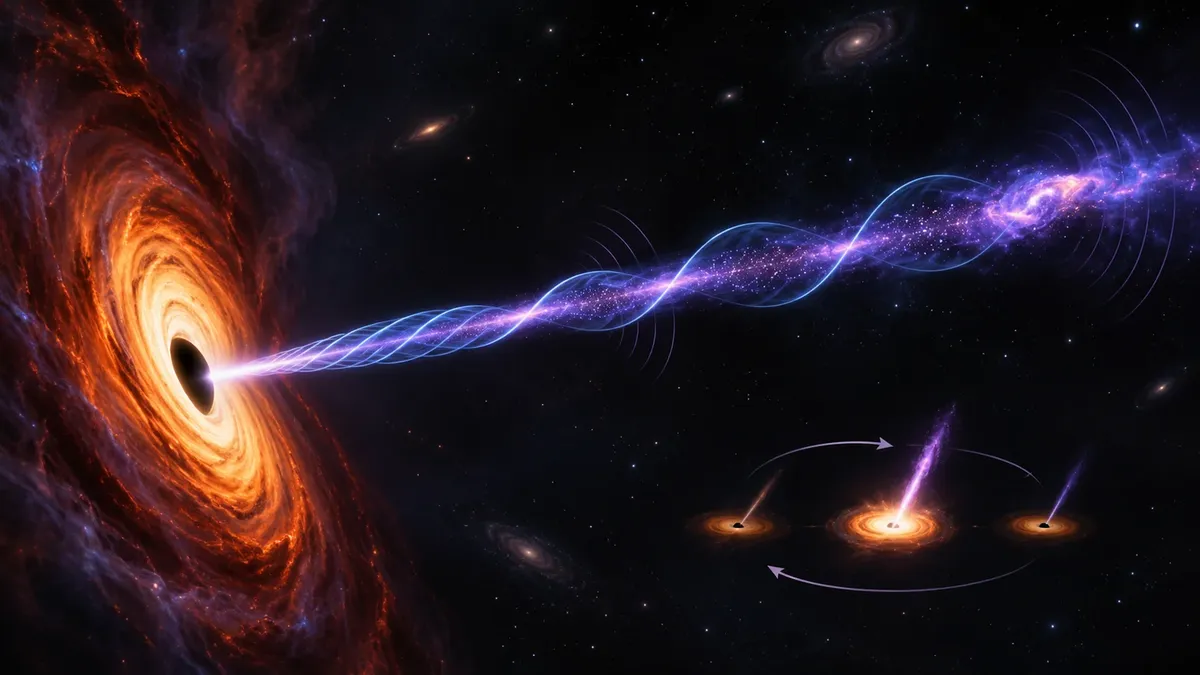
Jets from black-hole X-ray binaries change as their systems flare and shift between accretion states. A new model study asks whether a twisting magnetic instability could help accelerate particles in these jets—and whether changes in the jet might help explain the changing radio emission seen during an outburst.
Black-hole X-ray binaries can launch narrow jets of fast-moving material. In the hard accretion state, these systems are associated with compact, steady jets; as they change state, the jets can flare, fade or give way to discrete ejections. But how particles gain energy inside the jets—and how that process changes during an outburst—remains unsettled.
A study by Emma L. Elley and colleagues investigates one possibility: the kink instability. In a magnetised jet, a disturbance can grow into a helical, bent shape rather than leaving the jet straight. As the magnetic structure changes, magnetic energy may be released, potentially helping accelerate particles that produce radiation. The instability is not the only proposed mechanism; internal shocks, created by changes in jet speed, may also contribute.
Following a disturbance along a model jet
The researchers use a one-dimensional model to represent how a jet’s width, speed and magnetisation change with distance from a black hole. They calculate how quickly a kink-like disturbance could grow as jet material travels outward, exploring a range of model parameters. They then estimate where magnetic energy might be dissipated, drawing on earlier simulations of kink development and scaling their results to the modelled jet widths. Finally, they consider how radiation from accelerated particles could cool the jet and affect its evolution.
This is a chain of modelling steps, not a direct observation of a kink in an X-ray binary jet. The one-dimensional calculation estimates the instability’s growth but does not capture its nonlinear development—the complex behaviour after a disturbance becomes large. Estimates of energy dissipation also depend on scaling results from simulations that were not designed specifically to reproduce these binary jets.
A plausible instability, with several possible outcomes
Across a plausible range of model parameters, the authors find that the kink instability is likely to grow substantially within the acceleration region of hard-state, compact jets. In their calculations, the disturbance can pass beyond the regime where a small, linear perturbation is an adequate description. This makes the instability a candidate for influencing both magnetic-energy release and particle acceleration near the jet base.
The predicted distance over which energy is dissipated varies with the assumed jet properties. Depending on those choices, the model permits emission over scales associated with a very compact, or “failed,” jet, as well as scales consistent with resolved radio observations of compact jets. These are possible outcomes of the model, not a claim that the same jet must produce both appearances or that the instability has been observed directly.
The authors also connect their calculations to the outburst cycle. They argue that as accretion increases during a hard-to-soft transition, changes in jet speed and magnetisation could make the jet more stable to the kink instability. In the model, a more stable jet can dissipate energy over a greater distance, potentially producing a more extended emitting region. But what a radio telescope actually resolves also depends on brightness: a physically extended jet could have portions too faint to detect. The proposed connection is therefore a model-based interpretation, not a demonstrated cause of observed changes.
The paper estimates that kink-driven dissipation could provide enough energy for flaring within its adopted framework. That estimate depends on how much magnetic energy goes into particle acceleration rather than bulk motion, among other assumptions. The authors also discuss discrete ejecta, but do not establish that kink instability alone produces them; they identify challenges for that explanation and call for further simulations.
What remains uncertain
The main result is about feasibility: the instability appears capable of growing in the relevant region under many of the modelled conditions. It does not show that kinks are the dominant accelerator in real systems, nor rule out internal shocks or other processes. The authors stress that more realistic simulations should follow both the onset and nonlinear development of the instability while also treating radiation and jet-launching physics.
The supplied paper text identifies the work as a 2026 preprint and says it was accepted by Monthly Notices of the Royal Astronomical Society. This article summarizes that paper; the calculations are model estimates rather than new observational data, and their conclusions remain conditional on the models and assumptions used.
- X-ray binaries
- black-hole jets
- kink instability
- particle acceleration
- magnetic reconnection
- astrophysics
Related reading
Automatically matched by shared topic keywords. These links do not imply that the sources agree or establish a consensus.
Late solar radio bursts point to particle acceleration after a flare’s peak
Source published
Shared keywords: magnetic reconnection
Magnetic field geometry changes the pace of simulated reconnection
Source published
Shared keywords: magnetic reconnection
NGC 1300’s X-ray sources flicker across the ULX threshold
Source published
Shared keywords: x ray binaries
Magnetic disturbances could reshape polarized light around black holes
Source published
Shared keywords: magnetic reconnection
Small magnetic patches can bring a simulated solar eruption forward
Source published
Shared keywords: magnetic reconnection