TRANSMISSION // 2609.24984v2
How WorldCrafter helps video worlds remember
Source published
WorldCrafter gives an interactive video model a compact, viewpoint-aware memory intended to make scenes more consistent when revisited. In benchmark tests, the authors report stronger revisit consistency and camera control than the systems they compared. The model still drifts over time, and its memory can miss details seen only from narrow viewpoints.
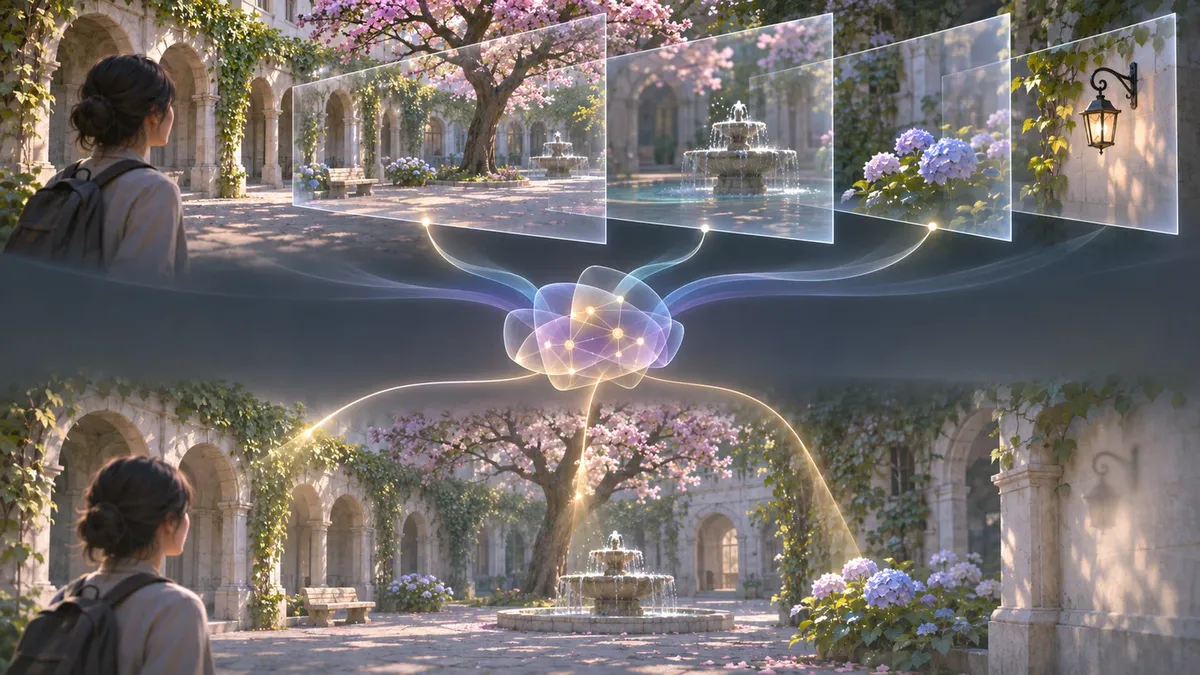
A generated world can look convincing moment to moment yet fail a simple test: turn away, come back, and see whether the place still looks the same. WorldCrafter is designed to help video models pass that test by storing a compact record of earlier views and consulting it when generating a new camera angle.
The challenge: remembering a changing view
Interactive video models generate new images as a user moves a virtual camera. But their recent video history may not include a place seen much earlier—or may not show it from the angle now requested. The result can be a scene that looks plausible but changes when the camera returns.
WorldCrafter, a system described by Wangbo Yu and colleagues, aims to preserve past observations across long explorations and changing viewpoints. Its central idea is to summarize earlier views in a learned memory that can be queried according to the camera’s upcoming path. The authors call this memory “implicit 3D-aware”: it is intended to carry information about scene layout and appearance without building an explicit 3D model from depth-based correspondences.
How the memory works
WorldCrafter generates video in successive chunks. Recent frames help the model continue visible motion, while the longer-term memory is meant to preserve information from earlier in the session. For each new chunk, the system selects historical frames that together cover the views the camera is expected to visit. A memory encoder compresses those frames into a representation, and a pose-conditioned readout turns that representation into a fixed set of tokens for the video generator. In plain language, the requested viewpoint helps determine which remembered details are passed along.
The memory encoder, readout module and video generator are trained together, allowing the memory to adapt to what the generator can use. The model also uses camera-pose conditioning and few-step distillation—a training technique intended to reduce the number of steps needed to generate video. The authors report that a fast version runs at 16 frames per second on a four-GPU machine. That is a hardware-specific result, not a claim about performance on ordinary computers.
What the tests found
The team tested the system on 145 starting images: 83 scenes featuring dynamic objects and 62 static scenes. Each was paired with five camera paths, producing 725 videos per method. The paths lasted 528 to 1,648 frames and included returns to previously visited views. The authors compared WorldCrafter and its faster version with eight other camera-controllable video models, using measures of revisit similarity, camera-path accuracy and visual quality.
On this benchmark, the authors report that WorldCrafter achieved the best results among the listed methods on all four revisit-consistency measures and all three camera-control error measures. For example, its reported LPIPS score was 0.255, compared with 0.487 for Lyra 2.0; lower LPIPS indicates greater perceptual similarity in the paired frames. The faster version ranked third on each of the three camera-control metrics, according to the paper.
The authors also tested the fast model on ORBIA, a separate benchmark of camera-controlled exploration. It received an overall score of 80.50, compared with 76.32 for the next-highest result listed, SolarWM-H3. These scores depend on ORBIA’s evaluation setup and should not be read as a universal ranking of world models. In component tests, replacing the learned memory with a small set of retrieved frames, or removing viewpoint-guided readout, worsened reported consistency and camera control. Such ablations support the authors’ design choices within their experiments; they do not establish that the same choices will help in every setting.
What remains uncertain
The paper acknowledges that generated scenes can still drift during prolonged exploration: errors in one chunk can enter the history and affect later chunks. It also notes that selecting a limited set of earlier views may miss details visible only from a narrow range of angles. And although the system is presented as supporting interactive exploration, the reported benchmarks and demo do not by themselves show that it is a reliable physical simulator or that it is ready for real-world use.
These results come from the authors’ own benchmark choices, comparison systems and metrics. Some camera and geometry measures rely on automated estimates, which can affect evaluation. The reported comparisons therefore show performance under the tested conditions, not independent confirmation across all scenes or applications.
This article is based on the arXiv paper identified as version 2, not an independent replication. An arXiv preprint is a research manuscript and may not have undergone peer review; source extraction can also lose table or formatting details. The evidence supports a promising approach to visual memory for generated worlds, alongside clear limitations—not a guarantee that an AI-generated environment will remember every detail.
- WorldCrafter
- video world models
- AI memory
- camera control
- 3D-aware representation
- video generation
Reviewed cross-references
These connections were reviewed by a model, not independently fact-checked by a human. Similarity does not imply agreement; consult the original papers and the evidence below.
EvoWorld tests whether AI-generated worlds can change while the camera looks away
Supporting evidence: Both papers treat preserving previously seen subjects across camera movement as important: WorldCrafter reports improved revisit consistency using pose-guided memory, while EvoWorld includes revisit success alongside event realization and causal reactions. This supports the bounded point that revisit consistency matters, not that the methods or results are directly comparable: WorldCrafter studies camera-controlled scene exploration, whereas EvoWorld tests event-conditioned reactions after subjects leave view.
Model review: · openai-codex/gpt-6-luna
Evidence and provenance
Selected excerpts, not complete papers. PDF extraction can omit figures or damage equations, tables and reading order; sources may be preprints.
2609.24984v2 — Original paper
Excerpt reference:
static/papers/2609.24984v2.md:240-295
Basis: Paper text
Source SHA-256:711df875dc0719d6482cdaa3f1a8c3816ae79e5ef75775be75a5f27fb47481242611.06748v2 — Original paper
Excerpt reference:
static/papers/2611.06748v2.md:77-111
Basis: Paper text
Source SHA-256:56d85315e232f90c720cd5e8ca3414f7bd4badc3e3ccae2d3f0eadf69cfdb33d2611.06748v2 — Original paper
Excerpt reference:
static/papers/2611.06748v2.md:801-896
Basis: Paper text
Source SHA-256:56d85315e232f90c720cd5e8ca3414f7bd4badc3e3ccae2d3f0eadf69cfdb33d
Related reading
Automatically matched by shared topic keywords. These links do not imply that the sources agree or establish a consensus.
TouchéWorld brings camera and hand controls together in generated video
Source published
Shared keywords: camera control, video generation, video world models
Teaching robot video models to focus on what moves
Source published
Shared keywords: video generation
When AI’s imagined drives miss the odds
Source published
Shared keywords: video generation
How video AI can remember the right character
Source published
Shared keywords: ai memory, video generation
WorldFlow predicts motion in both pixels and 3D
Source published
Shared keywords: video generation