TRANSMISSION // 2609.24948v3
A fuller picture of galaxy cluster mass
Source published
Simulations suggest two-dimensional weak lensing can improve estimates of cluster mass and offset, while ellipticity remains hard to measure for individual clusters.
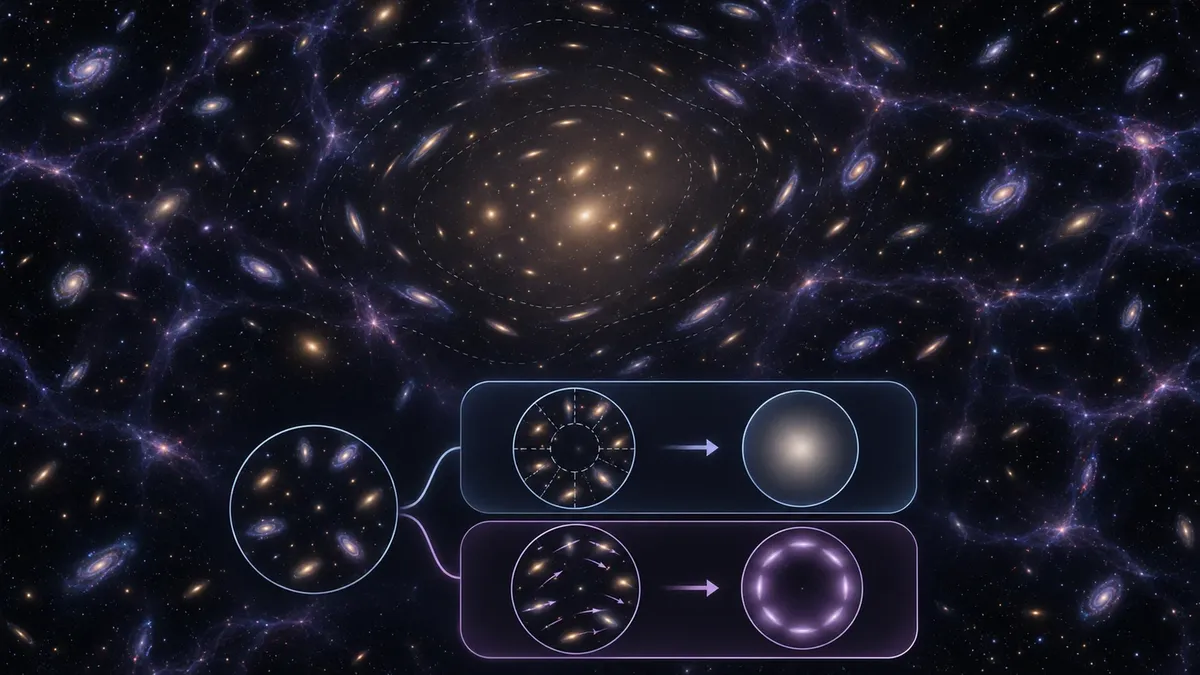
Galaxy clusters bend light from more distant galaxies, leaving subtle patterns in their apparent shapes. A simulation-based method uses more of those patterns than a circular average, while modeling other matter that also affects the light. Its gains are promising, but they have been tested on simulated observations, and some cluster properties remain difficult to pin down.
Weak gravitational lensing offers a way to estimate galaxy cluster masses without relying on how the cluster’s contents move. A cluster’s gravity slightly distorts the shapes of more distant galaxies; the pattern of distortions can reveal the mass, including dark matter. But the signal is subtle, and other matter along the light’s path also affects what is observed.
Calum Murray, Martin Kilbinger and Constantin Payerne investigate whether keeping directional information in the lensing pattern can improve estimates of cluster properties. The source is an Astronomy & Astrophysics proof manuscript whose received and accepted dates are blank; it does not establish the work’s peer-review or publication status.
Why keep the sky’s shape?
A common method averages the lensing signal in rings around a cluster, turning it into a one-dimensional profile. This is convenient, but it loses directional detail. If the mass is offset from the identified cluster centre or shaped like an oval, its signal is not perfectly circular and may be blurred by that averaging.
The analysis also accounts for two kinds of large-scale structure: matter correlated with the cluster’s cosmic-web environment, and uncorrelated structures elsewhere along the line of sight. These contributions affect the shear pattern and its uncertainty. The authors’ approach aims to use the spatial correlations in the modeled signal more effectively than a circular average does.
Simulating and summarizing the signal
The team built a forward model that generates mock reduced-shear fields from assumed cluster properties and surrounding matter. It includes an elliptical Navarro–Frenk–White cluster profile, possible miscentering, correlated structure drawn from N-body simulations, uncorrelated line-of-sight matter, and noise from the intrinsic variety of galaxy shapes.
The inference does not use every pixel of a generated field directly. Instead, the researchers compress the simulated fields into summaries and use simulation-based inference to estimate posterior distributions for cluster mass, concentration, ellipticity and offset from the assumed centre. Their neural posterior estimator combines a learned embedding with a masked autoregressive flow.
They compare two summaries. The one-dimensional version averages the signal in 15 radial bins. The two-dimensional version divides each ring into 10 angular sectors and retains tangential and cross-shear components. The study uses mock observations rather than measurements of a new sample of real clusters.
What improved—and what remains uncertain
In the tested simulations, the two-dimensional summary generally produced narrower posterior estimates. For mass, the reported improvement ranged from 3% to 18% across the tested cases. At a source density the authors associate with Stage IV surveys, the average mass improvement was 8%; at the highest tested density, it reached 18%. Concentration and miscentering estimates also improved, with the largest gains reported for miscentering.
The mass improvement was attributed to better treatment of spatially correlated large-scale-structure noise, rather than simply to recovering the cluster’s shape. Directional information is particularly relevant to miscentering: an offset can create an anisotropic pattern that circular averaging largely hides. Including cross-shear, which can carry information about anisotropic features, improved miscentering and concentration constraints in some tested cases.
Ellipticity needs a careful interpretation. The two-dimensional summary narrows its posterior somewhat, especially at higher simulated source densities, but ellipticity for an individual cluster remains prior-dominated. In other words, the estimate still depends strongly on assumptions used to set the prior; the reported narrowing does not establish a precise, independently informative ellipticity measurement. The authors suggest that stacking clusters could help, but that is not demonstrated here as an individual-cluster result.
The simulations also show the importance of including line-of-sight structure. When both correlated and uncorrelated large-scale structure were omitted, mass uncertainty was underestimated. For the most massive clusters tested, the uncertainty in the no-structure model was 2.2 times smaller than in the model including both contributions. This result applies to the modeled cases, not as a universal correction for observed clusters.
Limits and next steps
The model does not include cluster substructure, which the authors identify as a possible reason for a mismatch with another simulation. They also do not study contamination of the background-galaxy sample by foreground or cluster-member galaxies, or intrinsic alignments of cluster members. Those effects depend on survey conditions and redshift information. Handling changing source densities and survey masks will require additional work as well.
The authors report posterior-calibration tests and comparisons with the Euclid Flagship simulation. These checks support the method within the tested setup, but they do not establish performance on real survey data or remove the modeling limitations. Further tests with survey observations and more complete models will be needed to determine how well the approach works in practice.
- weak gravitational lensing
- galaxy clusters
- dark matter
- simulation-based inference
- large-scale structure
- cluster mass
Reviewed cross-references
These connections were reviewed by a model, not independently fact-checked by a human. Similarity does not imply agreement; consult the original papers and the evidence below.
A galaxy-cluster collision with a possible third player
Shared method: Both studies use weak-lensing shear with NFW halo models to infer cluster mass; Murray et al. also model ellipticity and miscentering in a two-dimensional forward model, while Stancioli et al. compare spherical and elliptical halo configurations for one merging cluster. This is a methodological overlap, not evidence that their particular mass or halo interpretations agree.
Model review: · openai-codex/gpt-6-luna
Evidence and provenance
Selected excerpts, not complete papers. PDF extraction can omit figures or damage equations, tables and reading order; sources may be preprints.
2609.24948v3 — Original paper
Excerpt reference:
static/papers/2609.24948v3.md:137-233
Basis: Paper text
Source SHA-256:721cf520c2899442bd423705eddf14b49a957a7e828447dc07d37ede7a4878fc2609.24948v3 — Original paper
Excerpt reference:
static/papers/2609.24948v3.md:16-69
Basis: Paper text
Source SHA-256:721cf520c2899442bd423705eddf14b49a957a7e828447dc07d37ede7a4878fc2611.33941v1 — Original paper
Excerpt reference:
static/papers/2611.33941v1.md:829-915
Basis: Paper text
Source SHA-256:5bc41b2c72964f40d7c54e5a1f9431a4d21a3cd1d71d35552c81cbe94fdffcdd2611.33941v1 — Original paper
Excerpt reference:
static/papers/2611.33941v1.md:540-667
Basis: Paper text
Source SHA-256:5bc41b2c72964f40d7c54e5a1f9431a4d21a3cd1d71d35552c81cbe94fdffcdd
Related reading
Automatically matched by shared topic keywords. These links do not imply that the sources agree or establish a consensus.
Galaxy Distortions Put Limits on Giant Primordial Black Holes
Source published
Shared keywords: dark matter, large scale structure, weak gravitational lensing
A galaxy-cluster collision with a possible third player
Source published
Shared keywords: dark matter, galaxy clusters, weak gravitational lensing
Quasar pairs offer a way to map young galaxy clusters
Source published
Shared keywords: large scale structure
Can AI read cosmic structure without becoming overconfident?
Source published
Shared keywords: simulation based inference, weak gravitational lensing
Blue disc galaxies align with the cosmic web
Source published
Shared keywords: weak gravitational lensing