TRANSMISSION // 2609.24352v2
Few-shot examples may help tested LLMs use world representations
Source published
An arXiv preprint reports that few-shot examples from worlds with the same or different graph structures improved prediction in tested language models. The authors also found changes in graph-related internal representations; how broadly the results apply remains uncertain.
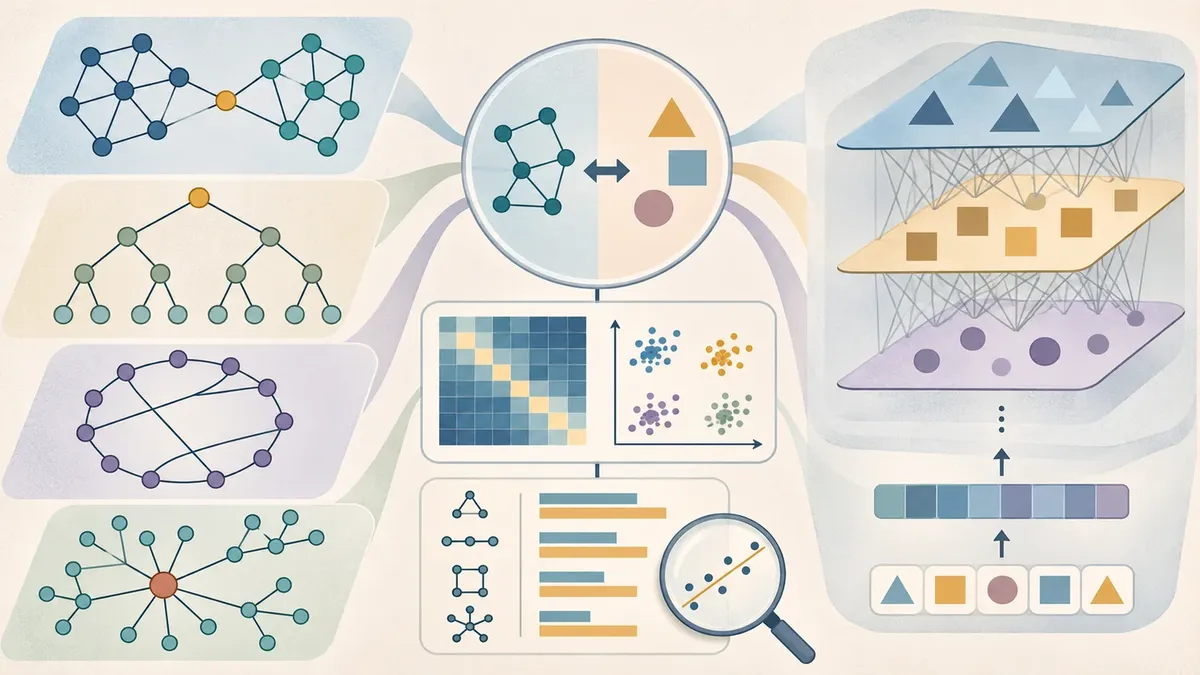
Language models are often given examples before tackling a task. Could examples drawn from more than one rule-governed setting help them make better predictions—and change how they represent the task internally? A preprint explores that question using graph prediction and several other benchmarks.
The question: can models use patterns learned from context?
An AI agent may need to use observations to work out the structure of a setting, then make predictions based on it. The paper studies this idea with a graph-tracking task. In a schematic graph, points are linked by connections, and the pattern of links defines its structure. The abstract does not give enough detail to describe the task’s exact questions or procedure, but it says models must construct a representation of the graph underlying the observations and use it for prediction.
The authors build on prior work that, they say, found language models struggled to use representations learned in context on this task. Their question is whether few-shot demonstrations—examples included in the prompt—can help, and whether the relationship between the worlds represented in those examples matters. The study tests demonstrations generated from worlds with either the same or different graph topologies. A topology is the arrangement of connections in a graph.
What the researchers did
The authors evaluated nine language models from seven model families. They compared performance with few-shot demonstrations involving worlds that shared a graph topology or had different topologies. The abstract reports that extending the task to these few-shot settings enhanced prediction, but does not provide the exact scores or enough methodological detail to establish which particular setup accounts for the gains.
To examine the models’ internal activity, the researchers used linear probes: readouts that test whether selected information can be recovered from hidden states, the numerical representations inside a model. They report probing a low-dimensional representation that encodes graph information. They also intervened on these representations and compared the effects on performance with interventions on other subspaces.
The abstract does not include the full protocol, model names, exact results, or detailed statistical analyses. Those details would be needed to evaluate the experiments more fully, so the account here is limited to claims in the abstract.
What the preprint reports
Few-shot demonstrations improved prediction on the graph-tracking task across the tested models. The authors report that the graph-related representations shifted when models received few-shot examples. The new directions were nearly orthogonal to the representations’ original subspace—roughly, they pointed in directions largely distinct from the earlier ones.
Interventions on the identified representations impaired performance more selectively than interventions on other subspaces, according to the abstract. This supports the idea that the graph-related representations were functionally relevant to prediction in the tested setup. It does not show that a model has a complete or human-like understanding of a world. Here, “world representation” means an internal pattern associated with graph information, as identified through the authors’ analysis.
The paper also reports improved performance with few-shot demonstrations on ARC-AGI-1 and ARC-AGI-2, web-agent tasks, and Othello. These results indicate that the authors tested the approach beyond the graph task. The abstract gives no benchmark-level scores, so the size and consistency of the reported gains across these settings cannot be assessed here.
What remains uncertain
The available evidence is the paper’s abstract, not its full text. It does not provide enough information to assess the detailed task designs, baselines, evaluation choices, or statistical analyses. That is a limit of the evidence available here, not evidence that such analyses were absent. The abstract also does not establish how reliably the results would transfer to other models or tasks beyond those reported.
The internal analysis calls for careful interpretation. A probe can show that information is detectable in a model’s hidden states; an intervention can test whether changing a selected representation affects performance. Neither result, by itself, demonstrates that the model thinks about a world as a person does. The abstract reports representation shifts alongside performance improvements, but does not settle all the causal steps by which demonstrations may produce those gains.
This work is an arXiv preprint. The supplied source does not establish its peer-review status, and preprint findings should be treated as provisional pending further assessment and replication. The study offers evidence that few-shot examples can affect both prediction and graph-related internal representations in the tested models. Whether the same pattern holds more broadly remains an open question.
- large language models
- in-context learning
- few-shot demonstrations
- world representations
- graph prediction
- AI agents
Reviewed cross-references
These connections were reviewed by a model, not independently fact-checked by a human. Similarity does not imply agreement; consult the original papers and the evidence below.
What ICLWorld Reveals About AI Agents on Screens and Robots
Supporting evidence: Both studies report better task performance when models use information supplied in context: the origin paper reports improved graph prediction with few-shot demonstrations from different worlds, while ICLWorld reports that removing task rules reduced agents’ success to at most 8%. The evidence is complementary, not a direct replication: the tasks, agents and forms of context differ.
Model review: · openai-codex/gpt-6-luna
Evidence and provenance
Selected excerpts, not complete papers. PDF extraction can omit figures or damage equations, tables and reading order; sources may be preprints.
2609.24352v2 — Original paper
Excerpt reference:
content/articles/2609.24352v2.md#extra.abstract
Basis: Abstract only; full paper text was not used for this evidence
Source SHA-256:f52a8d2e82e3173d370987c296599f69ae04aa3badd6a0c3580e00c6ee731aa92611.32649v1 — Original paper
Excerpt reference:
static/papers/2611.32649v1.md:215-290
Basis: Paper text
Source SHA-256:7f551d1d27d0710b2fece4088f1aaab6af3f4b65897a58b38c7422ac99a985be
Related reading
Automatically matched by shared topic keywords. These links do not imply that the sources agree or establish a consensus.
What ICLWorld Reveals About AI Agents on Screens and Robots
Source published
Shared keywords: ai agents, in context learning
What Numerical Patterns Look Like Inside Language Models
Source published
Shared keywords: in context learning, large language models
What would make an AI agent genuinely curious?
Source published
Shared keywords: ai agents, in context learning
Can a Small Selector Learn Which Examples Help a Language Model?
Source published
Shared keywords: in context learning, large language models
MotionDecipher turns gait measurements into AI-assisted clinical descriptions
Source published
Shared keywords: in context learning, large language models