TRANSMISSION // 2609.24295v4
When diamond’s vacancies combine, a qubit may keep its coherence longer
Source published
A simulation study challenges the idea that vacancy clusters in diamond necessarily worsen the coherence of nearby nitrogen-vacancy spins. It predicts that, at equal density of paramagnetic spins, several multi-vacancy environments preserve Hahn-echo coherence longer than isolated negatively charged vacancies. The proposed reason is that differently oriented defects have different transition frequencies and therefore exchange spin states less readily. The result is theoretical, with important limits in the simulation and no direct experimental test of the central comparison.
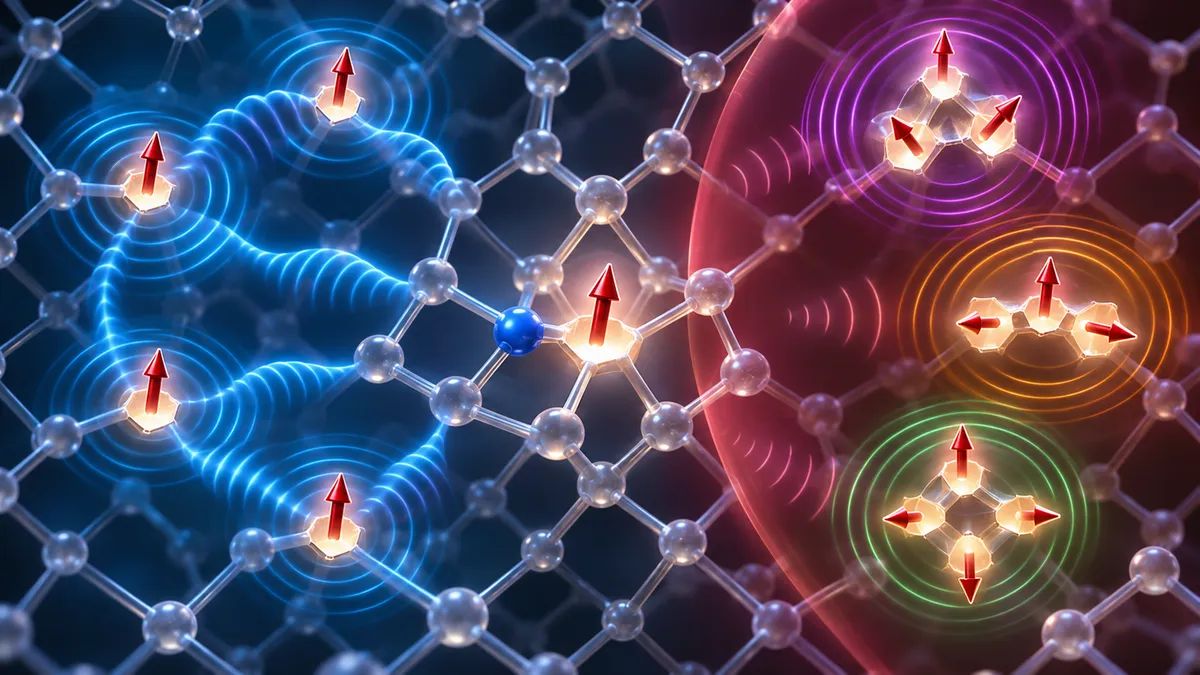
In diamond, nitrogen-vacancy centres can act as quantum sensors, but their spins lose coherence when their surroundings fluctuate. Vacancies left by material processing can aggregate into larger defects, often carrying spin. Are those clusters especially harmful neighbours—or can their internal structure make the surrounding magnetic noise less effective? A new simulation study argues for the latter in a specific case: negatively charged vacancies and multi-vacancy defects around NV centres.
The question behind the calculation
A negatively charged nitrogen-vacancy centre, or NV⁻, is a defect in diamond whose spin can be controlled and read optically. Its coherence time describes how long that spin retains useful quantum information. In a Hahn-echo measurement, a pulse sequence partly cancels slow disturbances; the remaining echo decay provides a measure called T₂. Longer T₂ is useful for quantum sensing and other spin-based applications.
The surrounding defects matter because their electron spins create fluctuating magnetic fields. The study focuses on vacancy-related defects formed when diamond is irradiated or implanted and then annealed. Annealing makes vacancies mobile, allowing them to meet and form multi-vacancy complexes. A common assumption is that these spin-carrying complexes add noise and therefore hurt NV⁻ coherence. Chikara Shinei’s paper asks whether that assumption holds when defect populations are compared at the same paramagnetic spin density.
How the study tested it
This is a computational study, not a new experiment. It uses a method called the cluster-correlation expansion, which estimates how a central spin loses coherence through interactions with its surrounding spin bath. The calculation includes bath spins exchanging spin projections in pairs—a process often called a flip-flop. Such an exchange is most effective when the two defects have matching transition frequencies.
The author first checked the calculation against a better-studied environment: substitutional nitrogen defects, known as P1 centres. The simulated Hahn-echo coherence time was 12% above the measured value, a difference the paper says lies within the combined statistical uncertainty. The study then used published electron-paramagnetic-resonance parameters to model isolated negatively charged vacancies and several multi-vacancy defects. The calculations used a magnetic field of 300 gauss along a specified diamond direction and simulated room-temperature spin populations.
The predicted reversal
At a fixed density of paramagnetic spins, the modeled multi-vacancy baths produced longer NV⁻ Hahn-echo coherence than a bath of isolated negative vacancies. At 1 part per million, the predicted improvement ranged from 3.0 to 6.1 times. Across concentrations from 0.01 to 10 parts per million, the reported range was 2.2 to 6.5 times, though some long-chain defects lose part of their advantage at higher concentrations.
The explanation is not simply that clusters have a large energy splitting. Their fine structure shifts the frequencies at which their spins can transition. But if every defect had the same orientation, those shifts would be alike and neighbouring spins could still exchange. In diamond, a given defect can occupy symmetry-equivalent sites with different orientations. The resulting frequency differences can put neighbouring spins out of resonance, suppressing their flip-flops and slowing changes in the magnetic field seen by the NV⁻.
A controlled model comparison illustrates the proposed mechanism. For one representative defect, changing the spin type gave a factor of 1.40 in coherence time; adding fine structure while keeping a single orientation gave a further factor of 1.19. Allowing the defect’s real set of orientations gave a factor of 2.30 at that step. In short, the study argues that the share of spin pairs with matching transition frequencies matters more than the size of the splitting by itself.
The author also modeled a defect mixture measured after annealing in an earlier study. For the 1000°C composition, the calculated T₂ was 88.4 microseconds, compared with 20.0 microseconds for an equal total spin density of isolated negative vacancies. This is a model-based comparison using defect concentrations digitized from a published graph, not a new measurement of coherence in that exact mixture.
What remains uncertain
The central result is a prediction. Matching one nitrogen-bath measurement supports the simulation approach, but it does not experimentally verify predictions for vacancy clusters. The paper reports several modeling limitations: the cluster expansion is evaluated only to second order, and convergence at higher order is not established. In particular, the isolated-vacancy reference has spin 3/2, a case not covered by cited convergence tests, so possible errors in the comparison ratios are not quantified. Statistical uncertainties also do not capture every sensitivity to simulation settings.
The modeled annealing-series concentrations were read from a graph with roughly 30% accuracy. The study does not extend its calculations to some higher-temperature defect species because their parameters or separate concentrations are unavailable. It also assumes the defect orientations are equally populated; stress during processing could change that distribution. The results apply to the specified charge states: neutral vacancies can behave differently, and the paper notes that aggregation could create paramagnetic centres from otherwise diamagnetic neutral vacancies.
The paper’s practical message is therefore narrower than “vacancy clusters are always good.” In the modeled negatively charged case, aggregation can reduce the number of spin centres and make the remaining spins less able to exchange with one another. The author argues that reducing the total paramagnetic spin count may be more important than simply preventing aggregation. Testing that interpretation will require experiments that identify vacancy charge states and defect populations alongside NV⁻ coherence. This arXiv preprint is provisional research, not settled experimental consensus.
- diamond
- nitrogen-vacancy centres
- spin coherence
- vacancy aggregation
- quantum sensing
- spin-bath simulation
Reviewed cross-references
These connections were reviewed by a model, not independently fact-checked by a human. Similarity does not imply agreement; consult the original papers and the evidence below.
How moving nitrogen spins reshape diamond’s quantum echo
Shared method: Both studies use cluster-correlation-expansion calculations with a dynamical mean field in which bath spins flip-flop in pairs. The vacancy-aggregation study applies this approach to predict NV⁻ coherence in multi-vacancy baths; the P1-bath study uses it to model echo decoherence in substitutional-nitrogen baths. This is a methodological connection, not independent confirmation of the vacancy-bath predictions.
Model review: · openai-codex/gpt-6-luna
Evidence and provenance
Selected excerpts, not complete papers. PDF extraction can omit figures or damage equations, tables and reading order; sources may be preprints.
2609.24295v4 — Original paper
Excerpt reference:
static/papers/2609.24295v4.md:145-184
Basis: Paper text
Source SHA-256:f393682ceff7e5ca3935f3218d19b3b4c28c5b01808be705eb7e965c066755c02611.02528v3 — Original paper
Excerpt reference:
static/papers/2611.02528v3.md:13-64
Basis: Paper text
Source SHA-256:c33376fede80a63368337bec68d6152cbce6eade79bd51215b0a82372b4cebe7
Related reading
Automatically matched by shared topic keywords. These links do not imply that the sources agree or establish a consensus.
A quieter diamond spin bath—if the magnetic field is low
Source published
Shared keywords: quantum sensing, spin coherence
How moving nitrogen spins reshape diamond’s quantum echo
Source published
Shared keywords: quantum sensing, spin coherence
AI agents test quantum-spin predictions and flag a drifting signal
Source published
Shared keywords: nitrogen vacancy centres
When a quantum sensing limit depends on the model
Source published
Shared keywords: quantum sensing
Two microwave tones sharpen a quantum sensor in boron nitride
Source published
Shared keywords: quantum sensing