TRANSMISSION // 2609.24222v2
Modelling Black-Hole Mergers Across Galaxy Histories
Source published
A galaxy-evolution framework predicts where binary black holes merge and how their birth metallicities and formation channels shape the forecasts.
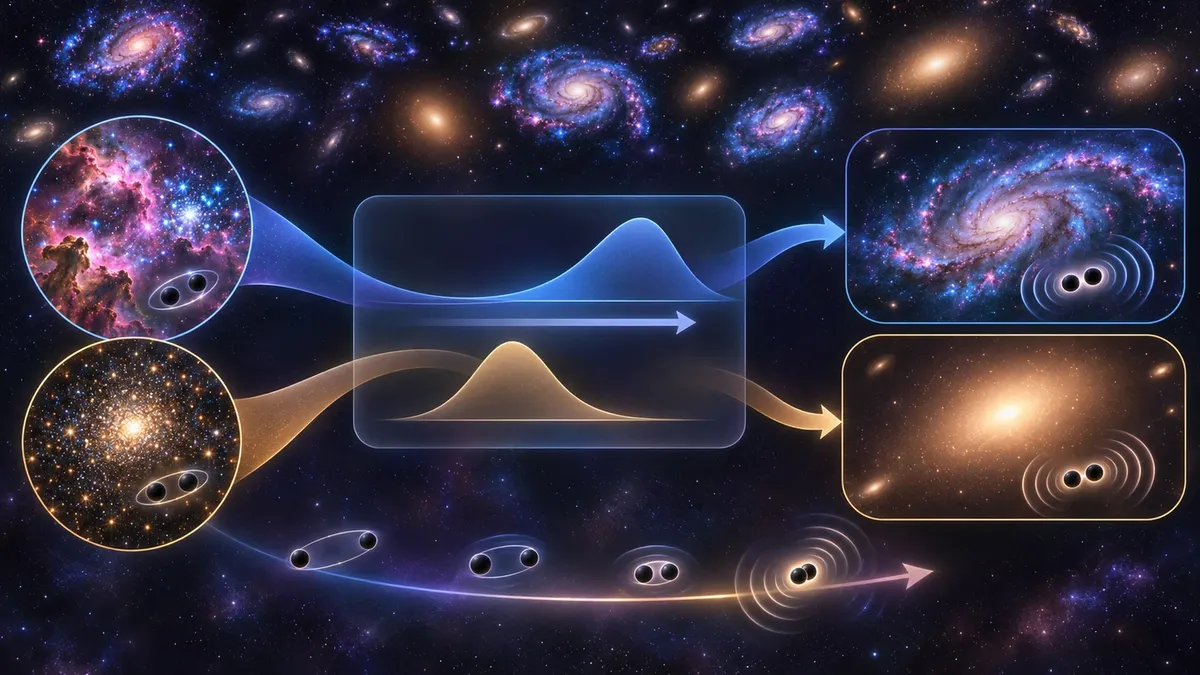
How do the histories of galaxies relate to binary black-hole mergers? A new modelling study connects reconstructed star-formation and chemical-enrichment histories to predictions for merger rates, merger-time host galaxies and gravitational waves. Its findings are forecasts from a model, not identifications of individual merger hosts.
Following black-hole binaries through galaxy histories
When two black holes in a binary merge, they produce gravitational waves. To understand what kinds of stars and galaxies are associated with these events, researchers need to connect how the stars formed with the later evolution of their black-hole binaries. A preprint by Irene Iorio and colleagues uses the StAGE galaxy-evolution framework to model binary black-hole (BBH) mergers associated with galaxies that are quiescent today and with their star-forming progenitors.
The distinction matters: the study predicts the properties of galaxies hosting mergers at the time those mergers occur. It does not identify individual galaxies as the hosts of observed gravitational-wave events.
How the predictions were made
The team combines StAGE histories of star formation and chemical enrichment with precomputed population-synthesis catalogs from SEVN. Population synthesis uses models of stellar and binary evolution to estimate the outcomes of many possible stellar systems. With these ingredients, the researchers predict BBH merger-rate density, intrinsic binary properties, the distribution of merger-time host galaxies and the stochastic gravitational-wave background.
A particular feature of the framework is that it tracks both the stellar-binary environment at birth and the properties of the galaxy at merger time. The authors also explore how their predicted merger rates respond to a choice of metallicity measure. They use stellar-archaeology constraints on alpha-element enhancement to consider iron abundance, which is relevant to winds from massive stars, rather than oxygen-based total metallicity. The abstract reports that this effect was explored but does not specify its direction or size.
What the model predicts
The authors report that most BBHs form at moderately subsolar metallicities, Z at or below about one-third of the Sun’s metallicity. Their predicted merger-time hosts typically have stellar masses of roughly 10¹⁰–10¹¹⋅⁵ solar masses and are at redshifts below 2.
The predicted host populations also vary across cosmic history. At and beyond cosmic noon, hosts lie mainly on the star-forming main sequence. At lower redshifts, starbursting galaxies and quenching descendants contribute increasingly. These are population-level model results, not evidence that a particular galaxy type causes a merger.
For most of the binary-evolution prescriptions considered, the predicted local BBH merger rates exceed the range inferred by the LIGO–Virgo–KAGRA collaboration. The abstract describes this as a result also found in recent literature, but provides neither the numerical rates nor enough detail to assess how individual assumptions affect the comparison. It should be read as a comparison between predictions and an observationally inferred range, not as a direct measurement of an excess.
The study also reports that dynamical formation in stellar clusters extends the predicted distribution of primary black-hole masses into a high-mass regime that is poorly populated by isolated binaries. Its predicted stochastic gravitational-wave background approaches the projected sensitivity of planned LVK upgrades and lies within reach of the Einstein Telescope. These are forecasts about instrument sensitivity, not detections.
What to keep in mind
By connecting binary environments at birth with galaxies at merger time, StAGE could provide physically motivated host-galaxy priors for gravitational-wave source localization and dark-siren cosmology. The abstract does not give further details about how those applications would be carried out.
This article is based on the paper’s abstract alone. It therefore cannot assess the full modelling choices, validation or sensitivity analyses, and the abstract does not provide numerical merger rates. The source is an arXiv preprint; the supplied information does not establish its peer-review status. The results above are the authors’ reported model predictions, not independently verified conclusions.
- binary black holes
- galaxy evolution
- stellar archaeology
- gravitational waves
- quiescent galaxies
- metallicity
Related reading
Automatically matched by shared topic keywords. These links do not imply that the sources agree or establish a consensus.
How a star feeds a black-hole binary
Source published
Shared keywords: binary black holes, gravitational waves
Galaxy Images Offer Clues to Billions of Years of Star Formation
Source published
Shared keywords: galaxy evolution
The first stars alone may not explain the iron in tiny galaxies
Source published
Shared keywords: stellar archaeology
What dust can reveal about galaxies that stopped making stars
Source published
Shared keywords: galaxy evolution, quiescent galaxies
Stellar motions support an excess of small stars in massive galaxy cores
Source published
Shared keywords: galaxy evolution, quiescent galaxies