TRANSMISSION // 2609.21857v2
Personality-tuned chatbots did not improve role-play
Source published
Fine-tuning two open language models on personality-labelled text did not make their dialogue more recognizably personality-specific than the original models. The result is uncertain because AI judges often disagreed.
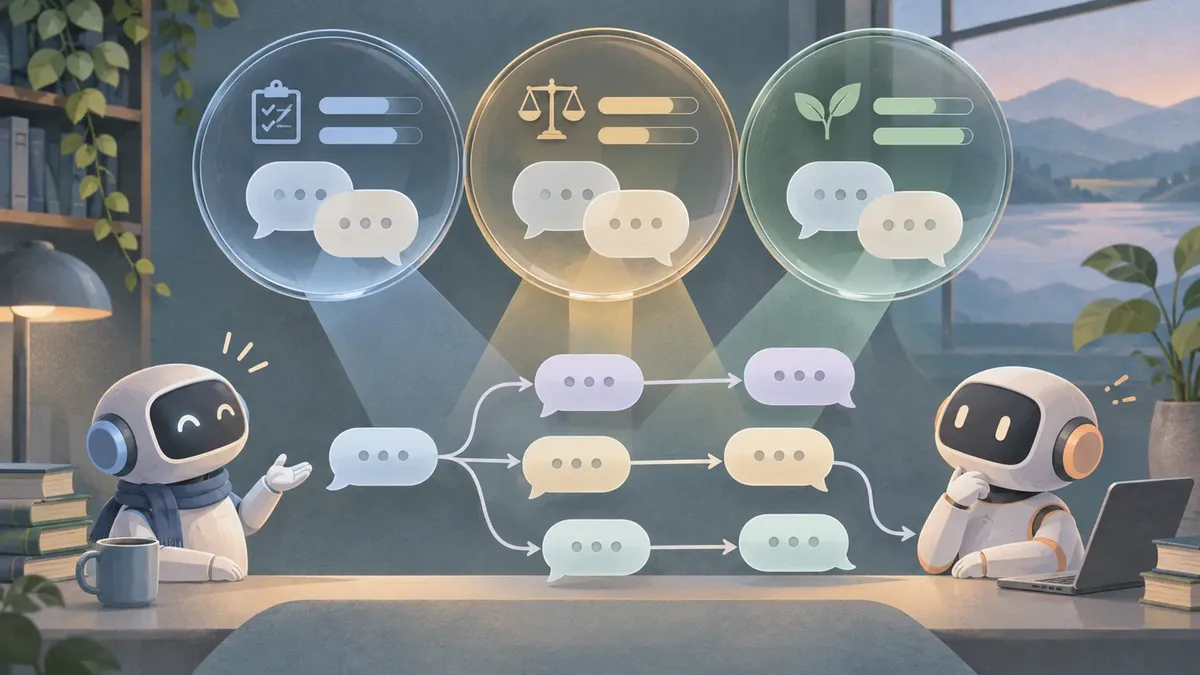
Can training a chatbot on personality-labelled conversations make it a more consistent social agent? In this preprint, researchers compared fine-tuned and untuned models across three scenarios. The fine-tuned versions did not outperform their baselines on the study’s personality measures, though the evaluation itself had important limits.
Large language models can produce fluent dialogue, but sounding natural does not necessarily make an agent’s behavior consistent from one situation to another. That matters when researchers use chatbots as characters in social simulations, or when they want a robot to adopt a particular interaction style. Tim Krabbe and Xiaodan Shi ask whether fine-tuning models on personality-labelled text helps them maintain distinct personalities better than simply instructing them to do so.
The study focuses on the Myers–Briggs Type Indicator (MBTI), which groups personality descriptions along four binary dimensions, such as Introversion–Extraversion. The authors stress that they use MBTI as a set of behavioral conditions for the experiment, not as psychological ground truth. They also note that the framework is criticized for its reliability and validity in personality research.
Training and testing the models
The researchers fine-tuned two open-weight instruction-following models: Qwen2.5-7B-Instruct and Ministral-8B-Instruct. They used Low-Rank Adaptation, or LoRA, a method that adjusts a relatively small set of added parameters rather than updating all the model’s weights.
Training data combined MBTI-labelled social-media posts with DailyDialog, a conversational dataset. Because DailyDialog did not come with MBTI labels, the team used RoBERTa classifiers to assign them. The resulting training set included roughly 582,000 observations. The researchers also used back-translation to help address an imbalance in one of the MBTI dimensions.
For evaluation, both the fine-tuned models and their original baselines generated dialogue in three scenarios: a workplace discussion about who should lead a meeting; disaster-relief planning; and a disagreement between neighbors about a mask requirement. Across five pairings of speaker types and the three scenarios, the researchers generated 225 dialogues for each model variant.
Three separate language models then judged the dialogue. They identified text they thought signaled personality traits, gave reasons for those interpretations, and assigned MBTI labels. The researchers compared those labels with the personalities the dialogue models had been asked to portray. They also measured agreement among judges and tracked language characteristics, including lexical diversity.
Fine-tuning did not improve the personality scores
On the study’s main measure, the judges generally classified the baseline models’ dialogue as matching its intended personality more accurately than the fine-tuned models’ dialogue. The authors therefore found no evidence in this experiment that their fine-tuning approach improved personality role-play. Results varied across personality dimensions and model configurations; neither LoRA configuration consistently overcame the baseline performance.
The text-quality findings were more mixed. Fine-tuned models were mostly comparable to their baselines on the reported language measures. Qwen’s fine-tuned versions showed greater lexical diversity, while the Ministral results did not show the same overall pattern. Fine-tuning also increased the share of Qwen outputs detected as English, though those outputs did not all become English.
Why the result needs caution
The judges often disagreed about what a line of dialogue revealed. They might interpret the same passage differently, or focus on different parts of it. Agreement was especially limited for some dimensions, and in the final personality assessments no model-and-dimension combination reached the paper’s cited threshold for strong agreement. The authors say this makes robust conclusions difficult.
That matters because judge classification is only a proxy for whether a model convincingly portrays a personality. It is not a direct measure of human readers’ impressions or of real-world social behavior. The authors recommend testing more and more varied judges, and checking some judgments with human experts.
The training data also poses a challenge. Social-media posts are not the same as conversations in a workplace or emergency-response setting. The paper gives an example of language that may fit a social platform but feel out of place in another context. The authors say this domain mismatch could have limited the fine-tuning results. They also acknowledge that they tested only a limited range of LoRA settings, so the findings do not rule out every possible fine-tuning approach.
The practical takeaway is narrow: for these two models, this dataset, these scenarios and this evaluation method, personality-oriented fine-tuning did not improve measured role-play over prompting the original models. The study does not establish that fine-tuning can never help, or that the baseline models are reliable representations of human personalities. It is an arXiv preprint, and its conclusions should be read alongside its acknowledged limits in data alignment and evaluation reliability.
- large language models
- personality role-play
- social simulation
- MBTI
- fine-tuning
- LLM evaluation
Reviewed cross-references
These connections were reviewed by a model, not independently fact-checked by a human. Similarity does not imply agreement; consult the original papers and the evidence below.
PsyAgent: Giving AI Agents a More Consistent Personality
Shared method: Both studies use parameter-efficient fine-tuning to shape personality-conditioned language-model behavior: Krabbe and Shi fine-tune Qwen and Ministral with LoRA on MBTI-labeled data, while Meng and Chen use PEFT adapters (including LoRA/QLoRA) with Big Five profiles and structured social contexts. Their methods overlap, but the personality frameworks, training data, and evaluations differ, so their reported outcomes are not directly comparable.
Model review: · openai-codex/gpt-6-luna
Evidence and provenance
Selected excerpts, not complete papers. PDF extraction can omit figures or damage equations, tables and reading order; sources may be preprints.
2609.21857v2 — Original paper
Excerpt reference:
static/papers/2609.21857v2.md:126-204
Basis: Paper text
Source SHA-256:3f8ba8f3639c573f85ef1079bab33a11c94accb8374ac718dbd5dfaccc1f769d2609.21857v2 — Original paper
Excerpt reference:
static/papers/2609.21857v2.md:205-284
Basis: Paper text
Source SHA-256:3f8ba8f3639c573f85ef1079bab33a11c94accb8374ac718dbd5dfaccc1f769d2601.06158v3 — Original paper
Excerpt reference:
static/papers/2601.06158v3.md:86-143
Basis: Paper text
Source SHA-256:60a8386afd2c19ce6aacaafd51dccd33c863c6366a2f7a9643e665c2b892ba972601.06158v3 — Original paper
Excerpt reference:
static/papers/2601.06158v3.md:556-679
Basis: Paper text
Source SHA-256:60a8386afd2c19ce6aacaafd51dccd33c863c6366a2f7a9643e665c2b892ba97
Related reading
Automatically matched by shared topic keywords. These links do not imply that the sources agree or establish a consensus.
Can AI agents model how people react emotionally to events?
Source published
Shared keywords: large language models, social simulation
The hidden date that can change an AI test
Source published
Shared keywords: large language models
AI models produce different opinion dynamics under the same discussion rules
Source published
Shared keywords: large language models, social simulation
AI Twins Can Rehearse a Meeting—but Do They Judge Like You?
Source published
Shared keywords: large language models, social simulation
A valid JSON answer can still be wrong
Source published
Shared keywords: large language models, llm evaluation