TRANSMISSION // 2609.21190v3
Why Passing Tests May Not Prove an AI Patch Is Correct
Source published
SWE-Proof applies machine-checked verification to real software issues. The study reports test-passing counterexamples and finds that writing faithful specifications remains difficult.
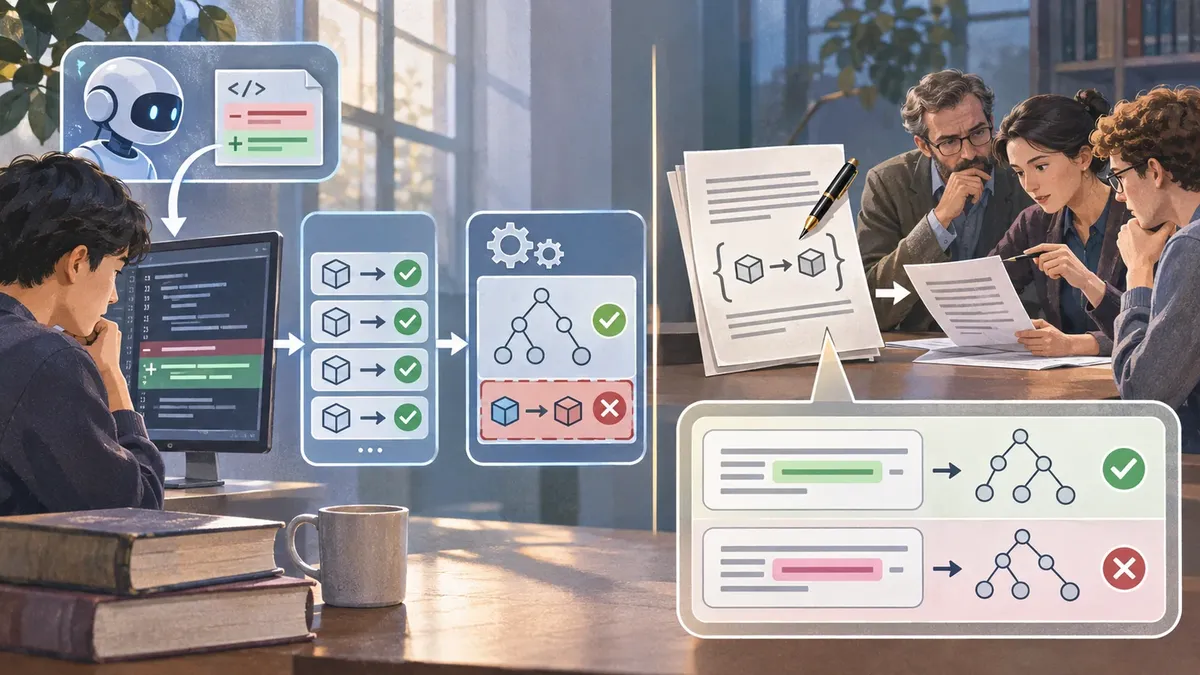
A patch can pass tests and still fail a formal check. SWE-Proof explores machine-checked proofs for real software issues—and the challenge of ensuring that the specification being proved captures the issue’s requirements.
Software tests check whether code behaves as expected in the cases they cover. But a patch can pass tests and still admit a counterexample under a formal check. SWE-Proof asks whether machine-checked formal verification can strengthen evaluations of AI coding agents on real software problems, where issue descriptions may be vague and code sits inside large repositories.
The researchers introduce BenchProofer, a pipeline that turns a coding task with a known correct patch into a formally verified benchmark instance. It writes a specification for the new code and summarizes existing functions the code calls, representing their behavior with axioms. An instance is included only after mechanical and adversarial gates agree.
Using this pipeline, the authors created SWE-Proof: 500 real issues from SWE-bench Verified. They also report extending the approach to SWE-bench Pro. In general, formal verification checks whether code meets a stated specification. The strength and meaning of that check depend on the specification and the method’s assumptions; the abstract does not give enough detail to describe the precise guarantees in this study.
What formal checks found
Evaluating Claude Opus 4.8, the authors report that nearly a third of patches that passed tests admitted counterexamples under formal verification. This means the formal checks identified cases that test-passing patches did not rule out; the abstract does not describe the counterexamples in detail. The authors also report that a correct formal specification raised the model’s issue-resolution rate from 85% to 95%.
These figures are results for the reported model and evaluation, not universal estimates of how much verification will improve coding agents. The supplied abstract does not include the exact evaluation procedure or uncertainty estimates. Because only the abstract was available for this account, further methodological detail cannot be assessed here.
The specification problem
A proof checks code against a specification. If that specification leaves out part of the requested behavior, code may satisfy the statement without capturing the full intent of the issue. Verification of the statement does not, by itself, show that the statement faithfully represents what was intended.
The authors identify writing that specification as a central difficulty. An agent tasked with writing its own specification gained nothing over an unaided baseline, and only 56% of its specifications passed the authors’ audit. The common failure, according to the abstract, was faithfulness: the specification constrained some required behavior while leaving other requirements open.
Specification quality was also associated with whether an issue was resolved. The authors report that specifications failed on 92% of unresolved instances, compared with 51% of resolved ones. This association does not show that poor specifications alone caused every unsuccessful repair. It does point to a key limitation: a machine-checked result cannot compensate for an incomplete statement of the task.
Scope and caveats
SWE-Proof applies formal specifications to a benchmark of real software issues and reports that formal checks can reveal counterexamples among patches that pass tests. The results also make clear that specification writing is not a solved step in the process. The authors identify faithful specification synthesis as an open problem.
This account relies on the paper’s abstract rather than its full text, so details of the experiments, audits and verification guarantees remain unavailable here. The source is an arXiv preprint, and the supplied information does not establish its peer-review status. The authors say code is available at https://github.com/amazon-science/BenchProofer.
- AI coding agents
- formal verification
- software testing
- SWE-Proof
- software benchmarks
- program specifications
Reviewed cross-references
These connections were reviewed by a model, not independently fact-checked by a human. Similarity does not imply agreement; consult the original papers and the evidence below.
Why scientific computing needs human-guided AI proofs
Supporting evidence: Both studies identify faithful formal statements as a bottleneck: SWE-Proof reports that only 56% of synthesized specifications passed its audit, with faithfulness a common failure, while the scientific-computing case study says explicit expert contracts helped prevent specification drift and that statement translation required manual audits. This is a bounded parallel, not a direct comparison: the studies address repository repairs and numerical computing, respectively.
Model review: · openai-codex/gpt-6-luna
Evidence and provenance
Selected excerpts, not complete papers. PDF extraction can omit figures or damage equations, tables and reading order; sources may be preprints.
2609.21190v3 — Original paper
Excerpt reference:
static/papers/2609.21190v3.md:128-209
Basis: Paper text
Source SHA-256:deec578e59f477760ba19741fc72e9ba7c5ef33285d8895b6a9dc694e976ae1b2611.31033v1 — Original paper
Excerpt reference:
static/papers/2611.31033v1.md:197-262
Basis: Paper text
Source SHA-256:425ed923e1c35ff7bbea7069f652925d84a0bd8add133e188a182fbdf5e4ed8d
Why AI coding agents struggle to clean up old code
Supporting evidence: Both papers illustrate limits of test-based evidence, but in different ways: SWE-Proof reports that nearly a third of test-passing patches admitted counterexamples, while RepoClean notes that passing tests cannot establish correctness in untested paths and scenarios. These findings support the narrow point that tests do not cover all behavior; they concern different benchmarks and do not establish comparable failure rates.
Model review: · openai-codex/gpt-6-luna
Evidence and provenance
Selected excerpts, not complete papers. PDF extraction can omit figures or damage equations, tables and reading order; sources may be preprints.
2609.21190v3 — Original paper
Excerpt reference:
static/papers/2609.21190v3.md:15-69
Basis: Paper text
Source SHA-256:deec578e59f477760ba19741fc72e9ba7c5ef33285d8895b6a9dc694e976ae1b2611.30350v1 — Original paper
Excerpt reference:
static/papers/2611.30350v1.md:1043-1100
Basis: Paper text
Source SHA-256:19610934d8371be1b1a7e11462b83306f2949494b09bec5f1b7ba9a037c60de7
Related reading
Automatically matched by shared topic keywords. These links do not imply that the sources agree or establish a consensus.
When Coding Benchmarks Reject Valid Fixes
Source published
Shared keywords: ai coding agents, software benchmarks, software testing
Can an AI-built app keep working as features pile up?
Source published
Shared keywords: ai coding agents, software benchmarks
Why AI coding agents struggle to clean up old code
Source published
Shared keywords: ai coding agents, software testing
A Proposed Way to Secure Coding-Agent Benchmarks
Source published
Shared keywords: ai coding agents, software testing
Testing AI coding agents on branching clinical rules
Source published
Shared keywords: software testing