TRANSMISSION // 2609.21040v2
ALMA measures dust in less metal-rich galaxies at cosmic noon
Source published
A study of 25 distant galaxies finds substantial dust reservoirs and links between dust, star formation and chemical enrichment. The interpretation depends strongly on assumed dust temperatures and grain properties.
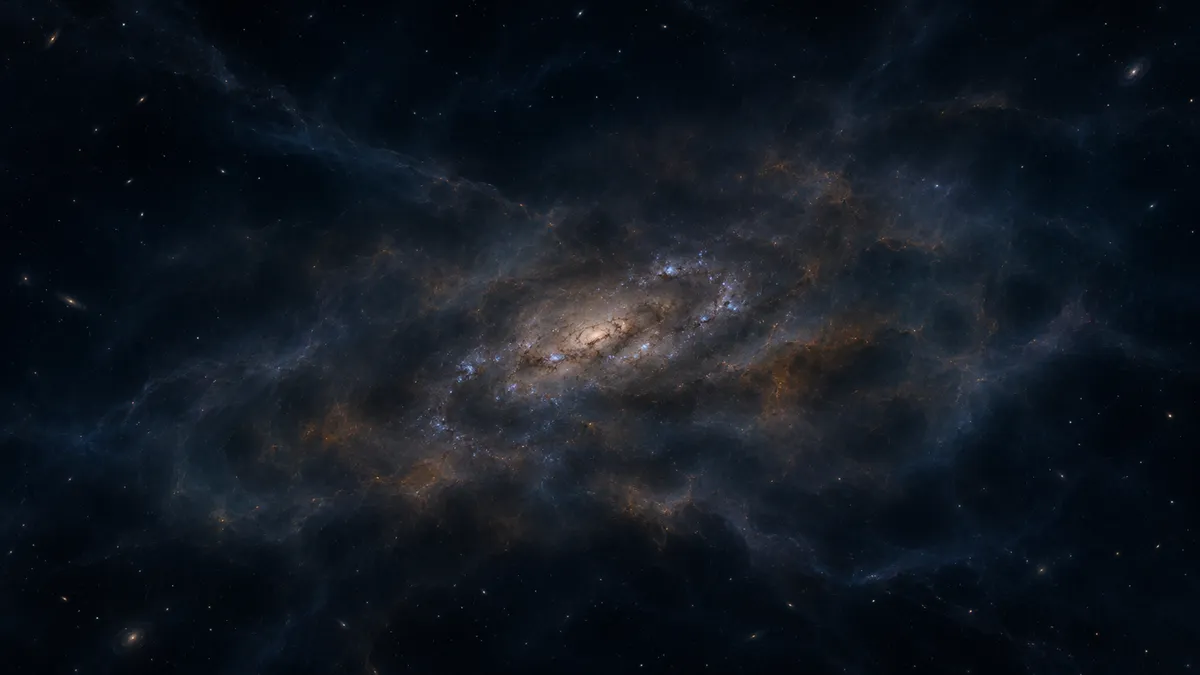
Galaxies with fewer heavy elements can still contain considerable dust. Observations from the ALMA Chemical Evolution survey extend dust measurements beyond the exceptionally dusty galaxies often studied at cosmic noon, while exposing uncertainties in how astronomers convert faint emission into dust mass.
Looking beyond the dustiest galaxies
Cosmic noon—the period around redshifts one to three—was the peak era of cosmic star formation. Yet measurements of galactic dust at that time have largely focused on massive, infrared-bright systems. Less massive galaxies with fewer heavy elements have been harder to detect, leaving an incomplete account of their dust content.
M. Solimano and colleagues studied 25 star-forming galaxies at approximately redshift 2.3 through the ALMA Chemical Evolution, or ACE, survey. Their revised arXiv preprint was resubmitted to Astronomy & Astrophysics after referee comments; the supplied record does not establish journal acceptance.
Dust matters because it helps molecules form, participates in gas cooling and absorbs starlight before emitting that energy at infrared wavelengths. Its abundance reflects competing processes: production by stars, growth of existing grains, destruction and removal from galaxies.
How the measurements work
The galaxies came from the MOSDEF spectroscopic survey in the COSMOS field. Selection required reliable measurements of several emission lines and no identified active galactic nucleus. Their stellar masses span roughly one billion to 40 billion solar masses.
The researchers estimated metallicity—the abundance of elements heavier than helium—using emission-line ratios calibrated against measurements of distant galaxies. Here, metallicity specifically tracks oxygen in gas. The sample ranges from about 32% to 83% of the solar oxygen abundance.
ALMA measured dust emission at observed wavelengths of 873 micrometres and 1.3 millimetres. Stellar masses came from modelling observations across many wavelengths, including JWST data. Star-formation rates came from dust-corrected hydrogen emission, keeping that measurement independent of the ALMA data used for dust masses.
Most individual dust estimates relied on a single ALMA wavelength. The team therefore could not independently determine each galaxy's dust temperature. Instead, it adopted a modified blackbody model: thermal emission adjusted for how efficiently grains absorb and emit radiation. The baseline assumed a temperature of 25 kelvin, Milky Way-like grain properties and emission thin enough that self-absorption could be neglected.
Statistical analyses included upper limits for undetected galaxies. The researchers also combined images in stellar-mass and metallicity groups to measure average signals.
What the survey found
The inferred dust masses are broadly tens to hundreds of millions of solar masses. At a given stellar mass, ACE galaxies contain about four to nine times more dust than nearby comparison galaxies. They nevertheless have substantially smaller dust reservoirs than the most dust-rich, infrared-selected systems at similar redshifts.
Under the baseline assumptions, dust mass increases with stellar mass, metallicity and star-formation rate. The relationship with star formation is approximately proportional: galaxies forming stars faster generally contain more dust.
Dust mass divided by stellar mass scatters around 0.01, meaning roughly one unit of dust mass per hundred units of stellar mass—not 1% of the galaxy's total mass. This ratio shows no statistically significant metallicity trend in the baseline analysis.
By contrast, dust mass divided by star-formation rate increases with metallicity. That pattern is consistent with more efficient grain growth in enriched interstellar gas. Better dust survival or changes in stellar dust production could also contribute; the observations do not isolate a single mechanism.
Galaxies forming stars faster relative to their existing stellar mass also tend to have higher dust-to-stellar mass ratios. No downturn appears at the high relative star-formation rates observed. However, both ratios share stellar mass as their denominator, so their correlation is not entirely independent.
For galaxies detected in carbon monoxide emission, inferred molecular gas masses are generally comparable to or greater than stellar masses. Large gas reservoirs could help explain both vigorous star formation and elevated dust content.
Why the assumptions matter
Temperature is a major uncertainty. At these wavelengths, changing it by only five kelvin can shift an inferred dust mass by roughly half. Allowing temperature to decrease with increasing metallicity produces a positive dust-to-stellar mass trend that is absent under the fixed-temperature assumption. Grain absorption properties add uncertainty: available dust models differ by up to a factor of three in their adopted opacity.
The sample is also small and favours actively star-forming galaxies because of its emission-line requirements. Much fainter dust populations remain below the detection threshold, so the missing downturn cannot establish that inefficient dust buildup never occurs. ACE extends observations into a less-explored population, but its conclusions remain conditional on selection and dust modelling.
- ALMA
- ACE survey
- cosmic dust
- galaxy evolution
- cosmic noon
- metallicity
- star formation
- molecular gas
Related reading
Automatically matched by shared topic keywords. These links do not imply that the sources agree or establish a consensus.
What dust can reveal about galaxies that stopped making stars
Source published
Shared keywords: cosmic dust, galaxy evolution
A third hydrogen line helps reveal how dust dims distant galaxies
Source published
Shared keywords: galaxy evolution, star formation
Early disk galaxies show a different mass–speed pattern
Source published
Shared keywords: galaxy evolution
How two young stars may draw gas from a shared reservoir
Source published
Shared keywords: molecular gas, star formation
Which galaxies could Euclid’s surveys miss?
Source published
Shared keywords: galaxy evolution, star formation