TRANSMISSION // 2609.20787v2
A search for long gamma-ray bursts without supernovae
Source published
A two-decade Swift search identifies more candidate long gamma-ray bursts without confirmed supernovae and estimates their apparent rate, while leaving their origins uncertain.
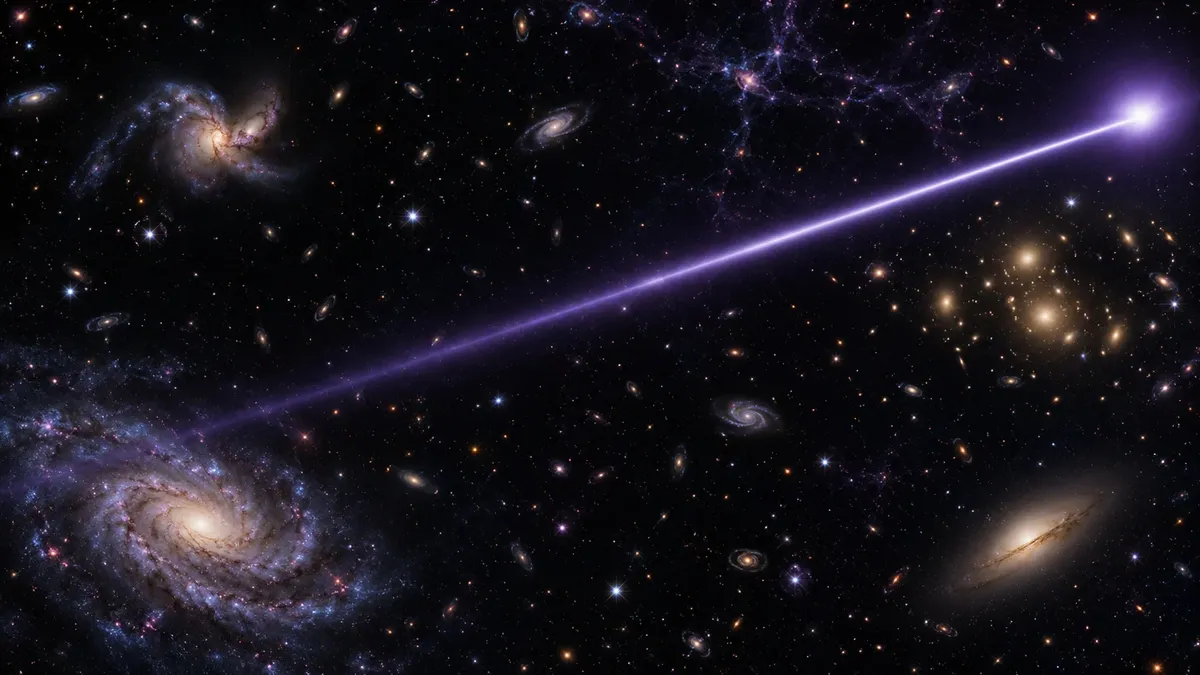
Some long gamma-ray bursts have no confirmed associated supernova. A systematic search of nearby events in two decades of Swift observations more than doubles the number of candidate cases, estimates their rate and highlights how much remains unknown about their origins.
Long gamma-ray bursts (LGRBs) are often associated with bright supernovae. In the traditional collapsar picture, a massive star collapses and produces a relativistic explosion. But some long bursts have no confirmed supernova association. Are these isolated exceptions, or do they represent a more substantial part of the gamma-ray-burst population?
A new study uses two decades of observations from NASA’s Swift satellite to search for nearby examples and estimate their rate. The authors report a larger set of candidate events, but say that small numbers and uncertainty in the distance scale prevent firm conclusions about what powers them.
A search close to home
The researchers looked for long gamma-ray bursts at redshifts of about 0.35 or less without a confirmed supernova association. Redshift is used in astronomy to describe how light from a distant object is shifted; here, the cutoff defines the nearby range targeted by the search.
To assess the events, the team examined their high-energy properties, afterglows and environments. From this analysis, they assembled a fiducial sample of bursts with robust limits on any supernova association and distance scales. The authors report that their work more than doubles the number of candidate supernova-less events.
The study describes these as candidates, not as a population whose origin is known. Its abstract does not establish that every event lacked a supernova; it reports the absence of a confirmed association and limits on possible supernovae.
An apparent rate, not a final census
For the fiducial sample, the researchers estimate a volumetric rate of 0.5 ± 0.2 events per cubic gigaparsec per year. A volumetric rate describes the estimated number of events in a given volume of space over time. This estimate is not corrected for beaming: gamma-ray bursts are thought to emit in narrow jets, so the observed rate depends on which jets point toward Earth.
The authors describe the result as comparable to the apparent rate of short-duration gamma-ray bursts and to the rate of standard long bursts with supernovae brighter than about 10^50 erg per second. These are comparisons between apparent rates; the abstract does not use them to establish a shared origin.
When plausible beaming factors are considered, the inferred rate is consistent with several compact-binary-merger channels. That means such channels could fit the rate, not that the study has identified the progenitors. The authors note that the allowed parameter space becomes narrow if the entire candidate population is attributed to a single channel.
What the sample cannot yet tell us
The sample contains few candidates, and the distance scale is uncertain. The authors say these limitations leave the low-luminosity end of the population unconstrained. As a result, the study cannot determine whether faint events belong to the low-luminosity tail of known progenitor channels or point to a distinct way of producing relativistic explosions.
The environments reported for the candidates are heterogeneous: some are linked to star-forming or dusty environments, others to quiescent galaxies. The abstract does not establish what this variety means for the bursts’ origins.
For now, the main contribution is an expanded candidate sample and a rate estimate with substantial caveats—not a verdict on the source of these explosions. A larger sample will be needed to clarify whether supernova-less long bursts fit existing explanations or require another route.
This article is based on the paper’s abstract, not a full-text examination. The source is an arXiv preprint, and the supplied information does not establish whether it has been peer reviewed. The rate and interpretations here are the authors’ reported results and should be read alongside the stated limitations.
- gamma-ray bursts
- supernovae
- Swift
- compact-binary mergers
- astrophysics
Reviewed cross-references
These connections were reviewed by a model, not independently fact-checked by a human. Similarity does not imply agreement; consult the original papers and the evidence below.
Early X-rays may help reveal what powers gamma-ray bursts
Supporting evidence: Both studies show why long-burst duration alone does not establish a collapsar origin: Yang et al. identify long bursts with evidence for merger progenitors, while Ierardi et al. report that prompt-emission classification has limitations and test early X-ray diagnostics on separate candidate samples. The samples and analyses differ, so this is compatible evidence for a bounded classification caveat, not a direct validation of the proposed diagnostic on Yang et al.’s events.
Model review: · openai-codex/gpt-6-luna
Evidence and provenance
Selected excerpts, not complete papers. PDF extraction can omit figures or damage equations, tables and reading order; sources may be preprints.
2609.20787v2 — Original paper
Excerpt reference:
static/papers/2609.20787v2.md:129-194
Basis: Paper text
Source SHA-256:bb5e4c0bf7a9ec8cea1c561e3b400a7df4878ccb47aa81c0ef526e1ff7ca73dd2611.12945v1 — Original paper
Excerpt reference:
static/papers/2611.12945v1.md:191-248
Basis: Paper text
Source SHA-256:613540e6ff80ac126f0e68e41a50264d9bc02198f498e49ee02a7527c3b5f68a
Related reading
Automatically matched by shared topic keywords. These links do not imply that the sources agree or establish a consensus.
Do gamma-ray bursts have two kinds of X-ray encore?
Source published
Shared keywords: gamma ray bursts
Fading X-rays connect merger-driven gamma-ray bursts to their opening flash
Source published
Shared keywords: gamma ray bursts
Early X-rays may help reveal what powers gamma-ray bursts
Source published
Shared keywords: gamma ray bursts
Could a magnetar power GRB 241030A’s early X-rays?
Source published
Shared keywords: gamma ray bursts
Reshaping telescope grids could widen the search for gamma-ray bursts
Source published
Shared keywords: gamma ray bursts